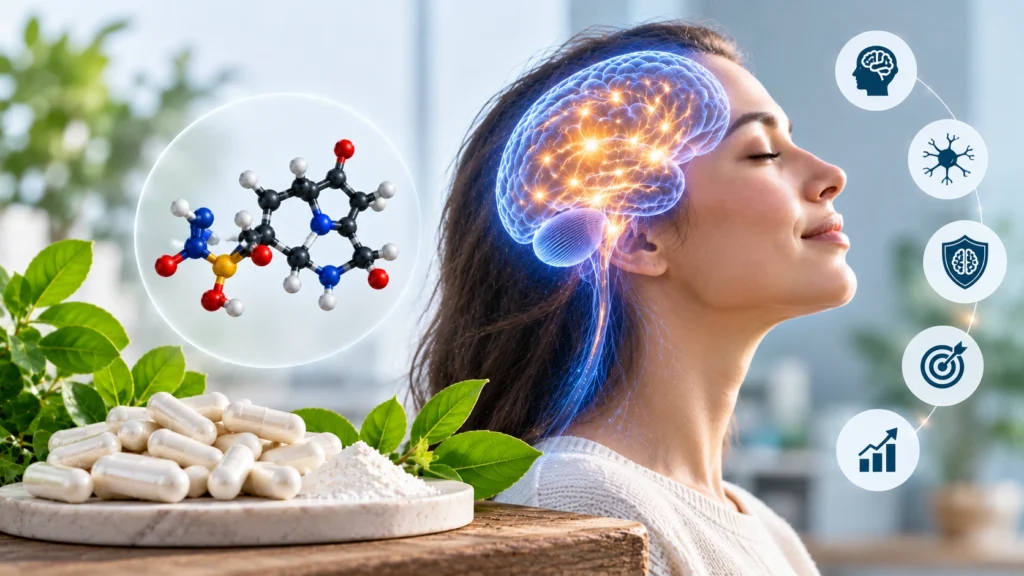
L-Theanine is a naturally occurring amino acid that has become one of the most popular ingredients in the modern nootropic and relaxation-supplement market.


The main natural dietary source of L-Theanine is tea made from Camellia sinensis.
This includes:
The amount of L-Theanine can vary significantly depending on the tea variety, growing conditions, harvesting period, shading, processing, and brewing method.
There is no single tea that always contains the highest amount because growing and processing conditions matter.
However, shaded Japanese teas such as Gyokuro and Matcha are particularly interesting because reducing sunlight exposure before harvest can increase L-Theanine accumulation in the leaves.
Tea concentration can vary dramatically.
One study measuring commercially available teas found that a 200 mL cup of black tea contained about 24 mg of L-Theanine, while the green tea tested in that study contained about 8 mg.
That does not mean black tea is always higher than green tea.
Different studies and different tea products can produce very different results.
If we are talking about natural tea, Japan is particularly important because of its high-quality green teas and traditional cultivation methods, especially shaded teas such as Gyokuro and Matcha.
But if we are talking about L-Theanine supplements, country of origin alone does not determine quality.
A high-quality supplement should ideally disclose:
One important distinction is Suntheanine.
Suntheanine is a branded form of L-Theanine produced through a patented enzymatic process. According to the ingredient manufacturer, it is designed to provide pure L-Theanine rather than simply being a tea extract.
So, when buying a supplement, don’t automatically assume that a product made in Japan, the United States, Singapore, or Europe is better.
The testing, purity, dose, and ingredient identity matter more than the country printed on the bottle.

L-Theanine was discovered in Japan in 1949.
Japanese researcher Y. Sakato identified the compound while studying the chemical constituents of tea. The compound was later isolated from Japanese Gyokuro tea leaves.
This discovery was important because L-Theanine is relatively unusual among naturally occurring amino acids.
It contributes to the characteristic umami taste associated with tea and can be found in substantial amounts in certain tea leaves.
For decades, L-Theanine remained primarily a compound of interest to tea and food scientists.
Its popularity grew much later as researchers began investigating why tea could produce a different psychological experience from coffee.
Coffee is typically associated with stimulation.
Tea can provide caffeine too, but many people describe the experience as more balanced or relaxed.
Scientists began investigating whether L-Theanine could be partly responsible.
This eventually became one of the most interesting areas of L-Theanine research.
Caffeine can improve alertness and attention, but it can also cause:
Researchers began studying whether L-Theanine could complement caffeine.
A 2025 systematic review of randomized controlled trials found evidence that L-Theanine plus caffeine could improve certain short-term measures of cognition and mood compared with placebo, although the size and consistency of the effects varied.
This combination helped L-Theanine move beyond tea and into the nootropic industry.
Today, you can find it in:

L-Theanine has several potential benefits, but the evidence is strongest for relaxation and stress-related outcomes, while evidence for cognition and sleep is more mixed.
This is probably the most interesting human benefit.
A systematic review of nine randomized controlled trials found that 200 to 400 mg/day of L-Theanine may help reduce stress and anxiety in people exposed to stressful situations. The authors also noted that larger and longer studies are still needed.
Another randomized, placebo-controlled study gave 30 healthy adults 200 mg of L-Theanine per day for four weeks.
Researchers reported improvements in several stress-related measures, including anxiety and sleep-quality scores. Some cognitive measures, including verbal fluency and executive function, also improved.
That is encouraging, but the study was small.
L-Theanine should therefore be viewed as a possible tool for managing everyday stress rather than a replacement for professional treatment of an anxiety disorder.
One of the characteristics that makes L-Theanine different from many sleep or relaxation supplements is that it generally does not act like a strong sedative.
The goal is not to knock you out.
Instead, research has investigated whether L-Theanine can encourage a state of relaxed alertness.
Studies have linked L-Theanine intake with changes in brain electrical activity, particularly increased alpha-wave activity, which is associated with relaxed attention.
This helps explain why people often use L-Theanine during the day rather than only before bed.
L-Theanine alone may have modest cognitive effects, but the combination with caffeine is more interesting.
A 2025 systematic review and meta-analysis found that L-Theanine alone produced a small benefit on certain measures of reaction time and visual information processing, although results were not significant across all tests.
The broader 2025 review of tea compounds found that L-Theanine plus caffeine may provide small-to-moderate improvements in some short-term cognitive and mood measures.
This does not mean L-Theanine makes you smarter.
It may simply help create a mental state where attention feels easier, particularly when paired with caffeine.
L-Theanine is sometimes marketed as a sleep supplement.
But its relationship with sleep is different from melatonin.
Melatonin directly influences the body’s circadian rhythm.
L-Theanine does not work in the same way.
Instead, its potential sleep benefit may come partly from reducing mental stress and promoting relaxation.
A 2019 randomized controlled trial found improvements in several sleep-related and stress-related measures after four weeks of 200 mg/day of L-Theanine.
However, sleep evidence remains mixed.
A 2024 randomized trial involving a product containing L-Theanine plus Lactium found improvements in several sleep-diary measures, but the primary standardized sleep and insomnia scales did not show significant differences between groups.
That is why L-Theanine is better described as a potential relaxation and sleep-quality aid, not a proven insomnia treatment.
This is one of the most popular uses of L-Theanine.
The idea is simple:
Caffeine provides stimulation. L-Theanine may help make that stimulation feel smoother.
Research supports some aspects of this combination.
The 2025 meta-analysis found that L-Theanine plus caffeine produced favorable effects on several short-term cognitive measures compared with placebo.
This does not mean L-Theanine cancels out all negative effects of caffeine.
If you consume too much caffeine, adding L-Theanine does not make excessive caffeine intake harmless.
Some human studies have reported improvements in mood-related measures after L-Theanine supplementation.
The evidence is still limited, but this may partly overlap with its effects on stress and relaxation.
It is important not to confuse this with treating clinical depression.
Someone experiencing persistent depression should seek appropriate medical care rather than relying on L-Theanine.

Compared with many stimulants and sedative medications, L-Theanine appears to have a relatively favorable short-term safety profile.
But it is not completely risk-free.
Some people may experience mild headache, dizziness, or gastrointestinal discomfort.
These effects are not common in most studies, but individual responses can vary.
This can potentially be useful for some people, but it may be a problem for someone who already has low blood pressure or takes blood-pressure medication.
ConsumerLab specifically notes the possibility of interactions involving blood-pressure medications.
If you take medication for hypertension, talk with your healthcare professional before adding L-Theanine.
Although L-Theanine is not generally considered a sedative, some people may feel unusually relaxed or sleepy.
This is particularly relevant if you combine it with:
Most human studies have been relatively short.
A 28-day randomized study using 400 mg/day found L-Theanine to be well tolerated, with no clinically relevant changes in laboratory measures or vital signs attributed to the supplement.
That is reassuring.
But a four-week study cannot tell us everything about taking L-Theanine every day for 10 or 20 years.
Not every L-Theanine supplement is identical.
Some products contain pure L-Theanine.
Others contain caffeine, magnesium, GABA, herbs, or other ingredients.
If you want to understand how L-Theanine affects you, a simple single-ingredient product can make more sense than a complicated blend.

L-Theanine has a surprisingly substantial human research base compared with many trendy nootropics.
But the evidence is not strong enough to support every claim made online.
This is one of the better-supported areas.
A systematic review of nine randomized controlled trials found that 200 to 400 mg/day may help reduce stress and anxiety in people exposed to stressful conditions. However, the authors called for larger and longer studies.
A separate randomized study using 200 mg/day for four weeks found improvements in stress-related symptoms, including anxiety and sleep-related measures.
This gives L-Theanine a reasonable scientific basis as a potential stress-management supplement.
The evidence is promising but inconsistent.
A 2025 systematic review and meta-analysis included five randomized controlled trials involving 148 healthy adults.
Researchers found a dose-dependent effect on some measures of cognitive function, particularly rapid visual information processing and recognition reaction time.
However, effects were not significant across all cognitive tests.
This is important.
It means L-Theanine may influence certain aspects of attention and information processing, but it should not be marketed as a general intelligence enhancer.
This combination has some of the most interesting short-term evidence.
The 2025 systematic review included 50 randomized controlled trials involving tea, L-Theanine, caffeine, or combinations of these compounds.
The researchers found that L-Theanine plus caffeine produced favorable differences in several measures of cognition and mood, although the effects were generally modest and uncertainty remained.
This helps explain why the combination is so popular.
The evidence is more complicated.
Some studies report improvements in sleep quality or sleep-related measures.
Others fail to find significant improvements in the main sleep questionnaires.
A 2024 randomized trial involving L-Theanine plus Lactium found some improvements in sleep duration and sleep onset but did not find significant differences in the primary sleep-quality and insomnia scales.
So, L-Theanine may be more useful when stress or racing thoughts are interfering with sleep than as a direct sleep-inducing compound.
The FDA’s GRAS database contains multiple notices for L-Theanine, including both tea-derived and chemically synthesized forms for specified food uses. The FDA lists “no questions” responses for several of these notices.
This should not be interpreted as FDA approval of L-Theanine as a treatment for anxiety, insomnia, or any disease.
It simply provides regulatory context for its use in foods.

For healthy adults, daily L-Theanine is not necessary, but it can be used regularly if there is a specific reason for taking it and it is well tolerated.
Human studies have used daily doses for periods ranging from several days to several weeks.
The commonly studied supplemental range is around 200 to 400 mg per day. ConsumerLab also identifies 200 to 400 mg/day as a typical supplemental range.
However, there is no official Recommended Dietary Allowance for L-Theanine.
A dose around 200 mg is commonly used in human research.
Some people combine L-Theanine with caffeine.
This may be useful if caffeine makes you feel overly stimulated.
However, caffeine intake should still remain reasonable.
Taking L-Theanine in the evening may make sense if stress and mental tension are keeping you awake.
But it should not be considered equivalent to melatonin.
There is no evidence that healthy adults need L-Theanine permanently.
A practical approach is to use the lowest amount that seems useful and periodically reassess whether you still need it.
If you are taking prescription medication, have low blood pressure, are pregnant or breastfeeding, or have a medical condition, speak with a healthcare professional before regular supplementation.
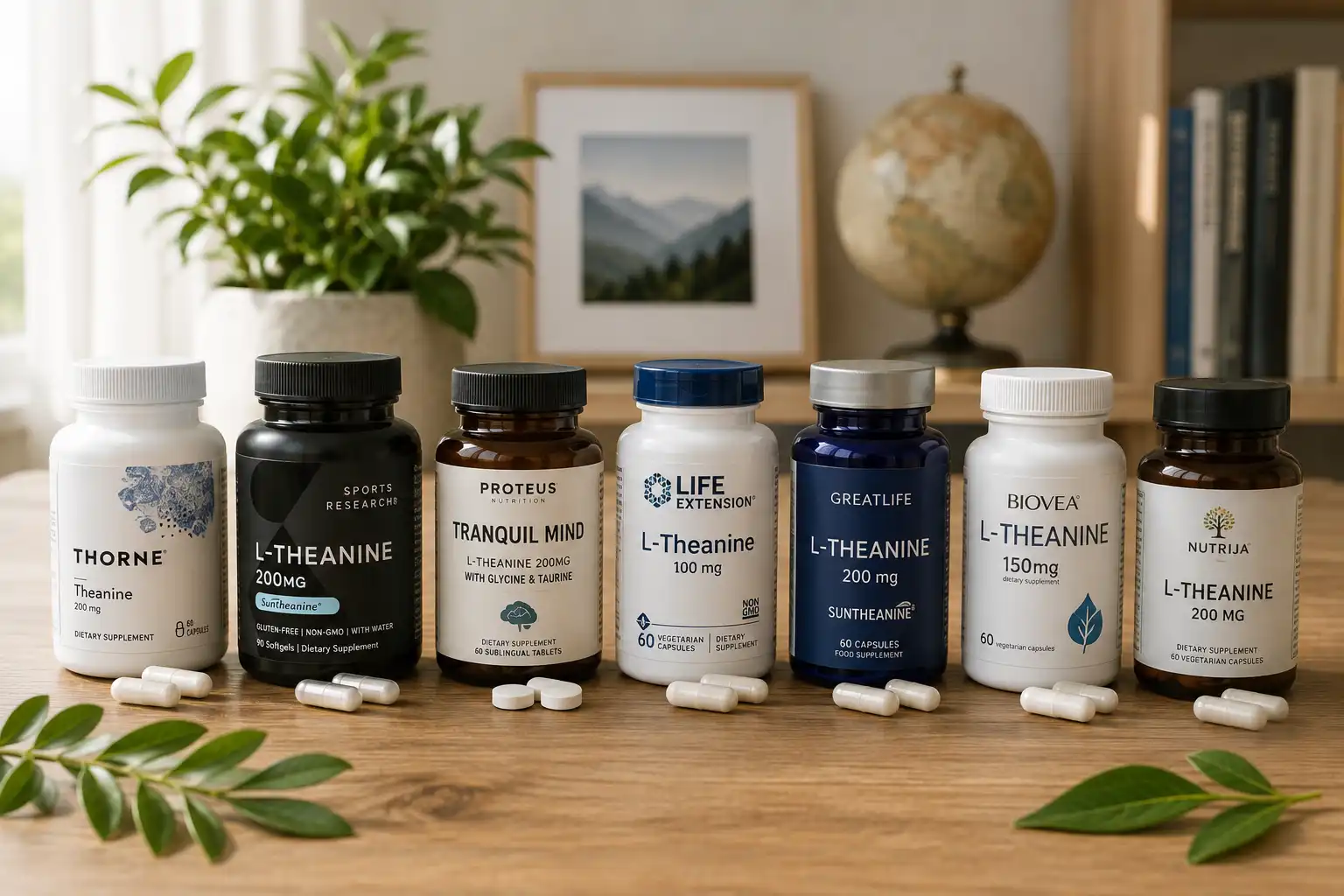
When choosing an L-Theanine supplement, prioritize actual L-Theanine content, ingredient purity, standardized branded ingredients when appropriate, third-party testing, and transparent labeling.
A 200 mg dose is particularly common in human studies and commercial products.
These products should not be treated as medically superior simply because they appear on a list.
For a standalone L-Theanine supplement, I would generally prefer clear labeling and a straightforward 150 to 200 mg dose over a product containing a long proprietary blend.
If you specifically want the ingredient used in many human studies and commercial products, Suntheanine is one recognizable option, but the presence of a branded ingredient alone does not guarantee a stronger clinical effect.
L-Theanine is a naturally occurring amino acid best known for its presence in green and black tea.
It was identified in Japan in 1949 by researcher Y. Sakato, and it later became one of the most researched compounds responsible for tea’s distinctive combination of relaxation and alertness.
Today, L-Theanine is widely used as a nootropic and relaxation supplement.
The most interesting human evidence involves stress, relaxation, attention, and certain aspects of cognitive performance.
Research suggests that 200 to 400 mg may help reduce stress in people exposed to stressful situations, although larger and longer trials are still needed.
The cognitive evidence is more mixed.
A 2025 meta-analysis found improvements in certain measures of reaction time and visual information processing but not across every cognitive test.
The combination of L-Theanine and caffeine appears particularly interesting for short-term attention and cognitive performance, which helps explain why this combination has become so popular in modern nootropic products.
L-Theanine may also help with sleep quality, particularly when stress is part of the problem. But unlike melatonin, it does not directly regulate the body’s circadian clock.
From a safety perspective, commonly studied doses appear to be reasonably well tolerated in healthy adults. The FDA’s GRAS database also contains multiple records involving L-Theanine for specified food uses.
Still, more research is needed on long-term daily supplementation.
If you decide to try L-Theanine, a simple product providing around 200 mg is a reasonable starting point for an adult, provided there are no medical reasons to avoid it. Higher amounts are not automatically better.
And remember that tea itself provides L-Theanine.
You do not necessarily need a supplement to experience its effects.
A good cup of tea, especially certain shaded Japanese green teas, can provide a modest amount naturally. However, the amount in tea is generally much lower than the 200 mg commonly found in capsules.
The bottom line is straightforward:
L-Theanine is a promising natural compound for relaxation, stress management, and possibly focused attention, with better human evidence than many trendy nootropics, but it is not a miracle anxiety cure, sleeping pill, or intelligence booster.
For most people, its greatest appeal is the possibility of feeling calmer without feeling completely switched off.
That makes L-Theanine particularly interesting for people who want to take the edge off stress while staying functional, focused, and alert.
Not necessarily. L-Theanine is better known for promoting relaxation without strong sedation. Some people may feel sleepy, particularly when taking it with other calming ingredients, but it does not work like a conventional sleeping pill.
It may help with stress and anxiety-like symptoms, particularly during stressful situations. A systematic review found that 200 to 400 mg/day may be helpful, but the evidence is not strong enough to consider L-Theanine a treatment for an anxiety disorder.
The combination may improve certain aspects of attention and cognitive performance. Research suggests L-Theanine plus caffeine can produce modest short-term benefits, but it does not make excessive caffeine consumption safe.
Healthy adults can generally use L-Theanine regularly at commonly studied doses, but daily supplementation is not necessary for everyone. Most human research is short-term, so long-term daily use has not been studied as extensively.
It may help some people sleep better by promoting relaxation, particularly when stress is contributing to poor sleep. However, evidence is mixed, and L-Theanine should not be considered a direct replacement for treatments designed specifically for insomnia.
Explore expert-reviewed articles on brain function, healthy habits, nutrition, age-related cognitive changes, and practical strategies to keep your mind sharp and resilient.