Elon Musk has never been known for following a conventional wellness routine.
The billionaire entrepreneur behind Tesla, SpaceX, xAI, Neuralink and several other companies has frequently spoken about working long hours, eating for convenience and having little interest in exercise. His health and fitness habits nevertheless attracted considerable attention after his weight loss in 2022 and subsequent conversations about diet, fasting, medication and performance.
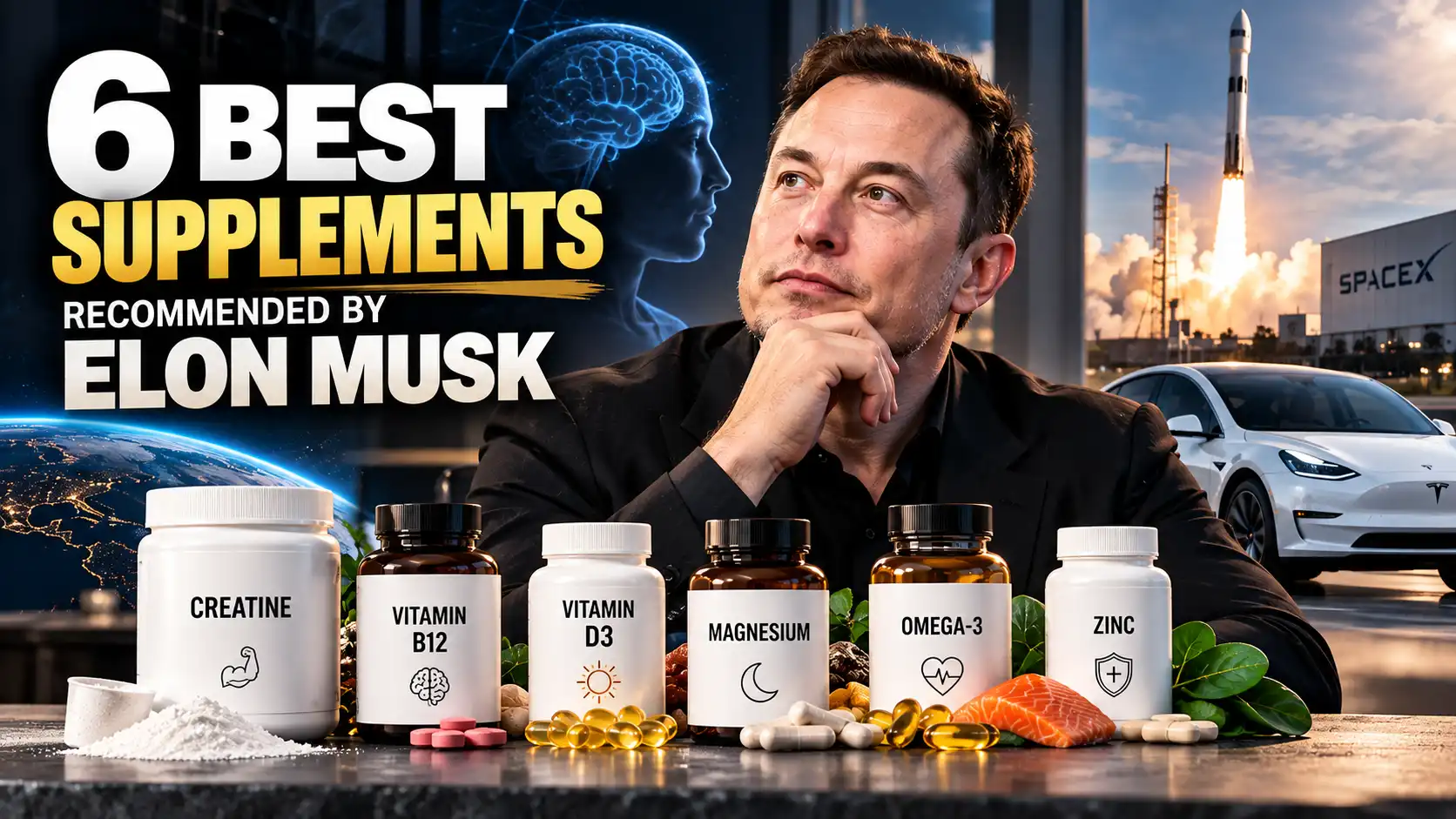
That has also created a problem for anyone searching for “Elon Musk supplements.”
Online lists often claim Musk takes everything from creatine and magnesium to vitamin D, omega-3, zinc and longevity compounds. But there is a major difference between a supplement being associated with Musk online and Musk actually saying that he takes it.
After reviewing his public interviews, podcast appearances and reported health discussions, there is no verified six-item supplement stack publicly disclosed by Musk. A 2026 evidence review similarly found no credible public record of Musk routinely taking vitamin D, magnesium, omega-3, NMN or a multivitamin.
The strongest supplement-related evidence involves creatine and vitamin B12. Other popular supplements can be discussed as evidence-based nutritional options, but should not be presented as Musk’s personal recommendations.
Elon Musk is one of the most influential technology entrepreneurs of the modern era.
He is CEO of Tesla and has led SpaceX since its early years. He is also associated with xAI, Neuralink and The Boring Company. Tesla says Musk has served as its CEO since 2008 and SpaceX’s CEO, CTO and chairman since 2002. He previously co-founded PayPal and Zip2.
His businesses span electric vehicles, reusable rockets, satellite communications, artificial intelligence, infrastructure and brain-computer interfaces.
In 2025, X and xAI were merged, and in 2026 xAI Holdings subsequently became a subsidiary of SpaceX.
Unlike dedicated longevity personalities, Musk has not built his public identity around a meticulously documented supplement or anti-ageing protocol.
Musk has never presented himself as a fitness influencer.
In 2022, however, he attracted attention after losing approximately 30 pounds, or 13.6 kilograms.
When asked how he lost the weight, Musk attributed it to fasting, Wegovy/Ozempic and having less tempting food around him. He had previously said he was fasting periodically and also acknowledged doing some weightlifting.
Later, during a 2024 appearance on The Joe Rogan Experience, he discussed another part of his diet: steak and eggs.
Musk said he had switched to steak and eggs for breakfast and described the meal as a “power up.” During the same conversation, creatine was discussed in the context of cognitive performance and sleep deprivation.
That conversation provides one of the clearest windows into Musk’s nutritional thinking, but it still does not establish a formal supplement stack.
If one supplement is most closely connected to Musk’s public conversations, it is creatine.
The important qualification is that Musk has clearly discussed creatine, but available evidence does not establish a precise daily dose or prove that he takes it consistently.
During his 2024 conversation with Joe Rogan, creatine was discussed in relation to cognitive performance, particularly during sleep deprivation. Musk asked whether creatine naturally occurs in steak, followed by a discussion of his steak-and-eggs breakfast.
Creatine is naturally produced by the body and is also obtained from foods such as meat and seafood.
It plays an important role in the phosphocreatine energy system, helping regenerate ATP during high-intensity activity.
That is why creatine monohydrate is one of the most researched sports supplements.
Research has also investigated possible effects on memory, attention and other aspects of cognition. Results vary between populations and circumstances, so creatine should not be marketed as a universal “brain booster.”
For someone who strength trains, creatine can support training performance and, over time, strength and muscle development.
It may also be particularly relevant to people consuming little or no animal products because dietary creatine intake tends to be lower.
However, creatine should not be viewed as a replacement for sleep. Potential benefits during sleep deprivation do not make chronic sleep loss healthy.
Musk has discussed creatine publicly, but there is insufficient evidence to claim that he follows a specific “5 g per day Elon Musk creatine protocol.”
Vitamin B12 is directly connected to a Musk story, although it is a story about questioning supplementation rather than recommending it.
During a 2024 Joe Rogan Experience conversation, Musk described visiting a doctor who told him his bloodwork showed B12 deficiency.
The doctor gave him B12 supplements and other vitamins. Musk then reviewed his laboratory results and said they actually showed that his B12 was already high. He also described the proposed supplements as containing an extremely large percentage of the recommended daily amount.
Vitamin B12 is essential for red blood cell formation, neurological function and DNA synthesis.
People at greater risk of deficiency include those following strict vegan diets, people with certain gastrointestinal conditions and people taking some medications that interfere with B12 absorption.
The important lesson is:
Test when appropriate and supplement for a reason.
Someone with a documented deficiency can benefit significantly from B12 supplementation. Someone whose levels are already adequate does not necessarily benefit from taking increasingly large amounts.
Musk’s story is therefore better interpreted as a cautionary example than as an endorsement of high-dose B12.
Vitamin D frequently appears on websites claiming to document Elon Musk’s supplement routine.
But there is no strong public evidence that Musk routinely takes vitamin D3.
That does not make vitamin D unimportant.
Vitamin D contributes to calcium absorption and normal bone health and also plays roles in muscle and immune function.
People with limited sun exposure or certain dietary and medical risk factors may be more likely to have inadequate vitamin D.
But correcting a deficiency is different from taking high doses when levels are already adequate.
The reason to consider vitamin D should be individual nutritional needs, not the possibility that Musk takes it.
Magnesium is another supplement frequently included in supposed “Elon Musk stacks.”
There is no reliable evidence that Musk has publicly confirmed a regular magnesium supplementation routine.
Magnesium nevertheless plays an important biological role, contributing to normal muscle and nerve function, energy metabolism, protein synthesis and other physiological processes.
Dietary sources include nuts, seeds, legumes, whole grains and leafy green vegetables.
Magnesium is also widely marketed for sleep and relaxation, although supplementation should not be treated as a universal solution for insomnia.
The practical question is whether an individual’s diet provides sufficient magnesium, not whether Musk takes it.
Omega-3 supplements are another common entry on celebrity supplement lists.
However, there is no verified public statement establishing omega-3 as part of Musk’s regular supplement routine.
The major long-chain omega-3 fatty acids are EPA and DHA. They are found primarily in oily fish and some marine sources, while ALA is found in foods such as flaxseed and chia.
EPA and DHA are components of cell membranes and participate in numerous biological processes. DHA is particularly abundant in the brain and retina.
Someone who regularly eats oily fish may already obtain substantial omega-3s. People who rarely consume seafood may have different nutritional needs, while vegetarians and vegans can consider algae-derived DHA and EPA.
The relevant question is not “Does Elon Musk take fish oil?” but “Does my diet provide sufficient omega-3?”
Zinc is often included in online “Elon Musk supplement stack” articles, but evidence linking Musk personally to regular zinc supplementation is weak.
Zinc contributes to normal immune function, DNA synthesis, wound healing and protein production.
Food sources include meat, seafood, dairy products, legumes, nuts and seeds.
Zinc is essential, but more is not automatically better. Excessive long-term intake can interfere with copper absorption.
Again, the important distinction is between a supplement being nutritionally useful and being genuinely part of Musk’s routine.
This is an important part of Musk’s health story, but these are prescription medicines, not dietary supplements.
In 2022, Musk publicly attributed part of his weight loss to fasting and Wegovy/Ozempic. Contemporary reporting documented his comments and the resulting public interest in GLP-1 medicines.
These medicines affect appetite, blood glucose and body weight through specific biological mechanisms.
They should not be treated like over-the-counter weight-loss supplements or copied from a celebrity routine.
Not in the conventional celebrity sense.
Musk experienced a highly visible weight-loss period in 2022, losing roughly 30 pounds according to his own comments. He also said he did some weightlifting.
There is no well-documented “Elon Musk fitness comeback” comparable to dramatic Hollywood transformations.
Instead, Musk has generally portrayed exercise as something he does pragmatically rather than enthusiastically.
His public comments have focused more on fitting activity and dietary changes around an exceptionally demanding schedule than on following a detailed bodybuilding programme.
One of the clearest examples comes from his 2024 Joe Rogan appearance.
Musk said he had switched to steak and eggs for breakfast, without bread, and described the meal as a “power up.”
The conversation also covered carbohydrates, ketosis and creatine.
However, a single breakfast should not be turned into a universal diet plan.
Nutritional requirements vary considerably between individuals depending on age, activity, health status and dietary pattern.
The biggest misconception is that there is a secret six-supplement formula responsible for Musk’s productivity or physique.
There is no credible evidence for that.
Some 2026 supplement websites present creatine, vitamin D3, omega-3, magnesium, zinc and B12 as an “Elon Musk supplement list,” while acknowledging that creatine is the only supplement Musk has actually discussed by name and that the rest are evidence-based additions rather than verified parts of his routine.
That distinction matters.
There is nothing wrong with discussing evidence-based supplements. The problem occurs when a generic supplement stack is presented as a celebrity’s personal regimen without supporting evidence.
| Supplement | Publicly linked to Musk? | What the evidence supports |
|---|---|---|
| Creatine | Discussed publicly; regular use not definitively confirmed | Exercise performance; possible cognitive benefits in some situations |
| Vitamin B12 | Directly discussed by Musk | Essential for neurological function and red blood cell formation; useful when deficient |
| Vitamin D3 | No reliable confirmation of routine use | Bone health and normal physiological function; particularly relevant when deficient |
| Magnesium | No reliable confirmation of routine use | Muscle, nerve and energy metabolism; useful when intake is inadequate |
| Omega-3 | No reliable confirmation of routine use | EPA/DHA contribute to normal biological functions; dietary context matters |
| Zinc | No reliable confirmation of routine use | Immune function, DNA synthesis and other physiological processes |
Not blindly.
The most useful lesson from Musk’s public health discussions is the difference between personal experience, scientific evidence and marketing.
His comments about fasting are personal observations.
His steak-and-eggs breakfast is a personal preference.
His B12 story illustrates why laboratory results matter.
His creatine discussion shows interest in the compound’s potential cognitive effects.
None of these establishes a universal health protocol.
A supplement should ideally be selected because it addresses a genuine nutritional or performance need — not because a famous person mentioned it on a podcast.
The accurate answer is surprisingly simple:
Elon Musk has not published a six-supplement regimen.
Creatine is the clearest supplement connected to his public conversations about performance and cognition, although there is insufficient evidence to state a precise current dose or permanent daily routine.
Vitamin B12 has also appeared directly in his own story, but in a different context: Musk questioned a doctor’s recommendation after finding that his bloodwork already showed elevated B12.
The remaining supplements commonly attributed to Musk — vitamin D, magnesium, omega-3 and zinc — have legitimate nutritional relevance, but there is not enough evidence to label them as his personal recommendations.
That may be less sensational than a conventional celebrity supplement article, but it is more useful.
The real lesson from Elon Musk’s health journey is not that there is a six-bottle formula behind extraordinary productivity.
It is that celebrity health claims need to be separated from evidence.
Creatine may be useful for someone who trains. B12 may be essential for someone who is deficient. Vitamin D may matter for someone with inadequate status. Magnesium, omega-3 and zinc can all play important nutritional roles.
But none of those facts requires Elon Musk’s name to make them scientifically interesting.
And when it comes to supplements, that is probably the most important distinction of all.