Creatine gummies have moved from being a novelty fitness product to a serious alternative to traditional creatine powder. The reason is simple: most people do not struggle to understand creatine, they struggle to take it consistently. Powder needs a scoop, liquid and a shaker. Gummies can sit in a gym bag, desk drawer or travel bag and be taken without preparation.
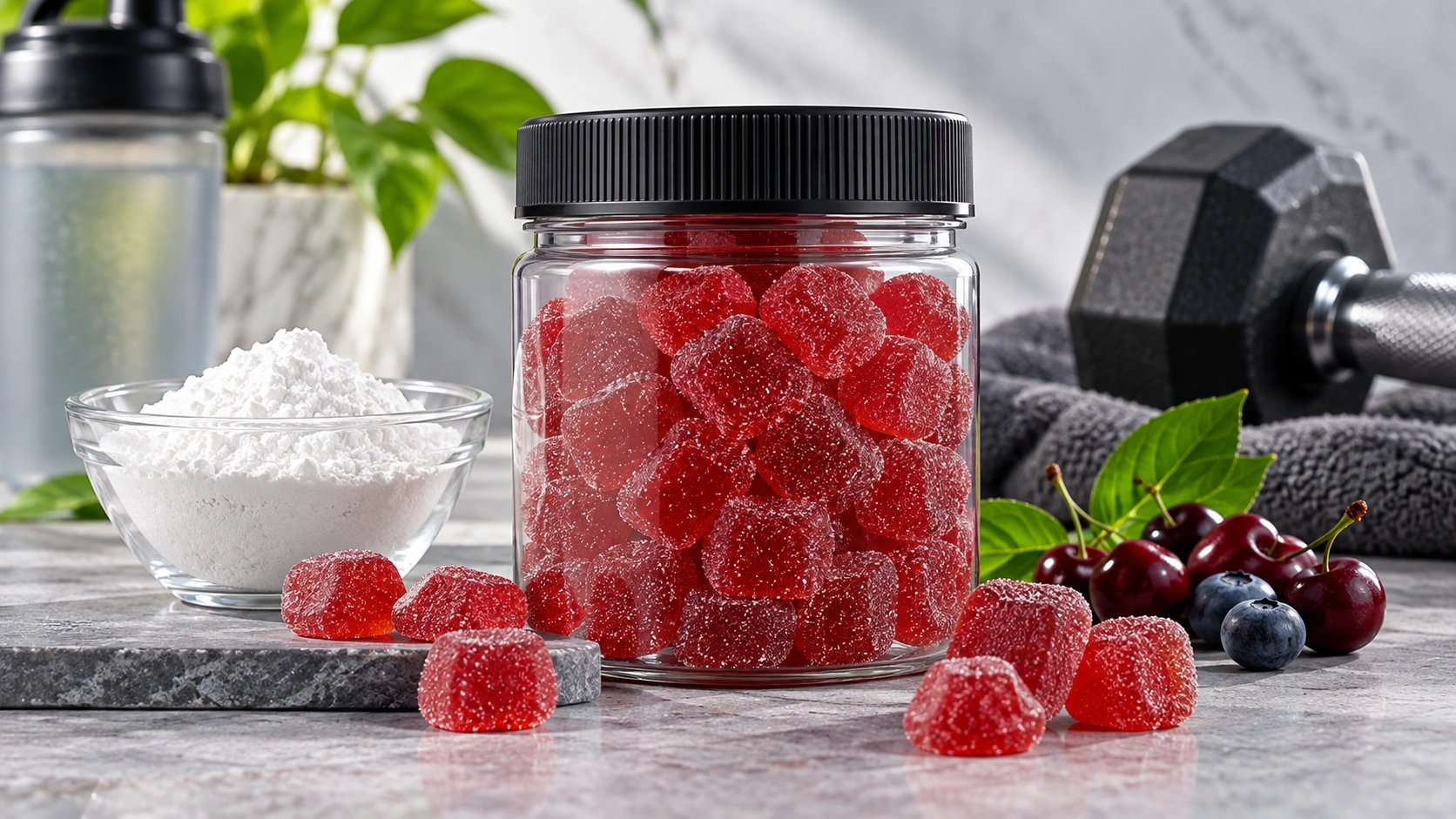
Creatine gummies are chewable dietary supplements that deliver creatine, usually creatine monohydrate, in a gummy or soft-chew format.
Creatine itself is not new. Humans naturally produce creatine, and it is also found in foods such as meat and seafood. Most of the body’s creatine is stored in skeletal muscle, where it helps replenish ATP, the body’s rapidly available energy currency during short, intense efforts. :contentReference[oaicite:2]{index=2}
The modern creatine supplement industry, however, grew rapidly during the late 20th century, particularly after creatine monohydrate became popular among athletes and strength athletes.
Gummies came much later.
There is no single inventor who can credibly be called the inventor of the modern creatine gummy. The format developed from the wider gummy-vitamin and chewable-supplement industry. As consumers became increasingly comfortable taking vitamins, probiotics and other supplements as gummies, sports-nutrition companies began trying to put creatine into the same convenient format.
That transition sounds easy, but chemically it is not.
Creatine is very stable as a dry solid but considerably less stable when dissolved in water, especially as temperature rises and pH falls. Research has shown that creatine can gradually convert to creatinine in aqueous solutions, which is one reason conventional creatine has historically been sold as a dry powder rather than as a ready-to-drink liquid.
Gummies therefore created a formulation challenge. Manufacturers had to deliver a meaningful amount of creatine while keeping the gummy physically stable, palatable and shelf-stable.
The category has grown particularly quickly in 2025 and 2026 because consumers increasingly want supplements that require less preparation. Australian brand Thurst, for example, currently reports more than one million gummies consumed and more than 5,200 reviews on its own site, while Shop’s product listing shows more than 1,200 ratings.
That does not mean Thurst is objectively the world’s number-one creatine gummy. It does show how quickly the category has moved toward high-volume consumer products.
The most important ingredient is surprisingly simple:
Creatine monohydrate.
You do not need a complicated proprietary blend to get the core benefit of creatine.
Creatine monohydrate is the most extensively studied form of supplemental creatine.
It increases muscle creatine and phosphocreatine stores. During high-intensity activity, phosphocreatine helps regenerate ATP, allowing muscles to maintain power during repeated short-duration efforts. Over time, this can support better training quality and greater gains in strength and lean mass when combined with resistance training.
For most people, a daily dose around 3 to 5 grams is a practical maintenance range. A loading phase is optional rather than mandatory.
Some brands use micronized creatine monohydrate.
Micronization refers to smaller particle size and is mainly a formulation strategy intended to improve handling and dispersion. It does not mean that micronized creatine is a fundamentally different form of creatine.
Some products add ingredients that are not necessary for creatine’s basic function.
Lemme Creatine, for example, combines 5 grams of micronized creatine monohydrate with its AstraGin ginseng and astragalus complex. Lemme says the product is NSF Certified for Sport and third-party tested.
These additional ingredients can be useful for specific formulations, but consumers should not pay a large premium simply because a gummy contains a long ingredient list.
The remaining ingredients are generally there to create the gummy itself.
Depending on the brand, these can include:
These ingredients affect taste, texture, calories, sugar content and stability, but they are not responsible for the main ergogenic effect of creatine.
Buying creatine gummies requires more attention than buying a normal candy product.
Ignore the size of the bottle until you know how much creatine it contains.
A bottle with 120 gummies sounds impressive until you discover that each serving requires four gummies and contains only 3 grams of creatine.
A better question is:
How many grams of creatine monohydrate do I get per daily serving?
Products in this article range from approximately 3 grams to 5.4 grams per serving.
Creatine monohydrate has the strongest evidence base.
There are other creatine forms on the market, but there is no strong evidence that consumers need to move away from monohydrate to obtain better results. The ISSN specifically identifies creatine monohydrate as the most effective form for increasing high-intensity exercise capacity and lean mass.
This is especially important with gummies.
Choose brands that publish certificates of analysis or clearly identify independent testing laboratories.
Thurst, for example, says every batch is independently tested by Eurofins and ACS Laboratories, with current 2026 batch reports listed on its website.
SteelFit says its products are third-party tested and its creatine gummies use Creapure creatine monohydrate.
This is one of the most common labeling mistakes consumers make.
If a bottle says “5,000 mg creatine,” find out whether that means:
For example, Thurst provides 5 grams across four gummies, while Nutramin provides 5 grams across three gummies.
Some creatine gummies contain several grams of added sugar per serving.
That is not automatically a deal-breaker, but it matters if you are taking the product every day.
For people monitoring sugar intake, look for sugar-free or low-sugar formulations.
Gummies may contain gelatin, dairy-derived ingredients, allergens or sugar alcohols.
Vegan consumers should look for pectin-based gummies.
People sensitive to sugar alcohols should check for ingredients such as maltitol and isomalt because large amounts can cause digestive discomfort.
This is an overlooked issue.
Creatine powder is comparatively easy to store. Gummies are much more sensitive to heat and humidity because they are food-like products containing a structured gummy matrix.
If you live in Australia, Thailand, Singapore, Florida or another hot and humid location, look for:
Do not leave creatine gummies inside a hot car.
Research on creatine stability shows that temperature and water activity can influence degradation, particularly in formulations containing water. Solid creatine itself is highly stable, but a gummy is not simply a dry scoop of creatine powder.
Several brands use phrases such as “clinical dose” in marketing.
The useful part is the actual number.
Look for the words:
Creatine monohydrate: 5 g per serving.
That is much more useful than vague phrases such as “maximum strength” or “advanced creatine matrix.”
Gummies are usually more expensive per gram than powder.
You are paying for convenience, flavor and formulation.
If convenience is what helps you take creatine every day, the premium may be worthwhile.
If cost is your primary concern, plain creatine monohydrate powder usually remains the better value.
The following list is designed to avoid repeating the same brand and to represent the requested two-product-per-country structure. Because manufacturers generally do not publish audited product-level sales by country, “best-selling” should be read as high-traction, widely available or strongly reviewed, not as a claim of verified global unit-sales leadership.
Company: SteelFit / Performance Brands Inc.
SteelFit was founded in 2015 by Stacy and Rob Kaufman, a father-son team with decades of experience in the fitness industry. The company is based in Florida and describes itself as a family-owned sports-nutrition business.
Creatine: 5 grams of Creapure creatine monohydrate per four-gummy serving.
Key formulation: Creapure creatine monohydrate is the primary performance ingredient. The gummy base includes tapioca syrup, soluble tapioca fiber, cane sugar, pectin, citric acid, natural flavors, stevia, spirulina and other formulation ingredients.
Why it stands out: 5 grams of creatine per serving, Informed Sport certification and a transparent label.
Customer feedback: The current SteelFit product page contains verified-buyer reviews praising flavor and convenience, while also showing a few complaints about gummies melting during long hot shipments. That is useful feedback for consumers living in hot climates.
Company: Lemme.
Lemme was launched in 2022 by Kourtney Kardashian Barker, Simon Huck and Nir Liberboim. Forbes reported in 2026 that the brand had grown into a roughly $200 million wellness business, demonstrating the scale of its celebrity-led and creator-commerce strategy.
Creatine: 5 grams of micronized creatine monohydrate per serving.
Additional ingredient: AstraGin, a patented ginseng and astragalus complex marketed for nutrient absorption.
Certification: NSF Certified for Sport and third-party tested, according to Lemme.
Customer feedback: Lemme’s current product page has more than 160 reviews at around 4.1/5. Independent iHerb reviews praise its taste and convenience, although some customers say they have not used it long enough to judge results.
Company: Thurst.
Thurst is an Australian-owned creatine-gummy company built specifically around solving the convenience problem associated with creatine powder.
Creatine: 5 grams of creatine monohydrate across four gummies.
Formula: Creatine monohydrate is the active ingredient, while the product is marketed as sugar-free and vegan.
Testing: Thurst says every batch is tested by both Eurofins and ACS Laboratories in Australia. Its current 2026 testing page lists multiple production batches. :contentReference[oaicite:18]{index=18}
Market traction: The company currently reports more than 5,200 reviews and more than one million gummies consumed. :contentReference[oaicite:19]{index=19}
Customer feedback: Current Shop reviews highlight taste and convenience. Some 2026 reviews also mention sticky or melted gummies, showing that shipping and climate can affect the physical product even when the creatine dose itself is verified.
Company: Flexies.
Flexies is an Australian supplement brand positioning its creatine product particularly toward women and consumers who want a convenient daily performance supplement.
Creatine: 5 grams of creatine monohydrate per four gummies.
Key formula: Creatine monohydrate is the primary active ingredient. The brand emphasizes a vegan, gluten-free formulation without synthetic dyes.
Positioning: Strength, recovery and everyday muscle support rather than only bodybuilding.
Customer feedback: The brand’s current page emphasizes the full 5-gram dose and its certificate-of-analysis approach. Because independent third-party review volume is lower than Thurst’s, it is better viewed as a strong emerging Australian option rather than an established market leader.
Company: Nutramin.
Nutramin is a Canadian supplement brand with its creatine gummies manufactured in Prince Edward Island, Canada. The company describes itself as Canadian-owned and female-founded.
Creatine: 5 grams per three gummies, or approximately 1.67 grams per gummy.
Formula: Creatine monohydrate, with a vegan and sugar-free gummy format. The product uses monk fruit for sweetness and contains maltitol and isomalt. :contentReference[oaicite:23]{index=23}
Why it stands out: High dose per gummy, Canadian manufacturing, vegan positioning and an allergen-conscious formulation.
Customer feedback: Nutramin has a more limited independent review footprint than some U.S. and Australian products, so claims about being the “best” should be avoided. Its strongest differentiator is formulation transparency.
Company: Limitless Pharma.
Canadian trademark records identify 9339-0458 Québec inc. as the applicant behind the Limitless Pharma trademark, with dietary supplements and creatine supplements among its registered goods.
Creatine: 5 grams of creatine monohydrate per three gummies.
Formula: Vegan pectin-based gummies with low sugar and no proprietary blend.
Why it stands out: The product gives consumers a full 5-gram serving in only three gummies.
Market evidence: Current Canadian rankings place Limitless Pharma among the leading creatine-gummy options based on dose, value and customer/marketplace signals.
Company: Real Essence.
Real Essence is a Thai-market creatine gummy brand and describes its Essence Bites product as one of the first creatine gummy products in Thailand.
Creatine: 1,000 mg per gummy.
Recommended serving: Three to five gummies per day according to the current product listing.
Sweeteners: Stevia and maltitol syrup.
Testing: The company says the product has third-party testing and promotes Eurofins certification.
Why it stands out: It is one of the clearest locally positioned Thai creatine-gummy products identified during current research.
Customer feedback: Current Shopee Thailand listings show the Real Essence store with approximately 4.9/5 store ratings and strong response metrics, although this should not be confused with an independent product clinical review.
Company: Naturecan.
Naturecan is not a Thai-origin company, so it would be misleading to call this a Thai-made product. It is included because it is currently marketed and regulated for sale in Thailand and has a dedicated Thailand product page.
Creatine: 3 grams of creatine monohydrate per daily serving.
Why it stands out: It offers a lower-dose option than the 5-gram products above and provides a certificate of analysis through its Thailand product information.
Important: If your requirement is strictly “manufactured in Thailand,” do not classify Naturecan in that category. Publicly available evidence supports “available in Thailand,” not “Thai-made.”
Company: Drops.
Drops is a Singapore-facing creatine-gummy brand that positions itself around daily convenience, strength, recovery and cognitive support.
Creatine: 5 grams of creatine monohydrate per serving.
Format: Tangy Orange and other flavors, with 30 servings per product.
Testing: Drops says its gummies are third-party lab tested.
Market traction: The current Drops website reports a 4.9-star rating and more than 1,000 customers, while current Singapore marketplace listings show the product being actively sold.
Customer feedback: Current Singapore marketplace listings show strong store ratings, although independent review volume is still much smaller than established U.S. products.
Company: FOULPLAY.
FOULPLAY was created by Ryan Foo, co-founder of Singapore-based anti-hangover supplement company DrinkAid. FOULPLAY moved into sports nutrition with Hi-Creatine Bites in 2025. NutraIngredients reported that the product was scheduled to launch through the brand’s website and selected Singapore gyms.
Creatine: 1,800 mg per gummy.
Serving: Three gummies provide approximately 5.4 grams of creatine monohydrate.
Flavor: Hakuto Peach.
Why it stands out: It is a Singapore-founded performance-nutrition product with an unusually high amount of creatine per individual gummy.
Customer feedback: Because the product is relatively new, independent review volume is much smaller than that of established products. Its strongest evidence currently comes from the formulation and the company’s Singapore launch rather than large-scale independent consumer data.
| Product | Market | Creatine per serving | Main advantage | Testing / evidence signal |
|---|---|---|---|---|
| SteelFit | USA | 5 g | Creapure + Informed Sport | Strong |
| Lemme | USA | 5 g | NSF Certified for Sport | Strong |
| Thurst | Australia | 5 g | Dual independent testing | Very strong |
| Flexies | Australia | 5 g | Women-focused formulation | Good |
| Nutramin | Canada | 5 g | Canadian-made, vegan | Good |
| Limitless Pharma | Canada | 5 g | 5 g in only 3 gummies | Good |
| Real Essence | Thailand | 1-5 g depending on serving | Thai-market product | Third-party testing claimed |
| Naturecan | Thailand market | 3 g | CoA availability | Good |
| Drops | Singapore | 5 g | Singapore-focused brand | Third-party testing claimed |
| FOULPLAY | Singapore | 5.4 g | High dose per gummy | Newer product |
Consumer reviews are useful, but they should not be confused with scientific evidence. A five-star review can tell you that someone liked the taste, packaging or convenience. It cannot prove that the product increases muscle mass.
Current verified-buyer reviews repeatedly praise taste and convenience. One reviewer described the gummies as easy to take on the go, while another said the watermelon flavor was enjoyable and did not cause stomach upset. There are also negative reviews reporting melting during prolonged hot shipping. :contentReference[oaicite:31]{index=31}
Current iHerb reviewers describe Lemme as good-tasting and convenient, with some saying it is easier to take every morning than powder. Others note that they had not used it long enough to judge results.
Current Australian customer feedback is particularly strong around taste and consistency. Reviews describe the gummies as easier to remember than powder, while some customers report better adherence simply because they enjoy taking them. Other reviews mention occasional stickiness or melting, reinforcing the importance of climate and storage.
These reviews point toward the biggest real-world advantage of gummies: adherence.
A theoretically perfect supplement is useless if you do not take it consistently.
Yes, provided the gummy delivers an effective amount of creatine monohydrate.
Your muscles do not care whether creatine arrived from a shaker bottle or a gummy.
Once absorbed, creatine is creatine.
The key difference is the formulation.
A powder can easily provide 5 grams in one scoop. A gummy must physically contain that same amount while maintaining acceptable texture, taste and stability.
This is why some gummies require three, four or five pieces per serving.
The evidence does not show that the gummy format itself makes creatine more powerful.
The advantage is convenience and consistency.
If you live in a hot country, this section matters more than many shopping guides admit.
Creatine monohydrate is stable as a dry powder, but creatine is less stable when dissolved in water, particularly under acidic and warm conditions. Research has shown that temperature and water activity influence degradation behavior.
Gummies contain more moisture than a dry powder, and their structure can also change when exposed to heat.
That means a product can remain chemically acceptable while becoming physically unpleasant, sticky or melted.
For consumers in Australia, Thailand, Singapore, Florida and other hot or humid locations:
The best brands should be able to provide stability information rather than simply saying “long shelf life.”
Creatine gummies are not replacing creatine powder because they are scientifically superior. They are becoming popular because they solve a different problem: consistency.
If you already enjoy mixing creatine powder and want the lowest cost per gram, there is little reason to switch.
If you hate the gritty texture, travel frequently, forget your daily dose or simply want something easier to take, gummies can be a genuinely useful upgrade.
Among the products reviewed here, Thurst stands out for its current Australian review volume and dual-laboratory testing. SteelFit is attractive for consumers looking for Creapure and sports-certification signals. Lemme combines 5 grams of creatine with a strong mainstream wellness brand and NSF Certified for Sport status. Nutramin and Limitless Pharma provide strong Canadian options, while Real Essence is particularly relevant for consumers looking for a Thailand-market product.
Singapore has an interesting emerging category, with Drops offering a full 5-gram serving and FOULPLAY offering a high-dose gummy format.
The most important buying rule remains the same across all ten:
Check the actual grams of creatine monohydrate per serving, verify testing where possible, compare the cost per 5 grams, and consider how the gummies will handle the climate where you live.
And remember that no gummy can replace progressive resistance training, adequate protein, sufficient calories, sleep and a sensible overall diet.
Creatine is one piece of the performance puzzle.
The best creatine gummy is ultimately not the one with the most impressive marketing. It is the one that delivers a meaningful, verified dose, remains stable in real-world storage and is convenient enough that you actually take it consistently.
Not inherently. Creatine monohydrate powder remains the simplest and usually the cheapest way to take creatine. Gummies are mainly better for people who dislike powder, travel frequently or struggle to take supplements consistently. The physiological effect depends on receiving an effective creatine dose, not on whether you chew it or mix it.
For many healthy adults, around 3 to 5 grams per day is a common maintenance range, with 5 grams widely used in research and commercial products. You do not have to take creatine only on workout days because maintaining elevated muscle creatine stores depends on consistent intake.
Creatine can increase body weight, particularly during the early stages of supplementation, because muscles retain more water. This is not the same thing as gaining body fat. Longer-term changes in lean mass depend on training, nutrition and other factors.
No. Research supports creatine use across different populations, and women can also benefit from creatine supplementation, particularly when combined with resistance training. Creatine is not a male hormone or anabolic steroid.
In healthy individuals, controlled research has not demonstrated compelling evidence that recommended creatine monohydrate use causes kidney damage. However, people with kidney disease or other medical conditions should discuss creatine supplementation with a healthcare professional before starting it. :contentReference[oaicite:37]{index=37}
The evidence does not support the common claim that normal creatine supplementation causes dehydration. Creatine can increase water stored inside muscle cells, and research has even investigated its potential role in maintaining hydration during exercise in the heat. Normal hydration practices still matter.
No. Loading can raise muscle creatine stores more quickly, but it is optional. A consistent daily maintenance dose can also gradually saturate muscle stores. If you prefer simplicity, daily maintenance without loading is perfectly reasonable.
Yes. The gummy itself can deteriorate, and formulation stability matters. Creatine is highly stable as a dry solid but is less stable in aqueous conditions, especially with higher temperature and lower pH. Always follow the product’s expiry date and storage instructions.
Creatine monohydrate is a relatively high-dose ingredient compared with many vitamins. Putting 5 grams into a single small gummy can be technically difficult while maintaining a pleasant texture. That is why four or five gummies per serving are common. A smaller number is not necessarily better.
They can be. Three grams is still a meaningful daily amount. However, if two products cost roughly the same and one provides 5 grams of creatine monohydrate while the other provides 3 grams, compare the cost per gram rather than simply comparing bottle prices.