American presidents have spent decades telling the public about the dangers of drugs, signing anti-drug laws and, in some cases, overseeing some of the most aggressive drug-enforcement campaigns in U.S. history.
But presidential history is rarely as tidy as official speeches suggest.
Several American presidents have acknowledged using marijuana before entering the White House. Others were connected to substances that later became controlled or prohibited. In a few cases, historians and biographers have uncovered evidence of prescription stimulants or other drugs being used for medical purposes. And then there are the stories that have circulated for decades but don’t survive close examination.
That distinction matters.
Calling every historical case a president being “caught consuming banned drugs” would be misleading. Drug laws have changed dramatically over the last two centuries, and a substance that was legal, commonly prescribed or medically accepted in one period could later become heavily regulated. The federal Controlled Substances Act, for example, did not exist until 1970.
So this list examines ten presidents who have been documented, acknowledged, credibly reported or repeatedly linked to drugs that were prohibited, controlled or later became prohibited—while separating solid evidence from historical claims.
The result is a more complicated story than a viral list suggests.
Barack Obama is one of the clearest examples because much of the evidence comes from Obama himself.
Before becoming the 44th president, Obama wrote openly about his teenage years and early adulthood, including his experimentation with marijuana and cocaine. His drug use was not a secret uncovered years later by an investigative reporter; it was part of the story he told about his own youth.
Obama later became unusually candid about marijuana when compared with many politicians of his generation.
In a 2008 interview during his presidential campaign, he acknowledged that he had smoked marijuana as a young person and famously explained that inhaling was the point. His account had already appeared in his memoir Dreams from My Father, making this one of the better-documented examples of a future president acknowledging illegal drug use.
That is an important distinction.
Obama was not admitting to secretly using marijuana while president. The use occurred years before his presidency, when he was a young man. By the time he entered the White House in 2009, he was a politician with a very different relationship to drug policy.
His administration did not legalize marijuana federally, although Obama later supported changes in how federal authorities handled marijuana enforcement and pardons. His presidency also coincided with a rapidly changing American attitude toward cannabis.
The historical irony is obvious: a future president who acknowledged using marijuana as a young man eventually occupied the White House while the national debate over legalization was becoming one of the biggest drug-policy debates in America.
Obama’s story is therefore one of the strongest examples of a president acknowledging past drug use rather than a president being secretly caught using drugs while in office.
George W. Bush presents a more complicated case.
Unlike Obama, Bush spent much of his political career refusing to give a direct public answer about his youthful marijuana use.
That changed, at least partially, when secretly recorded conversations from the period before his presidency became public.
In recordings made while Bush was considering another presidential campaign, he discussed his reluctance to answer questions about marijuana because he did not want young people to copy his behavior. The tapes were made between 1998 and 2000 by author Doug Wead and were later publicly reported. Bush was quoted discussing what he had tried while emphasizing that he did not want to become an example for children.
Bush was also repeatedly questioned about allegations of cocaine use during his younger years. Unlike his comments about marijuana, he generally declined to provide a clear public confirmation of cocaine use.
That means the evidence levels are different.
His marijuana history has substantially stronger documentary support than the cocaine allegations.
Bush’s case is particularly interesting because his presidency became closely associated with America’s continuing War on Drugs. His administration inherited the federal drug-control framework built over previous decades, while his political identity emphasized personal responsibility and opposition to illegal drug use.
Yet the historical record surrounding his younger years demonstrates why personal history and public policy can be two very different things.
He was not “caught” using drugs in the White House. Rather, evidence emerged concerning experimentation before he became president.
That distinction is important when discussing any president’s drug history.
Bill Clinton’s marijuana story became one of the most famous political drug controversies in modern American history.
During the 1992 presidential campaign, Clinton acknowledged that he had experimented with marijuana while studying at Oxford University in Britain.
He famously added that he had not inhaled.
The statement became a cultural and political punchline, but underneath the jokes was a genuine historical fact: Clinton acknowledged that he had experimented with marijuana.
The episode also demonstrated how differently politicians were expected to discuss youthful drug experimentation depending on the era.
Clinton was running for president at a time when the United States remained deeply influenced by the War on Drugs. Republican opponents used his admission politically, while Clinton attempted to distinguish youthful experimentation from habitual drug use.
The controversy followed him throughout the campaign and presidency.
President George H. W. Bush even referred to Clinton’s marijuana statement during the 1992 campaign, demonstrating how drug history had become a political issue rather than merely a private matter. The American Presidency Project preserves contemporary remarks concerning Clinton’s famous “didn’t inhale” statement.
Clinton’s admission therefore belongs on any historically responsible list of presidents who acknowledged consuming marijuana.
But again, the timeline matters.
The marijuana use occurred before Clinton became president. There is no credible evidence that he was secretly smoking marijuana inside the White House while serving as president.
John F. Kennedy’s drug history is far more complicated than the image of the glamorous young president often presented in popular culture.
Kennedy suffered from significant and recurring medical problems, including severe back pain. During his presidency, he was treated by Dr. Max Jacobson, a physician whose controversial “vitamin injections” became famous among celebrities and political figures.
The treatments contained amphetamines and other substances.
Jacobson eventually became known as “Dr. Feelgood,” and accounts of Kennedy’s relationship with him have generated decades of historical debate.
More recent biographical work has brought the issue back into public discussion. In 2026, biographer Laurence Leamer’s work on Kennedy again highlighted the president’s use of amphetamine-based treatments and their relationship to Kennedy’s health and private life.
However, describing Kennedy simply as a “drug user” without context would be misleading.
Amphetamines were prescribed and used medically in the United States during this period. The modern regulatory environment was different from today’s system, and Kennedy was receiving treatment from a physician.
The marijuana stories surrounding Kennedy are much less certain.
Several books and articles have claimed that Kennedy smoked marijuana in the White House, allegedly for pain relief. Those accounts have circulated for years, but the evidentiary foundation is weaker than the documentation surrounding his medical stimulant treatments.
Therefore, Kennedy is better understood as a president with a documented history of controversial prescription stimulant treatment rather than as someone conclusively “caught” using an illegal street drug.
Franklin Pierce is one of the most intriguing names in the early history of presidential drug stories.
Before becoming the 14th president, Pierce served as a military officer during the Mexican-American War.
Accounts of the war have long connected Pierce and other American soldiers with cannabis smoking. Historical writers have frequently cited a letter in which Pierce reportedly described cannabis as one of the few positive experiences associated with the conflict.
The story has become part of the wider historical literature about cannabis use among American soldiers in the nineteenth century.
Pierce’s extensive papers are preserved by the Library of Congress, including correspondence associated with his military career and the Mexican War.
But there is a crucial legal problem with calling Pierce’s behavior “banned drug use.”
Cannabis was not federally prohibited in the United States in the way marijuana was later criminalized.
Cannabis had a very different cultural and legal status in nineteenth-century America. It appeared in medical preparations and was known in various forms long before the twentieth-century marijuana prohibition era.
That means Pierce is historically interesting, but calling him a president who broke a modern marijuana prohibition would impose a later legal framework on an earlier period.
His story belongs on a list like this because it illustrates how dramatically America’s relationship with cannabis changed.
Zachary Taylor, the 12th president, is sometimes included alongside Franklin Pierce in accounts of nineteenth-century cannabis use among American military personnel.
Taylor was a career Army officer who became nationally famous during the Mexican-American War. He later rode that military reputation into the White House, serving as president from 1849 until his death in 1850.
Historical cannabis accounts have claimed that Taylor smoked cannabis with troops during the Mexican-American War.
The problem is that the evidence is considerably weaker than the modern admissions of Obama or Clinton.
There is a major difference between a documented presidential memoir, a recorded conversation and a later historical claim repeated by cannabis publications.
Taylor’s surviving correspondence is extensive, and archival institutions hold original letters from his military and presidential years.
Yet a reliable primary-source record conclusively demonstrating that Taylor personally consumed marijuana is difficult to establish.
Consequently, the most responsible description is that Taylor has been historically linked to cannabis use during his military career, rather than stating categorically that he was caught consuming an illegal drug.
The distinction may make a headline less dramatic, but it makes the history considerably more accurate.
Andrew Jackson is another early president whose name frequently appears in historical cannabis lists.
Jackson became the seventh president after a long military and political career. His surviving papers include thousands of documents covering his military service and political life. The Library of Congress and the American Presidency Project preserve substantial collections of his correspondence.
Some cannabis histories claim that Jackson smoked marijuana with soldiers during his military career.
However, the documentary evidence is not as straightforward as internet lists sometimes imply.
Jackson’s letters clearly demonstrate the realities of his military campaigns, relationships with soldiers and interactions with Native American nations, but the frequently repeated cannabis story is difficult to establish at the same level of certainty as Obama’s or Clinton’s own admissions.
There is another important problem: the word “marijuana” itself can distort the history.
Nineteenth-century Americans did not use cannabis within the same cultural framework that emerged during the twentieth-century marijuana prohibition era.
Cannabis existed as hemp, medicine and intoxicant in different contexts.
Jackson therefore belongs in this article primarily as an example of a historical claim that has been repeatedly circulated—not as a president conclusively caught violating a drug ban.
James Monroe spent significant time in Europe as a diplomat before becoming America’s fifth president.
His diplomatic career included serving as the U.S. minister to France, a country where hashish and other intoxicants had become subjects of curiosity among certain intellectual and artistic circles.
That historical setting is the foundation for claims that Monroe personally consumed hashish.
Some later accounts have stated that Monroe smoked cannabis while living in Paris and continued the habit after returning to America.
But again, historians have to separate possibility from proof.
The U.S. State Department’s historical biography documents Monroe’s diplomatic career in France and his presence in Paris during the revolutionary era, but it does not establish a presidential history of recreational cannabis consumption.
This makes Monroe a particularly good example of how historical drug stories grow.
A real historical fact—Monroe lived in France during a period when hashish was known—can gradually become a much stronger claim: that he personally consumed it regularly.
Those are not equivalent statements.
There is insufficient evidence to present Monroe as a president definitively caught consuming a banned drug.
George Washington may be the most famous example of a president who is frequently accused online of smoking marijuana despite a lack of convincing evidence.
Washington absolutely grew hemp.
That part is not controversial.
His Mount Vernon estate records show that hemp was cultivated for practical purposes, including rope, thread, canvas and fishing-related equipment.
The problem begins when industrial hemp is transformed into “marijuana” in popular retellings.
Mount Vernon specifically distinguishes Washington’s industrial hemp from modern drug-type cannabis and states that there is no evidence that Washington used his crop recreationally.
His agricultural notes about separating male and female plants have frequently been interpreted online as evidence that he was attempting to produce more potent cannabis.
But that interpretation is not established by the surviving evidence.
Industrial hemp production itself could require managing male and female plants for agricultural purposes.
Therefore, George Washington should not be presented as a president proven to have smoked marijuana.
His inclusion in this article is useful precisely because it demonstrates how a historical fact can become a modern myth.
Washington grew hemp.
That does not prove Washington smoked marijuana.
And it certainly does not prove he was “caught” consuming a banned drug.
Thomas Jefferson is another Founding Father whose name frequently appears in online cannabis histories.
Jefferson cultivated hemp, just as Washington did.
He also spent considerable time in France, where hashish was known among certain intellectual and artistic communities.
That combination has produced generations of stories claiming that Jefferson personally smoked cannabis.
The most famous version is a quotation supposedly describing Jefferson sitting on his veranda and smoking hemp.
There is a major problem with that quotation: it is not reliably attributable to Jefferson.
The supposed quote has been investigated as a modern misattribution, and historians have pointed out that Jefferson’s actual surviving writings do not support the popular quotation.
This is an important lesson for anyone researching presidential history online.
A quotation appearing on thousands of websites does not become authentic through repetition.
Jefferson really did grow hemp.
He really did live in France.
But neither fact establishes that he was a recreational cannabis user.
So, like Washington, Jefferson is better included as a myth-versus-evidence case rather than as a confirmed example of illegal drug consumption.
This is where the entire subject becomes more complicated.
The phrase “banned drug” sounds straightforward, but American drug law has changed repeatedly.
A substance could be:
The Controlled Substances Act of 1970 created the modern federal scheduling system. Marijuana, heroin and LSD were placed in Schedule I, while other substances were placed in lower schedules depending on their medical use and abuse potential.
That means it is historically inaccurate to describe every nineteenth-century president who allegedly consumed cannabis as a person who was “breaking the law.”
The law simply wasn’t the same.
The same problem applies to prescription stimulants.
John F. Kennedy’s use of amphetamine-containing medical treatments occurred in an era when medical practice and drug regulation were different from today.
This is why historical reporting must distinguish between drug use, illegal drug use, and drug use that later became illegal or tightly controlled.
When the evidence is narrowed to presidents who personally acknowledged recreational drug experimentation, the list becomes much shorter.
Barack Obama openly acknowledged marijuana use and discussed cocaine experimentation in accounts of his youth.
Bill Clinton acknowledged experimenting with marijuana while at Oxford.
George W. Bush was captured on recordings discussing his past marijuana use, although he avoided publicly confirming many details.
Those cases are considerably stronger than claims about early presidents based on later biographies or popular cannabis publications.
Kennedy occupies a different category because the strongest evidence concerns medical treatment involving amphetamines rather than an admission of recreational drug use.
The early presidents require even more caution.
The internet loves a simple list.
“Presidents who smoked weed.”
“Presidents who used cocaine.”
“Presidents caught using illegal drugs.”
These headlines are easy to share because they reduce complicated historical questions to a yes-or-no answer.
But presidential drug history is not that simple.
For some presidents, the evidence comes from their own words.
For others, it comes from biographies.
For others, it comes from letters whose interpretation remains disputed.
And for some, the evidence simply isn’t there.
George Washington is an excellent example. The evidence proves hemp cultivation but does not prove recreational marijuana use.
Thomas Jefferson provides another example. A quotation widely circulated online is not supported by reliable historical evidence.
The lesson is broader than drug history: primary sources matter.
A presidential diary, archived letter, recorded conversation or authenticated memoir is generally more valuable than a viral quotation graphic.
Perhaps the most fascinating part of this story is how dramatically America’s attitude toward drugs changed.
Cannabis was once an agricultural crop.
Amphetamines were once used as common medical stimulants.
Cocaine appeared in medical products before modern drug-control laws.
Opium derivatives were used medicinally.
Over time, federal and state governments developed increasingly complicated systems of prohibition and regulation.
Then, decades later, some of those laws began changing again.
In 2026, for example, the federal government took steps toward reducing restrictions on certain medical marijuana products, while recreational marijuana remained federally restricted. That illustrates just how fluid drug policy can be.
A president who used a substance legally in one era could therefore be described unfairly as a “drug criminal” when judged by laws enacted generations later.
History needs a timeline.
There is a sensational headline hidden inside America’s presidential history: several presidents have acknowledged or been credibly associated with drugs that later became prohibited or heavily controlled.
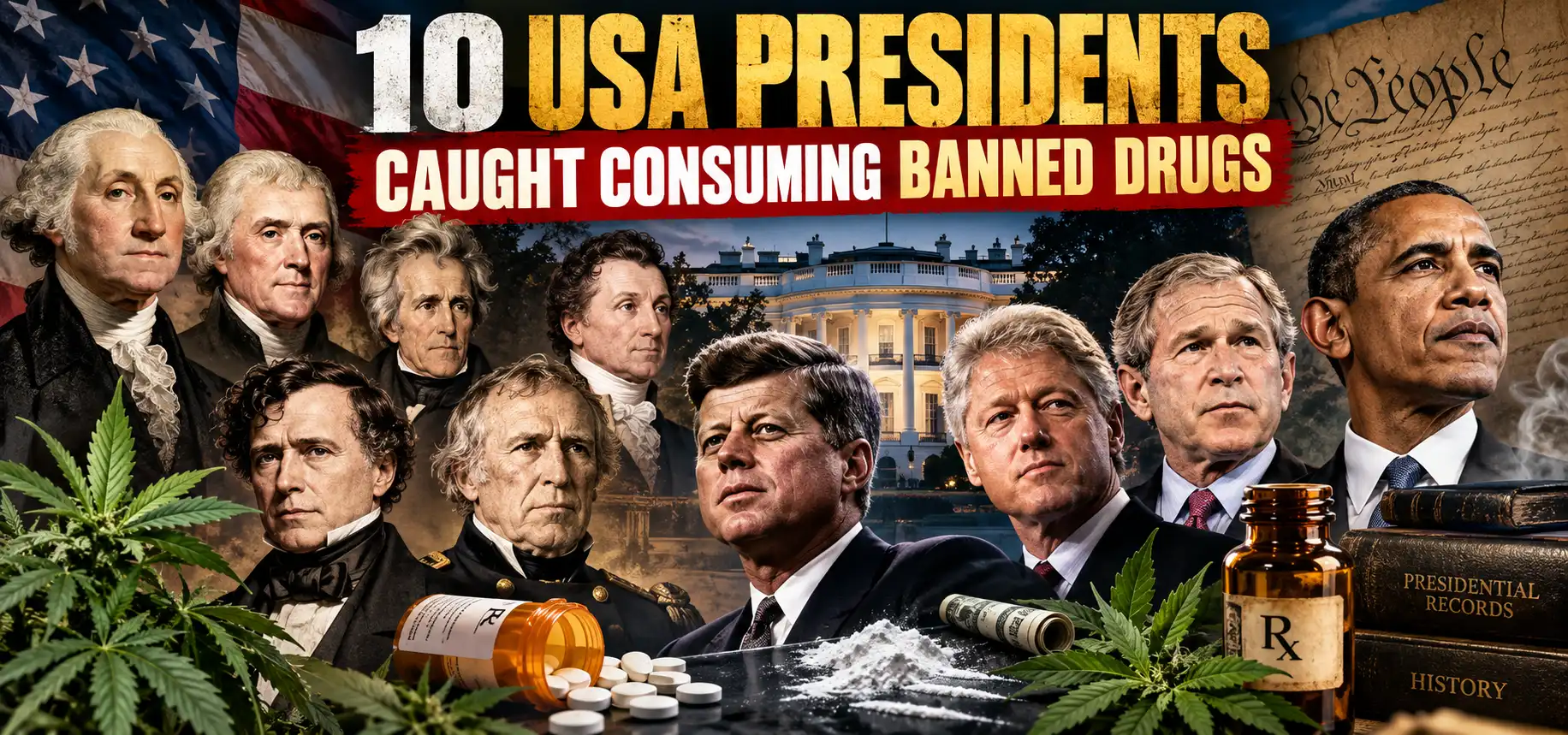
But the reality is more nuanced than the phrase “10 USA presidents caught consuming banned drugs” suggests.
Barack Obama, Bill Clinton and George W. Bush have the clearest modern records of marijuana experimentation before becoming president. John F. Kennedy’s medical treatment provides one of the strongest historical examples involving amphetamine-containing drugs.
Franklin Pierce, Zachary Taylor, Andrew Jackson and James Monroe are associated with older cannabis stories, but the evidence varies considerably in strength.
George Washington and Thomas Jefferson are especially important because their names demonstrate how historical drug myths can emerge from genuine facts—hemp cultivation, European travel and old agricultural records—and turn into claims that the evidence does not actually establish.
So the most accurate conclusion is not that ten presidents were literally “caught” breaking modern drug laws.
It is that American presidential history contains a surprising number of documented admissions, medical drug treatments, historical associations and persistent myths involving substances that Americans later came to regulate or prohibit.
And that distinction is exactly what makes the subject worth investigating.
The real story is not simply about presidents and drugs.
It is about how America’s definition of an “illegal drug” has changed—and how the private lives of the people who occupied the Oval Office sometimes reflected those changes long before the public was ready to talk about them.