Today, nootropic supplements are sold for focus, memory, mental energy, stress management, productivity and healthy brain aging. Some contain synthetic compounds, while others rely almost entirely on herbs, mushrooms, tea-derived compounds and traditional botanical extracts.
The natural category is particularly interesting.
Ingredients such as Bacopa monnieri, lion’s mane mushroom, Rhodiola rosea, Ginkgo biloba and L-theanine have moved from traditional medicine or food culture into modern cognitive-health products. They now appear in everything from capsules and powders to mushroom coffees, productivity drinks and “brain health” formulas.


Caffeine is probably the most familiar natural cognitive enhancer on this list.
It is found naturally in coffee beans, tea leaves, cacao, guarana and several other plants. Unlike many fashionable nootropic ingredients, caffeine has been part of everyday human diets for centuries.
It is also one of the clearest examples of how a familiar food compound can become a nootropic ingredient.
Caffeine primarily works by blocking adenosine receptors in the brain.
Adenosine is a signaling molecule associated with sleep pressure and reduced alertness. By interfering with adenosine’s action, caffeine can make people feel more awake and less fatigued.
That is why caffeine-based nootropics are usually marketed around:
Unlike many herbal extracts, caffeine can produce noticeable effects relatively quickly.
This is one reason it appears so frequently in pre-workout formulas, energy drinks, focus supplements and productivity products.
Caffeine is particularly interesting because it is often paired with other natural ingredients.
The most famous combination is caffeine + L-theanine, generally inspired by the natural combination of compounds found in tea.
A 2025 systematic review and meta-analysis examined randomized controlled trials involving tea, L-theanine and combinations of L-theanine plus caffeine. The researchers found evidence of small-to-moderate improvements in some short-term cognitive and mood outcomes, although the magnitude varied between tests and uncertainty remained.
More caffeine does not necessarily mean better concentration.
High intake can cause:
The timing also matters. A supplement taken late in the day may improve alertness temporarily while making it harder to sleep later.
And poor sleep can undermine cognitive performance more substantially than a stimulant can compensate for it.
Bottom line: Caffeine is one of the most established natural nootropic ingredients for short-term alertness, but its benefits are closely tied to dose, tolerance and timing.

If caffeine is the stimulant side of the natural nootropic world, L-theanine is often presented as its calmer counterpart.
L-theanine is an amino acid naturally found in tea, particularly Camellia sinensis.
It has become extremely popular in modern focus supplements because manufacturers frequently combine it with caffeine.
The ingredient is commonly marketed for:
The interest comes partly from the way tea feels different from a high-caffeine energy drink.
Tea contains both caffeine and L-theanine, along with numerous other compounds. Researchers have therefore investigated whether L-theanine can influence attention and mood independently or when combined with caffeine.
A 2026 systematic review and meta-analysis of 31 randomized trials involving 1,168 participants found that a single 200 mg dose of L-theanine produced a statistically significant improvement in choice reaction time, suggesting a short-term attention benefit. The researchers described the overall effect on acute stress as modest and noted uncertainty around several other outcomes.
A separate 2025 meta-analysis of randomized trials reached a more cautious conclusion: L-theanine appeared beneficial for some cognitive measures, but effects were not consistent across every test.
This is where L-theanine becomes particularly relevant to nootropic formulas.
The combination has been studied for attention and task performance, and a 2025 systematic review found some short-term advantages for the combination compared with placebo.
However, this should not be interpreted as proof that every “focus” capsule containing the two ingredients will produce the same result.
Extract quality, dose, caffeine content and the user’s baseline tolerance all matter.
Bottom line: L-theanine is one of the most recognizable natural focus ingredients, with increasingly interesting evidence for short-term attention, particularly in combination with caffeine.

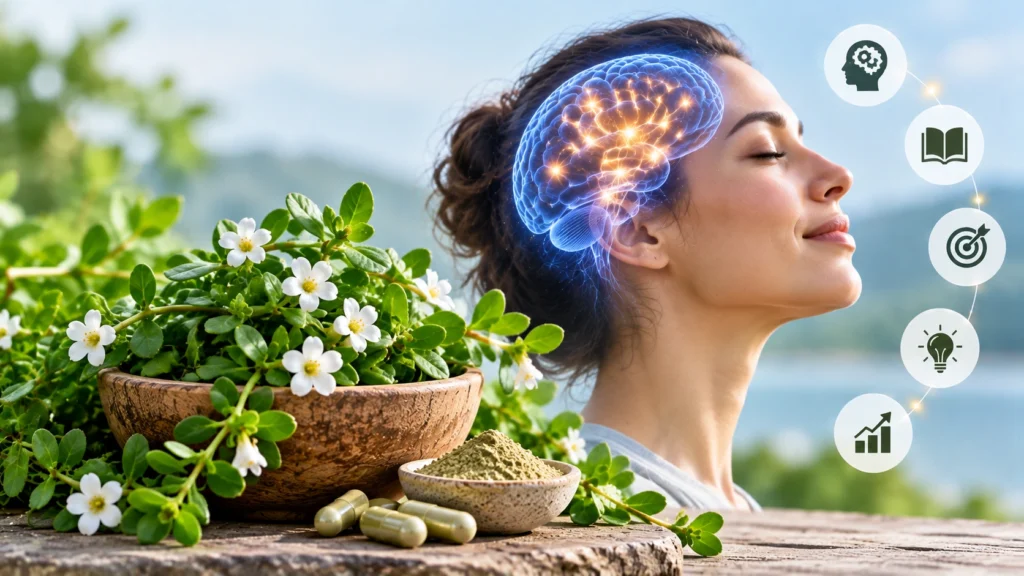
Few herbs have a stronger reputation in the natural nootropics market than Bacopa monnieri.
Known as Brahmi in traditional Ayurvedic medicine, Bacopa has a long history of use in traditional systems of health care.
Modern supplement companies generally market it around memory, learning and cognitive performance.
Bacopa contains compounds called bacosides, which have been investigated for their potential effects on neuronal signaling, antioxidant activity and other biological pathways.
Unlike caffeine, Bacopa is not typically positioned as an instant stimulant.
Instead, many clinical studies have examined supplementation over several weeks.
That distinction matters.
Consumers sometimes expect natural nootropics to work like caffeine, producing an obvious effect within an hour. Bacopa research generally does not fit that model.
An earlier meta-analysis of nine studies involving 518 participants found evidence that Bacopa could improve certain measures of cognition, particularly speed of attention.
The evidence became even more interesting in 2026.
A network meta-analysis published in Phytomedicine examined 29 randomized controlled trials involving 2,107 healthy adults. It compared different doses of Bacopa and Ginkgo and reported that higher-dose Bacopa was associated with better working-memory outcomes than lower-dose Bacopa, Ginkgo and placebo in the included analyses.
Another 2026 network meta-analysis examining plant-active substances in healthy older adults placed Bacopa-containing interventions among the more promising approaches for executive function and language-related outcomes, although the researchers emphasized the need for further work on dose and long-term safety.
Not every Bacopa product is equivalent.
The amount of bacosides, extraction method, plant material and formulation can vary substantially.
That means a clinical trial involving a standardized extract cannot automatically be used to predict the effect of every Bacopa capsule sold online.
Bottom line: Bacopa is one of the most scientifically interesting herbal nootropics, particularly for memory and attention, but its effects are generally studied over time rather than as an instant stimulant.

Ginkgo biloba is another veteran of the natural brain-health market.
The tree itself is ancient, while ginkgo leaves have been used in traditional medicine for centuries.
Modern supplements commonly promote standardized Ginkgo extracts for:
Ginkgo leaves contain flavonoids and terpene lactones that have been investigated for antioxidant, vascular and neurological effects.
The theory behind Ginkgo as a cognitive supplement partly involves blood flow and neuronal protection.
But the human evidence is more complicated than supplement advertising often suggests.
A meta-analysis specifically examining healthy people found no significant positive effects of Ginkgo on memory, executive function or attention.
An earlier systematic review similarly concluded that controlled trials in healthy individuals did not demonstrate marked or consistent improvements in objective cognitive measures.
That is an important counterweight to the ingredient’s popularity.
The latest evidence is particularly interesting because researchers have now compared the two directly through network meta-analysis.
The 2026 analysis found stronger results for higher-dose Bacopa than Ginkgo on several memory measures among healthy adults.
That does not make Ginkgo useless.
It means consumers should distinguish between:
“widely used”
and
“consistently demonstrated to improve cognition in healthy people.”
Those are not the same thing.
Bottom line: Ginkgo remains one of the most recognizable natural nootropic ingredients, but evidence for cognitive enhancement in healthy adults is inconsistent.

Panax ginseng, particularly Asian or Korean ginseng, has been used in traditional medicine for generations.
It is one of the world’s best-known botanical supplements and is commonly associated with energy, resilience, concentration and mental performance.
Its major active compounds are called ginsenosides.
Ginseng is often marketed as an adaptogenic or performance-supporting botanical.
Unlike a traditional stimulant, it is generally positioned as something that may support mental and physical function without relying on a strong stimulant effect.
Research has examined ginseng in areas including:
A 2024 systematic review and meta-analysis examined 15 randomized controlled trials involving 671 participants. It found a statistically significant effect on memory, particularly at higher doses, but did not find positive effects on overall cognition, attention or executive function. The authors concluded that more high-quality research is needed.
More recent research has continued to examine ginseng in people with cognitive impairment, with some studies suggesting potential benefits for certain cognitive measures.
“Ginseng” is not necessarily one standardized product.
Species, extraction methods, ginsenoside composition, dose and duration can differ considerably.
That is one reason two products carrying the same broad ingredient name may not behave identically.
Bottom line: Panax ginseng is a major natural nootropic ingredient with promising evidence for certain memory outcomes, but the evidence does not support broad claims that it improves every aspect of cognition.

Rhodiola rosea occupies a slightly different niche.
Rather than being marketed purely as a memory enhancer, it is frequently positioned around mental fatigue, stress resilience, energy and performance.
That makes it particularly attractive to students, athletes, professionals and people working long hours.
The plant is sometimes described as an adaptogen, although “adaptogen” is a broad marketing and pharmacological term rather than a guarantee of clinical effectiveness.
Common claims include:
A systematic review of Rhodiola for physical and mental fatigue identified 11 controlled studies. Some reported benefits, but the review found methodological weaknesses and concluded that the evidence was contradictory.
Another systematic review found possible benefits for mental and physical performance but noted a lack of independent replication.
More recent research has focused heavily on exercise performance and physiological outcomes rather than purely cognitive enhancement. A 2025 meta-analysis, for example, examined Rhodiola’s effects on endurance performance and related biomarkers.
The appeal is straightforward.
Modern nootropics increasingly target productivity under pressure, not simply memory.
A compound that might help with fatigue or stress therefore fits the modern nootropic category even if it does not dramatically improve IQ or memory scores.
Bottom line: Rhodiola is best viewed as a fatigue- and stress-oriented natural nootropic rather than a proven universal memory enhancer.

Few ingredients have experienced as much recent attention in the wellness industry as lion’s mane mushroom, scientifically known as Hericium erinaceus.
It appears in:
Its popularity comes partly from research into compounds called hericenones and erinacines, which have been investigated for their potential influence on nerve-growth-related pathways.
The central theory is that compounds in lion’s mane may influence pathways involved in neuronal growth and maintenance.
That has created considerable excitement around memory and brain health.
But human evidence is still developing.
A 2023 randomized, double-blind pilot study examined lion’s mane in 41 healthy young adults. Participants received 1.8 grams per day for 28 days. Researchers reported faster performance on a Stroop task 60 minutes after a single dose, while the longer-term cognitive and mood findings were more complicated.
This is promising—but it is not enough to establish lion’s mane as a clinically proven cognitive enhancer.
Lion’s mane has a compelling story:
Those characteristics make it highly marketable.
But consumers should distinguish between preclinical mechanisms, small human trials and large clinical evidence.
They are not interchangeable.
Bottom line: Lion’s mane is one of the fastest-growing natural nootropic ingredients and has intriguing biological and early human evidence, but larger and longer clinical trials are still needed.

Ashwagandha, or Withania somnifera, is another Ayurvedic botanical that has moved rapidly into mainstream wellness products.
It is often marketed for stress, sleep, recovery and overall mental performance rather than as a conventional “memory pill.”
That distinction is important because stress itself can affect concentration and cognitive performance.
Common claims involve:
Several randomized trials have examined its potential cognitive effects.
A 2021 randomized, double-blind, placebo-controlled study involved 130 healthy adults with elevated perceived stress. Participants receiving a standardized sustained-release ashwagandha extract for 90 days showed improvements in certain memory measures, stress scores, sleep quality and psychological well-being compared with placebo.
A more recent randomized placebo-controlled study examined 600 mg/day of ashwagandha root extract for eight weeks in adults reporting cognitive and energy problems. The researchers assessed cognition, mood, mental fatigue and executive function.
This may be where ashwagandha’s nootropic appeal is strongest.
Rather than directly stimulating the brain, it may influence factors that affect cognitive performance indirectly—particularly stress and sleep.
That does not mean everyone taking ashwagandha will suddenly experience sharper memory.
It means the ingredient’s potential role may be broader than simple stimulation.
Natural does not mean universally appropriate.
Ashwagandha can interact with medications and may not be suitable for everyone, including certain people with thyroid, autoimmune or liver-related concerns.
Consumers with medical conditions or those taking medication should discuss concentrated herbal extracts with a qualified healthcare professional.
Bottom line: Ashwagandha is increasingly used in nootropic formulas where stress, sleep and mental performance overlap, with some encouraging clinical evidence but important individual safety considerations.

Saffron may seem like an unusual addition to a nootropic list.
It is better known as one of the world’s most expensive culinary spices.
Yet Crocus sativus has attracted substantial scientific interest for mood, anxiety and cognitive health.
The key compounds include crocin, crocetin and safranal.
The modern nootropic industry is gradually moving away from the idea that cognitive performance means only “more focus.”
Mood, emotional well-being and sleep are increasingly treated as part of overall brain health.
Saffron fits this broader model.
A 2024 systematic review examined 46 randomized controlled trials involving saffron and neurological or psychiatric outcomes. The review reported potential benefits for cognition, depression, anxiety and sleep, although the included populations and conditions varied substantially.
A 2026 GRADE-assessed meta-analysis of 34 randomized controlled trials involving 1,769 adults found significant reductions in some depression and anxiety measures, while also noting substantial heterogeneity and a lack of significant effects on several clinician-rated scales. The authors rated the certainty of evidence as moderate overall.
Earlier systematic reviews of saffron and cognition have been more cautious, pointing out that many cognitive studies were small and potentially at risk of bias.
Saffron illustrates how the definition of a nootropic is changing.
The goal is increasingly not simply:
“Make me concentrate harder.”
It is:
“Help me function mentally while supporting mood and overall brain health.”
That broader approach explains why saffron has started appearing in premium cognitive-health formulas.
Bottom line: Saffron is a promising natural ingredient for mood-related and potentially cognitive outcomes, but the evidence is still evolving and should not be confused with proof that saffron treats psychiatric or neurological diseases.

The final ingredient is Gotu kola, scientifically known as Centella asiatica.
It has a long history of traditional use in Asian medicine and has attracted interest for its potential effects on memory, anxiety, stress and neurological function.
Gotu kola is not as commercially dominant as caffeine, Bacopa or lion’s mane, but it appears in natural cognitive formulas and belongs to the broader family of botanical ingredients studied for nootropic effects.
Research has investigated its potential role in:
A review of botanicals with potential nootropic effects identified Gotu kola alongside Bacopa, Ginkgo, ginseng, holy basil, lemon balm and several other herbs as part of the natural cognitive-enhancement research landscape.
The important limitation is that the human evidence is less extensive than for some of the better-established ingredients on this list.
That makes Gotu kola an interesting emerging or supporting ingredient, rather than one that should be treated as a proven cognitive enhancer.
Gotu kola fits the current direction of the natural nootropics market.
Consumers are increasingly interested in formulas combining multiple botanicals rather than relying on a single stimulant.
Gotu kola may therefore appear alongside ingredients such as Bacopa, Rhodiola, Ginkgo or L-theanine.
But multi-ingredient formulas create their own scientific problem: when someone feels better after taking a five- or six-ingredient product, it becomes difficult to determine which component caused the effect.
Bottom line: Gotu kola has a long traditional history and interesting preliminary research, but its cognitive evidence remains less developed than that of several leading natural nootropic ingredients.

The biggest misconception surrounding natural nootropics is the assumption that a plant-derived ingredient must be safer or more effective than a synthetic one.
Science does not work that way.
A compound’s origin tells us where it came from.
It does not tell us:
The FDA also makes an important distinction in the United States: dietary supplements are regulated differently from drugs and are not approved by the FDA for safety and effectiveness before they reach the market.
That means consumers should be cautious about claims such as “FDA-approved nootropic” or “FDA-approved brain supplement.”
For dietary supplements, that language can be misleading.

A better approach is to evaluate the ingredient rather than the marketing story.
Animal research can help explain mechanisms, but human trials are much more relevant to consumers.
The strongest evidence usually comes from randomized controlled trials and systematic reviews.
“Bacopa” is not a complete description of a supplement.
Look for information about:
The same principle applies to ginseng, Rhodiola, Ginkgo and other botanical extracts.
A company might say an ingredient:
“supports neurogenesis” or “increases BDNF.”
Even if a laboratory study supports a biological mechanism, that does not automatically demonstrate improved memory, concentration or productivity in humans.
The final question should always be:
Did people actually perform better in controlled human studies?
The brain is not a computer that can simply be “optimized” by adding the correct capsule.
Sleep, physical activity, nutrition, stress, hydration and underlying medical conditions all influence cognitive performance.
A supplement may contribute to a specific outcome without transforming overall mental performance.
Safety depends on the ingredient, dose, formulation and individual.
Even common natural substances can have pharmacological effects.
Caffeine can disturb sleep.
Herbal extracts can interact with medications.
Some botanical supplements can affect blood pressure, blood glucose or liver enzymes.
And multi-ingredient nootropic formulas can make it difficult to determine which ingredient is responsible for either a benefit or an adverse reaction.
Another problem is product quality.
The ingredient studied in a clinical trial may be a standardized extract manufactured under controlled conditions. A commercially available supplement may use a different extraction method, different concentration or different combination of ingredients.
So the statement:
“There is a study showing that Bacopa works.”
is incomplete.
The more useful question is:
“Does the specific Bacopa extract and dose in this product resemble the preparation that was studied?”
That is the level of detail serious supplement research requires.

The natural nootropics industry is changing.
The first generation of products largely focused on stimulation:
energy + caffeine + focus.
The newer generation is broader:
focus + memory + stress + mood + sleep + healthy aging.
That explains the growing presence of ingredients such as lion’s mane, saffron and ashwagandha alongside older cognitive botanicals.
Recent research also reflects this shift.
A 2025 systematic review and network meta-analysis examined 19 natural extracts and cognitive outcomes in healthy adults, looking separately at global cognition, attention, memory, executive function and cognitive flexibility. The researchers found that effects differed considerably depending on the extract and cognitive domain rather than identifying one universal natural cognitive enhancer.
That is probably the most useful way to think about the category.
There is no single “best natural nootropic” that reliably improves every aspect of cognition.
Different ingredients appear to have different evidence profiles.
Caffeine is primarily associated with alertness and acute performance.
L-theanine has growing evidence for attention, particularly in combination with caffeine.
Bacopa has a more memory-focused evidence base.
Ginkgo remains widely used but has inconsistent evidence in healthy adults.
Ginseng shows some evidence for memory but not uniformly for broader cognition.
Rhodiola is more closely associated with fatigue and stress-related performance.
Lion’s mane has promising but still early human research.
Ashwagandha may be particularly relevant where stress, sleep and cognitive performance overlap.
Saffron is increasingly interesting for mood and potentially cognitive health.
Gotu kola remains a traditional botanical with an emerging evidence base.
Natural nootropics are no longer a niche corner of the supplement industry.
They have become part of the broader consumer conversation around brain health, focus, memory, productivity, stress and healthy aging.
The 10 ingredients discussed here—caffeine, L-theanine, Bacopa monnieri, Ginkgo biloba, Panax ginseng, Rhodiola rosea, lion’s mane mushroom, ashwagandha, saffron and Gotu kola—represent some of the most recognizable natural compounds and botanicals encountered in modern nootropic products.
But their evidence is not equal.
Some have substantial human research behind specific outcomes. Others remain promising but preliminary. And even when an ingredient has positive clinical evidence, the result from one standardized extract cannot automatically be transferred to every capsule, powder or mushroom coffee on the market.
That is why the smartest way to evaluate a natural nootropic is not to ask whether it is “natural.”
Ask:
What exactly is the ingredient?
What dose was studied?
Was the research conducted in humans?
Was the extract standardized?
What cognitive outcome actually improved?
How long did participants take it?
What are the known risks and interactions?
Those questions cut through much of the hype.
And they reveal something important about the modern nootropic market: the most interesting ingredients are not necessarily the ones making the loudest promises. The strongest candidates are the ones where traditional use, plausible biological mechanisms and carefully conducted human research begin to overlap—but where the limits of that evidence are still clearly acknowledged.