WholeLeaf MigroHeal is an Indian plant-based topical roll-on marketed for headache, migraine and sinus-related discomfort. Unlike traditional pain balms that usually come in a jar or tube, MigroHeal uses a compact roll-on format designed for direct application to areas such as the temples, forehead and back of the neck.
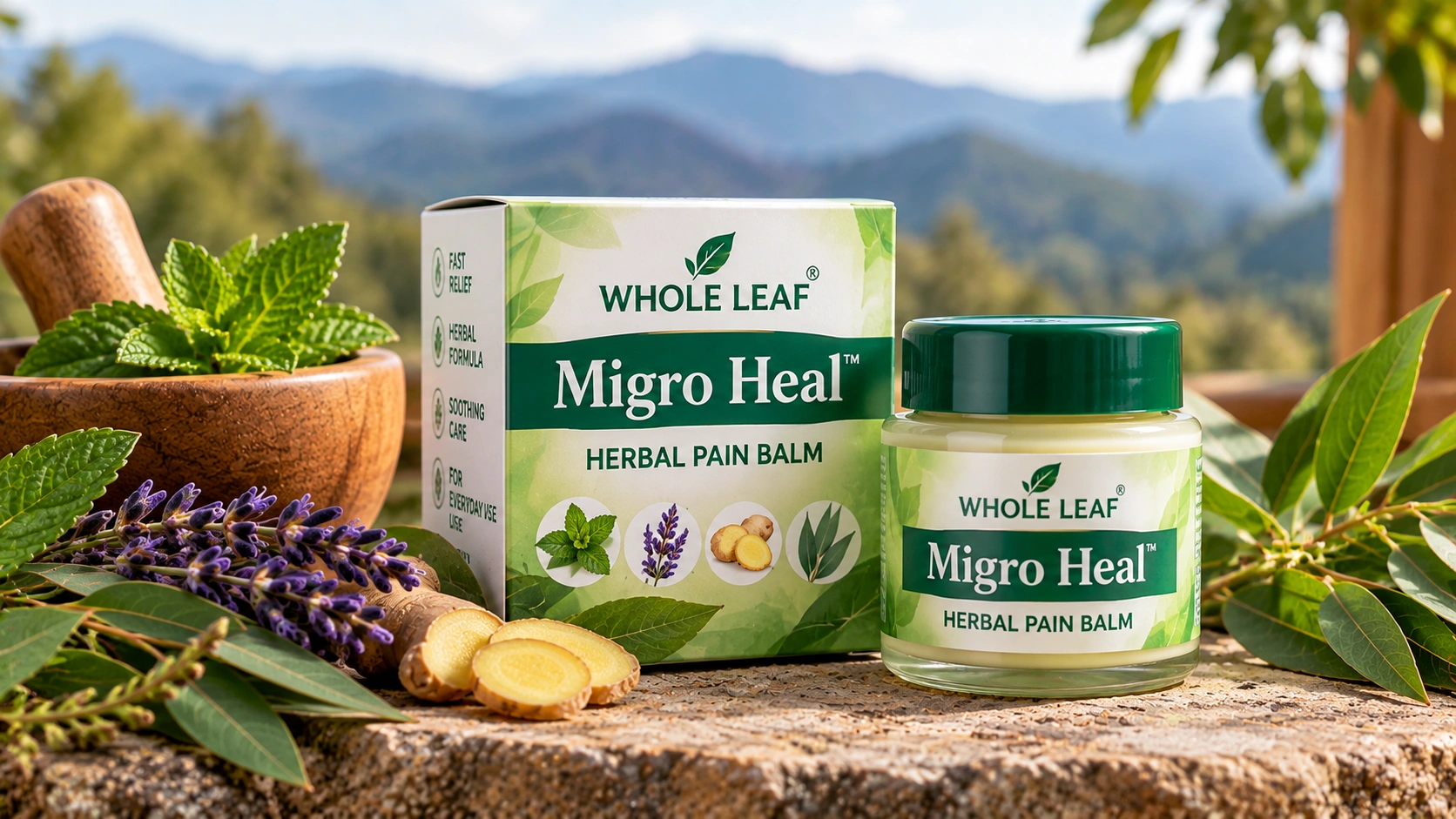

WholeLeaf is a comparatively young consumer-health and wellness company when compared with heritage balm brands such as Tiger Balm, Zam-Buk and Aboniki.
The company has built its identity around plant-based topical products rather than conventional pharmaceutical painkillers.
Publicly available information does not provide a detailed, independently documented founding history comparable to the century-old brands in the traditional medicated-balm category. This is worth mentioning because many online articles can make young wellness companies appear older or more established than the available evidence actually demonstrates.
What can be verified from current product and marketplace information is that the business behind the brand is Whole Leaf Organics Private Limited, with its address listed in New Delhi, India.
The company currently sells several topical wellness products through its own online store and through Indian e-commerce and pharmacy platforms.
The current official WholeLeaf product page identifies Wholeleaf Organics Pvt. Ltd. as the manufacturer of MigroHeal.
Apollo Pharmacy also lists Whole Leaf Organics Private Limited as the manufacturer/marketer for its MigroHeal headache and migraine product.
The product is manufactured in India.
This gives WholeLeaf a different identity from multinational pain-relief brands that manufacture across multiple countries.
WholeLeaf’s current model is much closer to the modern Indian direct-to-consumer wellness business: develop a focused product line, manufacture domestically, sell online and build awareness through social media and digital creators.
MigroHeal is specifically positioned around headaches and migraines.
The current WholeLeaf product page describes it as a “Headache & Migraine Relief” roll-on and identifies tension headaches, sinus headaches and cluster headaches among the conditions it is marketed toward.
The product is designed to be applied to the temples and forehead, with the company also recommending application to the back of the neck in some product-bundle instructions.
The 10 ml roll-on is designed to be portable, making it particularly suitable for consumers who want to carry a headache product in a handbag, backpack, office drawer or travel kit.
MigroHeal is not the company’s only topical product.
WholeLeaf’s current topical collection includes:
This portfolio approach is commercially important.
Rather than trying to make one balm suitable for every type of discomfort, WholeLeaf creates separate products for different pain categories.
That gives the company more opportunities to appear in online searches for specific consumer problems.
MigroHeal is currently available through the WholeLeaf website and Indian online retailers.
Apollo Pharmacy lists the product, while Flipkart marketplace listings also show the 10 ml roll-on.
Third-party international marketplaces have listings for customers outside India as well.
WholeLeaf also says its broader topical range is available through more than 2,000 stores nationwide.
That claim is made by the company and should be treated as a company-reported distribution figure rather than independently audited retail data.

MigroHeal is marketed as a plant-powered formula.
The current official product page lists:
Apollo Pharmacy’s current product information identifies hemp leaf extract, sesame oil and Pudina Satwa among its key ingredients, while the official WholeLeaf page uses the term “Vijaya leaf extract.” This difference in terminology is worth noting because Vijaya is a traditional Indian term associated with cannabis.
Consumers should therefore rely on the ingredient and regulatory information printed on the specific package they purchase.
The most distinctive ingredient in MigroHeal’s marketing is Vijaya leaf extract.
Vijaya is a traditional name used in India for cannabis. WholeLeaf presents the ingredient as part of its plant-based formulation.
This does not necessarily mean that the product is equivalent to a cannabis medicine or contains a clinically significant amount of psychoactive THC.
Those are separate questions that depend on the exact extract, its chemical composition, concentration, manufacturing process and regulatory status.
Consumers should not assume that a product containing “Vijaya leaf extract” will produce cannabis-like effects.
Sesame oil serves as an oil-based carrier in topical formulations.
It allows other ingredients to be dispersed and helps create a product that can be applied to the skin.
Sesame oil is also commonly used in Ayurvedic topical preparations.
People with a known sesame allergy should check the label carefully before using products containing sesame oil.
Pudina is the Hindi term commonly used for mint.
Pudina Satwa is a concentrated mint-derived preparation used in traditional Indian formulations.
Mint’s most familiar compound is menthol, which can activate cold-sensitive sensory receptors and create a cooling sensation.
That cooling sensation may temporarily alter how a person perceives headache or facial discomfort.
Kapur refers to camphor in traditional Indian terminology.
Camphor is widely used in topical balms and oils because it produces a noticeable cooling, warming or tingling sensation.
It interacts with sensory receptors in the skin and can change the way local discomfort is perceived.
Camphor should not be swallowed and should be kept away from children.
Wintergreen oil is naturally rich in methyl salicylate.
Methyl salicylate is used in many topical products for temporary relief from minor muscle and joint discomfort.
It creates a characteristic warming or stimulating sensation and can act as a counter-irritant.
Because methyl salicylate is pharmacologically active, more is not necessarily better. Users should follow the product’s directions and avoid applying it to broken skin or near sensitive areas unless the label specifically permits it.
The cooling experience is likely to come largely from the aromatic ingredients, particularly mint-derived compounds and camphor.
When these compounds activate sensory receptors, the nervous system interprets the signal as cooling or refreshing.
This can be especially appealing for headache products because consumers often associate cooling sensations with comfort.
However, the sensation of cooling does not prove that inflammation has been reduced or that the underlying cause of a migraine has been treated.

WholeLeaf says MigroHeal works by combining Vijaya leaf extract with Ayurvedic herbs to influence pain receptors and provide relief.
The company’s website also says the product may reduce the recurrence of headaches by addressing underlying inflammation.
These claims should be interpreted carefully.
Headache and migraine are not simply caused by one area of muscle tension or skin inflammation.
Migraine involves complex interactions among the brain, trigeminal nerve pathways, blood vessels, neuropeptides and sensory processing.
A topical roll-on applied to the temples does not directly treat every biological mechanism involved in migraine.
What it may do is provide a local sensory input that changes how the person experiences pain.
This is similar to the reason cooling products, menthol rubs and aromatic preparations can feel soothing even when they do not remove the underlying cause of a headache.
Menthol and camphor can influence sensory receptors involved in temperature and irritation.
These signals travel through peripheral nerves and are processed by the nervous system.
In some people, the competing sensory input may reduce the perceived intensity of pain.
This is sometimes described as a counter-irritant effect.
It does not mean the underlying migraine mechanism has been permanently changed.
The Vijaya component requires particular care in how it is described.
Cannabis contains many chemical compounds, including cannabinoids such as THC and CBD.
The presence of a cannabis-derived plant extract does not automatically mean that a topical product has psychoactive effects.
Topical application also produces very different exposure than inhaling or ingesting cannabis.
For a consumer product, the important questions are the exact extract used, cannabinoid content, concentration, regulatory approval and laboratory testing.
Those details should be checked on the current product label rather than inferred from the word “Vijaya.”
WholeLeaf markets MigroHeal for several headache-related situations.
The current official product information says it can be used for:
The company also states that consistent use may reduce the frequency of migraine episodes.
That is a stronger claim than simply saying the roll-on provides temporary comfort.
There is currently insufficient independent evidence publicly available to conclude that MigroHeal itself prevents migraine attacks in the way established preventive migraine medications do.
That distinction is particularly important for readers searching for “MigroHeal migraine prevention.”
Tension headaches are often associated with pressure or tightness around the head and may occur alongside neck or shoulder tension.
A topical roll-on applied around the temples or neck may feel soothing because of its cooling and aromatic properties.
For occasional tension-type headaches, some people may find this sensory effect useful as part of their personal comfort routine.
Mint and camphor aromas can create a subjective sensation of easier breathing or freshness.
That can make aromatic topical products appealing when congestion accompanies head discomfort.
However, the product should not be considered a treatment for a sinus infection.
Migraine is more complex than an ordinary headache.
Some people experience throbbing pain, nausea, vomiting, sensitivity to light or sound and visual disturbances.
Because migraine is a neurological condition, recurrent attacks should be evaluated by a healthcare professional, especially if they are becoming more frequent or severe.
A roll-on may be used as a comfort measure, but it should not replace appropriate migraine treatment when medical care is needed.

The official WholeLeaf instructions recommend applying a small amount to the temples and forehead and gently massaging until absorbed.
Some current WholeLeaf bundle instructions also recommend applying the roll-on to the back of the neck.
The company says it can be used at the onset of a headache and also recommends repeated daily use for chronic symptoms.
However, users should follow the instructions printed on their current product packaging.
Avoid contact with the eyes and other sensitive areas.
Wash your hands after application if necessary, particularly before touching your eyes.
If redness, burning, rash or significant irritation develops, stop using the product.
Apollo Pharmacy specifically advises pregnant and breastfeeding women to consult a physician before using the product.

The roll-on format is one of MigroHeal’s strongest marketing assets.
Instead of carrying a jar of balm, users can carry a small 10 ml bottle.
This makes the product easy to use at work, while traveling, during commutes or when studying.
WholeLeaf’s marketing repeatedly emphasizes portability and convenient application.
WholeLeaf describes MigroHeal as a plant-powered formula.
This is important because many consumers actively search for terms such as “natural migraine relief,” “herbal headache remedy” and “Ayurvedic headache relief.”
The brand’s use of Vijaya, Pudina and Kapur gives it a distinct identity compared with pharmaceutical headache medicines.
Traditional oils can leave an oily residue.
MigroHeal’s roll-on format is promoted as non-greasy and easy to apply.
This is a practical benefit for office workers and consumers who want to use a headache product without touching their hands to the product.
Recent Instagram activity shows MigroHeal being promoted by wellness and lifestyle creators.
Several posts in 2025 and 2026 use short-form video content around recurring headaches, migraine discomfort and the convenience of carrying the roll-on.
Some creator posts use very strong language, including describing the product as a “permanent solution.”
That language should be treated as promotional content, not established medical evidence.
The brand itself does not have the same evidentiary burden as an influencer’s personal claim, and consumers should distinguish the two.
MigroHeal fits naturally into content aimed at busy professionals, students and people who spend long periods in front of screens.
A small roll-on can be positioned as something to keep in a work bag or desk drawer.
That makes the product relevant to a common modern headache trigger: demanding routines and prolonged screen time.
WholeLeaf has created bundles that combine MigroHeal with its other pain products.
Its current Head & Back Pain Relief Kit, for example, combines MigroHeal with Flexomove Back Pain Spray.
The company also offers a Whole Body Relief Pack combining several topical products.
This is a classic direct-to-consumer strategy because it increases the number of products in each order.
WholeLeaf does not market MigroHeal in isolation.
The company presents itself as a broader natural pain-management brand.
A consumer who first purchases MigroHeal for headaches may later encounter products for joint pain, back pain, muscle stiffness or menstrual discomfort.
This creates opportunities for repeat purchases and customer retention.
The official MigroHeal page currently displays 189 reviews.
The page reports that 72% of the displayed ratings are five-star reviews, 23% are four-star, 4% are three-star and 1% are one-star.
Third-party marketplaces show additional customer feedback, including both positive and negative experiences.
This is useful because it shows that consumer experiences are not universally identical.
However, customer reviews cannot establish clinical efficacy because they are uncontrolled and subject to placebo effects, selection bias and differences in the underlying cause of each person’s headache.

Many traditional pain balms are marketed for almost everything.
MigroHeal is more specific.
Its name and packaging immediately communicate that it is intended for headaches and migraines.
That focused positioning makes it easier for consumers to understand the product.
The roll-on format removes the need to scoop balm out of a container.
It also allows users to apply a controlled amount directly to the intended area.
Mint and camphor provide an immediate cooling or refreshing sensation.
For headache sufferers, that sensation can feel reassuring even if it does not treat the underlying neurological cause.
WholeLeaf’s use of terms such as Vijaya, Pudina, Kapur and Ayurvedic super-herbs makes the product appealing to consumers interested in traditional Indian wellness.
This differentiates it from mainstream pharmaceutical products.
Consumers can purchase MigroHeal directly from WholeLeaf or through online pharmacies and marketplaces.
This is particularly useful for a young brand that does not have the decades-long physical retail presence of older healthcare companies.
Hundreds of reviews across marketplaces and the brand website provide social proof.
Although reviews are not clinical evidence, they can influence purchasing decisions significantly.

MigroHeal competes in a slightly different category from traditional pain creams because it specifically targets headaches and migraine discomfort.
Its competitors include:
Amrutanjan is one of India’s strongest heritage competitors.
Its name has been associated with headache balms for generations.
Amrutanjan’s biggest advantage is brand recognition.
MigroHeal counters with a more modern roll-on format and a natural bio-active positioning.
Moov is primarily known for muscle and joint pain, but its broader topical pain portfolio means it competes for consumers who want convenient topical relief.
Its major advantage is massive Indian brand recognition.
Dr. Ortho is another Indian herbal pain-relief brand with strong online visibility.
Its positioning around Ayurvedic and herbal ingredients overlaps with WholeLeaf’s natural approach.
Pure or blended peppermint roll-ons are perhaps the closest conceptual competitor.
They are marketed specifically around cooling sensations and headache comfort.
WholeLeaf differentiates MigroHeal through a more complex formulation and the addition of Vijaya, camphor and wintergreen oil.
Prescription and over-the-counter migraine medicines are also indirect competitors.
These include medicines such as NSAIDs, acetaminophen, triptans and newer migraine-specific treatments.
They should not be treated as equivalent products because they work through different mechanisms and have different evidence, indications and safety considerations.

This is one section where reliable reporting requires caution.
WholeLeaf does not publicly disclose an audited standalone 2026 revenue figure for MigroHeal.
Therefore, claims about exact annual sales or company revenue should not be presented as established fact unless supported by financial statements or official disclosures.
WholeLeaf’s official website currently lists the 10 ml MigroHeal roll-on at ₹399.
A two-pack is currently listed at ₹679, compared with an MRP of ₹798.
Prices can change because of promotions, marketplace discounts and retailer-specific offers.
The official WholeLeaf product page currently displays 189 customer reviews.
Third-party marketplace listings also show hundreds of ratings.
A Desertcart listing, for example, currently shows hundreds of reviews for the 10 ml product.
These figures indicate that MigroHeal has achieved meaningful online consumer activity.
They do not reveal the number of units sold.
WholeLeaf’s current website states that its products are available at 2,000+ stores nationwide.
MigroHeal is also listed by online pharmacies such as Apollo Pharmacy and marketplaces such as Flipkart.
This combination of offline distribution and digital sales gives the brand a broader reach than a purely online startup.
Not accurately.
For example, knowing that a product sells for ₹399 does not tell us how many units are sold, how much retailers retain, how many discounts are applied or how much the company spends on advertising.
A revenue estimate would require verified unit-sales data.
Therefore, the responsible 2026 conclusion is:
MigroHeal has an established online retail presence and growing distribution, but WholeLeaf does not publicly disclose a verified standalone annual revenue figure for the product.

This section is particularly important because the product is marketed for migraine, a medical condition rather than ordinary muscle soreness.
There is scientific evidence supporting some of the mechanisms of individual ingredients used in topical headache products.
For example, peppermint oil has been studied for tension-type headache, and menthol’s action on cold-sensitive receptors is well established.
Camphor also interacts with sensory receptors.
Capsaicin has substantial scientific literature around pain signaling, although MigroHeal’s current headache roll-on is not the same thing as a high-concentration capsaicin treatment.
However, there is an important evidence gap.
Ingredient evidence is not the same as clinical evidence for the finished MigroHeal product.
To establish that MigroHeal prevents migraine attacks or reduces their frequency, researchers would ideally conduct randomized, controlled clinical trials comparing the finished product with placebo or another established treatment.
Publicly available information located for this article does not establish a large independent randomized controlled trial demonstrating that MigroHeal prevents migraine.
That does not prove the product cannot help an individual.
It simply means the strength of evidence should not be overstated.

The manufacturer states that MigroHeal is suitable for daily use and recommends application two to three times per day in some product instructions.
However, “natural” does not automatically mean risk-free.
Topical botanical products can cause irritation or allergic reactions in some people.
The current Apollo Pharmacy listing advises stopping use if redness or a rash occurs and recommends medical advice for pregnant or breastfeeding women.
Users should also avoid the eyes and use the product only externally.
If headaches are occurring frequently, becoming more severe or changing in character, relying on a roll-on every day without identifying the underlying problem may delay appropriate medical care.
A sudden, extremely severe headache, headache accompanied by neurological symptoms, fever with neck stiffness, confusion, fainting or other serious symptoms requires urgent medical attention rather than self-treatment with a topical product.
WholeLeaf MigroHeal is a modern Indian plant-based topical roll-on designed primarily for headache, migraine and sinus-related discomfort.
It is manufactured in India by Whole Leaf Organics Private Limited and sold through the company’s own website, online pharmacies and e-commerce marketplaces.
The current product is available in a convenient 10 ml roll-on format, with the official WholeLeaf website listing the single pack at ₹399 and a two-pack at ₹679 at the time of research.
MigroHeal’s main differentiator is its formulation.
The company markets it around Vijaya leaf extract, sesame oil, Pudina Satwa, Kapur Satwa and wintergreen oil, together with excipients.
These ingredients give the product a distinctly herbal and cooling sensory profile.
Vijaya is particularly notable because it is a traditional Indian name associated with cannabis. However, consumers should not assume that the presence of Vijaya leaf extract means that the product is intoxicating or equivalent to ingesting cannabis. The actual chemical composition, cannabinoid concentration and regulatory status depend on the finished formulation.
Pudina and camphor contribute cooling and aromatic sensations, while wintergreen oil contains methyl salicylate, a compound widely used in topical preparations.
The company claims that MigroHeal provides fast relief and may reduce the recurrence of migraine episodes with regular use.
Those statements should be treated as manufacturer claims rather than established evidence that the product can prevent migraine.
There is good scientific evidence for some of the sensory mechanisms associated with ingredients such as menthol and camphor, and peppermint oil has been studied for certain types of headache.
But there is an important difference between research on individual ingredients and clinical research on the complete MigroHeal formulation.
Publicly available evidence reviewed for this article does not establish a large independent randomized clinical trial proving that MigroHeal prevents migraine attacks.
From a marketing perspective, the product has several advantages.
The roll-on format is portable, the application is clean, the cooling sensation is immediate, and the Ayurvedic positioning appeals to consumers who prefer natural products.
WholeLeaf also uses social media creators, customer reviews, product bundles and direct-to-consumer marketing to grow the brand.
Its current topical portfolio extends beyond MigroHeal into joint, back, muscle, stiffness and menstrual-pain products.
The company’s current website says its products are available through 2,000+ stores nationwide, while MigroHeal has accumulated substantial review activity on its own website and third-party marketplaces.
The strongest competitors include Amrutanjan, Moov, Dr. Ortho, herbal headache balms and peppermint-based roll-ons, while conventional migraine medicines represent a different and more medically established category of competition.
Financially, WholeLeaf does not publicly disclose a verified standalone 2026 revenue number for MigroHeal.
Current retail pricing and review activity show that the product has developed meaningful consumer traction, but those figures cannot be converted into reliable sales revenue without verified unit-sales information.
The most accurate way to describe MigroHeal in 2026 is as an emerging Indian plant-based headache and migraine topical product with growing online and offline distribution.
Its biggest strength is its combination of convenience, natural-ingredient branding and a distinctive roll-on format.
Its biggest limitation from an evidence perspective is that the marketing claims appear stronger than the publicly available independent clinical evidence for the finished product.
For occasional mild headache discomfort, some consumers may find the cooling and aromatic experience useful. But people experiencing frequent, severe or disabling migraines should not rely exclusively on MigroHeal or any other topical balm without discussing their symptoms with a qualified healthcare professional.
The larger story behind WholeLeaf MigroHeal is the changing Indian pain-relief market.
Consumers are increasingly looking for products that combine traditional herbs, modern packaging, portability and online convenience. MigroHeal is designed precisely for that market.
Whether WholeLeaf can turn its current digital traction into the long-term brand recognition enjoyed by India’s older headache and pain-relief companies will depend on continued product development, regulatory compliance, distribution and, most importantly, stronger independent evidence supporting the claims made for its formulations.

Watch expert-inspired short videos on health, wellness, nutrition, fitness, preventive care, and healthy living in under a minute.