Known for its unmistakable green jar, strong herbal aroma and compact size, Hong Thai is one of Thailand’s best-known ya dom, or traditional herbal inhalers. For years, it was an everyday item used by Thai students, office workers, commuters, drivers and travelers. Then social media changed everything.
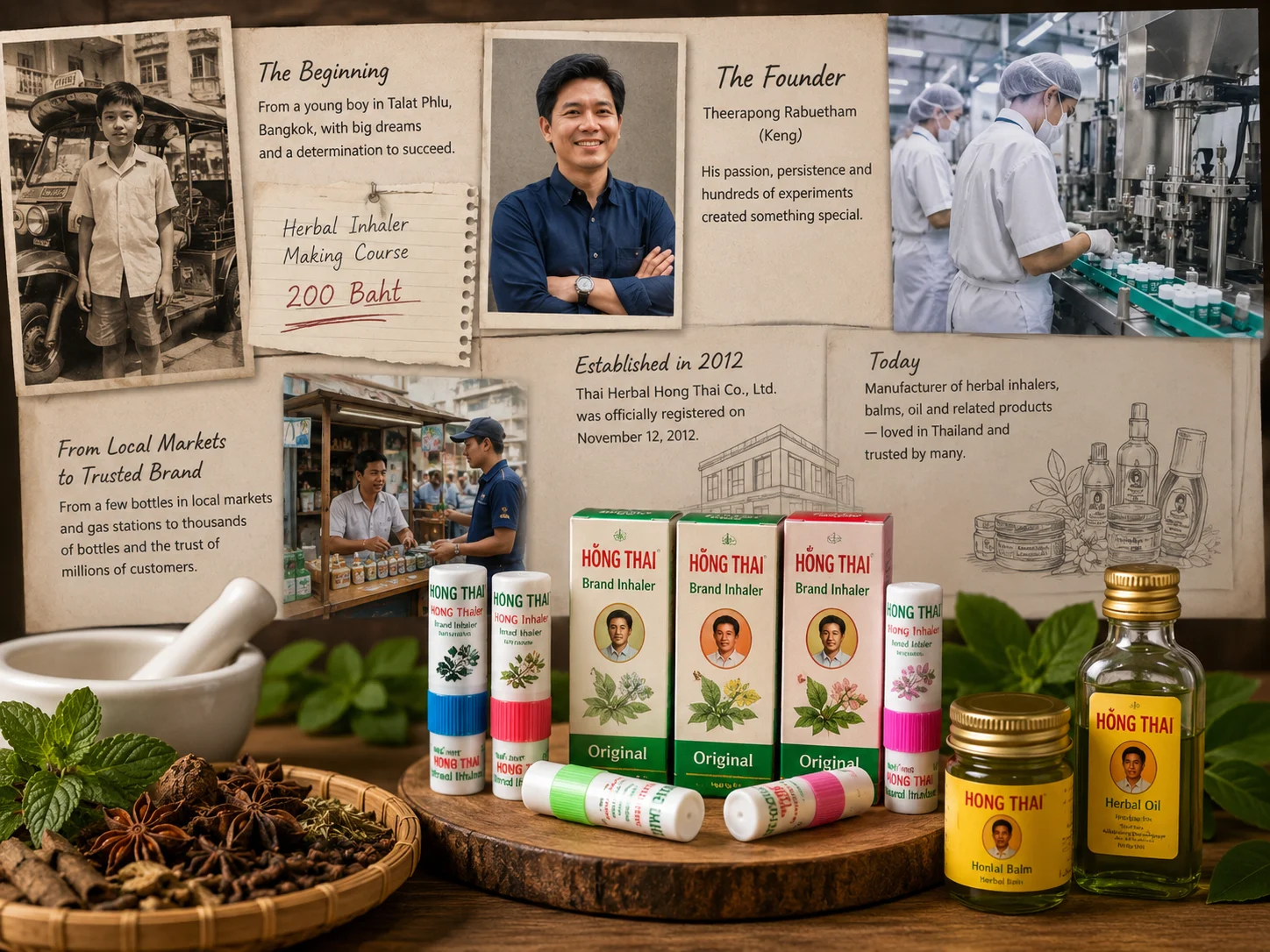
The founder of Hong Thai is Theerapong Rabuetham, commonly referred to as Keng.
His story is one of the strongest parts of the brand.
According to accounts published by Khaosod English and VnExpress, Rabuetham grew up in Bangkok’s Talat Phlu area in a poor family. His father worked as a taxi driver, his mother was a housewife, and he was one of six children. He began working at a young age and tried several different jobs before eventually entering the herbal-products business.
The turning point came when he saw a newspaper advertisement for a course on making herbal inhalers.
The course reportedly cost just 200 baht.
Rabuetham enrolled, learned the basics and began experimenting with his own formulas.
The first attempts were not immediate successes.
He sold products at local markets and gas stations, but demand was initially weak. At one point, he stopped producing them. Then a gas-station employee asked him why he had disappeared because customers had been asking for his products.
That moment convinced him that something about the product was working.
He returned to production and began refining the formula.
Khaosod reported that he experimented hundreds of times and continually adjusted the fragrance based on customer feedback.
That approach became central to the eventual Hong Thai brand.
Company information available through business and corporate sources identifies Thai Herbal Hong Thai Co., Ltd. as being registered in 2012, with Rabuetham as a major shareholder and director. A business analysis published by SCG Packaging, citing Thai corporate-data sources, reports that the company was registered on November 12, 2012.
This is an important distinction.
The founder’s business journey started earlier, while the corporate entity known as Thai Herbal Hong Thai Co., Ltd. was formally registered in 2012.
That explains why some online articles give different dates for the beginning of Hong Thai.
Rabuetham initially sold products in plain packaging.
The fragrance became the differentiator.
Customers remembered the smell and came back.
According to Khaosod’s account, orders eventually grew from small quantities to larger orders, including one order for around 600 bottles intended as souvenirs.
The company gradually expanded from inhalers into a wider range of herbal products, including balms and massage oils.
Today, Thai Herbal Hongthai describes itself as a manufacturer of herbal inhalers and related products.
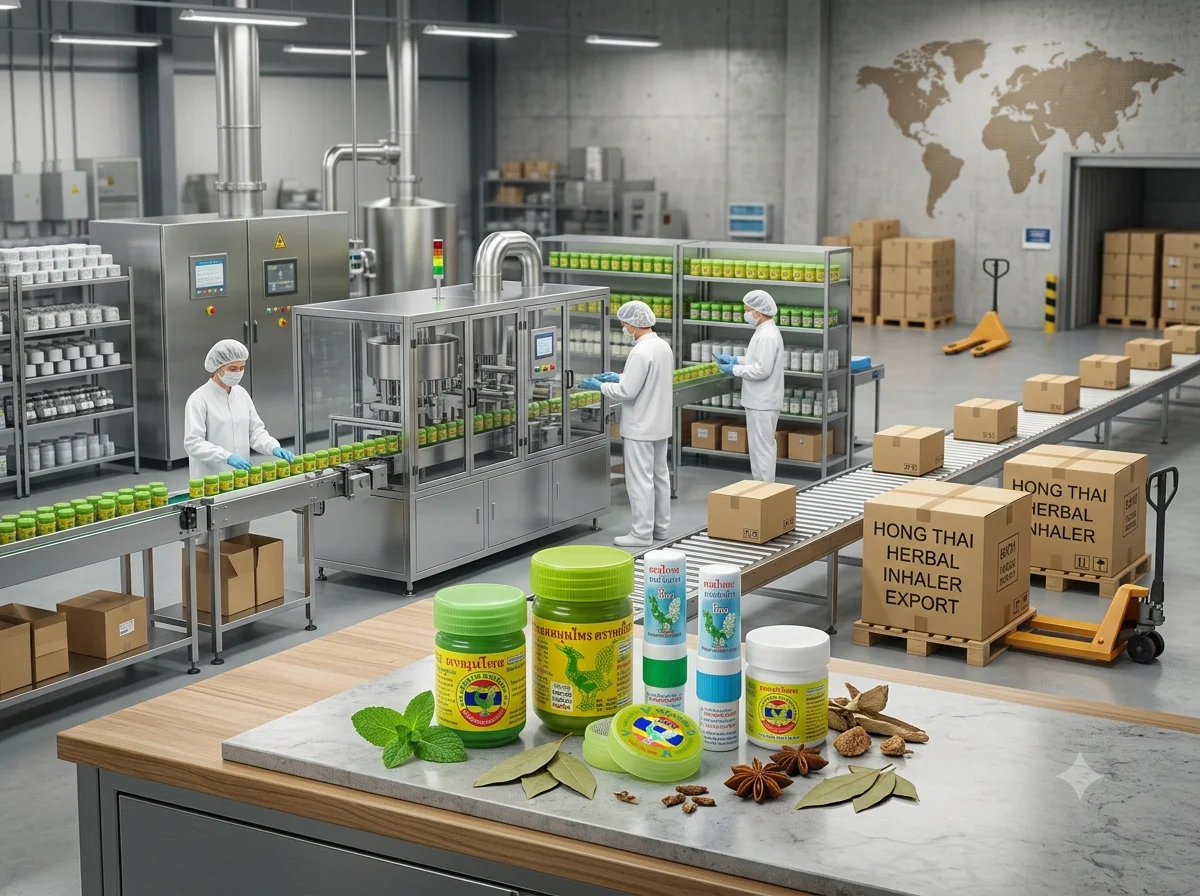
Hong Thai is a Thai-made product.
The company’s official website lists its headquarters at:
434 Phutthamonthon Sai 2 Road, Bang Phai, Bang Khae, Bangkok 10160, Thailand.
The company also lists an international distribution center in Phuket:
No. 112, 60 Patchamansion, Muang Phuket 83100, Thailand.
For North America, the company’s website lists a U.S. address in Wilmington, Delaware. This appears to function as a North American business/distribution presence rather than evidence of a U.S. manufacturing plant. The products themselves remain identified as made in Thailand.
In 2024, The Nation reported that Hong Thai was producing approximately 50,000 bottles per day and had announced plans for a new factory on a one-rai site with an investment of approximately 60 million baht.
The proposed expansion was expected to increase production capacity by two to three times.
That gives a sense of how dramatically the business had grown.
A company that started with a street vendor and small batches was now planning industrial-scale expansion.
Hong Thai’s international reach has expanded significantly.
The brand is now sold through distributors and retailers outside Thailand, including markets in Asia, Europe, North America and the Middle East.
Current international trademark activity also shows that Thai Herbal Hongthai is actively protecting the brand abroad. In 2025, the company filed HONG THAI and HONGTHAI BRAND trademark applications in Canada covering herbal inhalers, aromatherapy products, massage oils and related products.
A 2026 European distributor currently describes itself as an official Hungarian partner and says its Hong Thai products come directly from the Thai manufacturer.
This is important because Hong Thai is no longer simply a Thai souvenir.
It is becoming an international consumer brand.
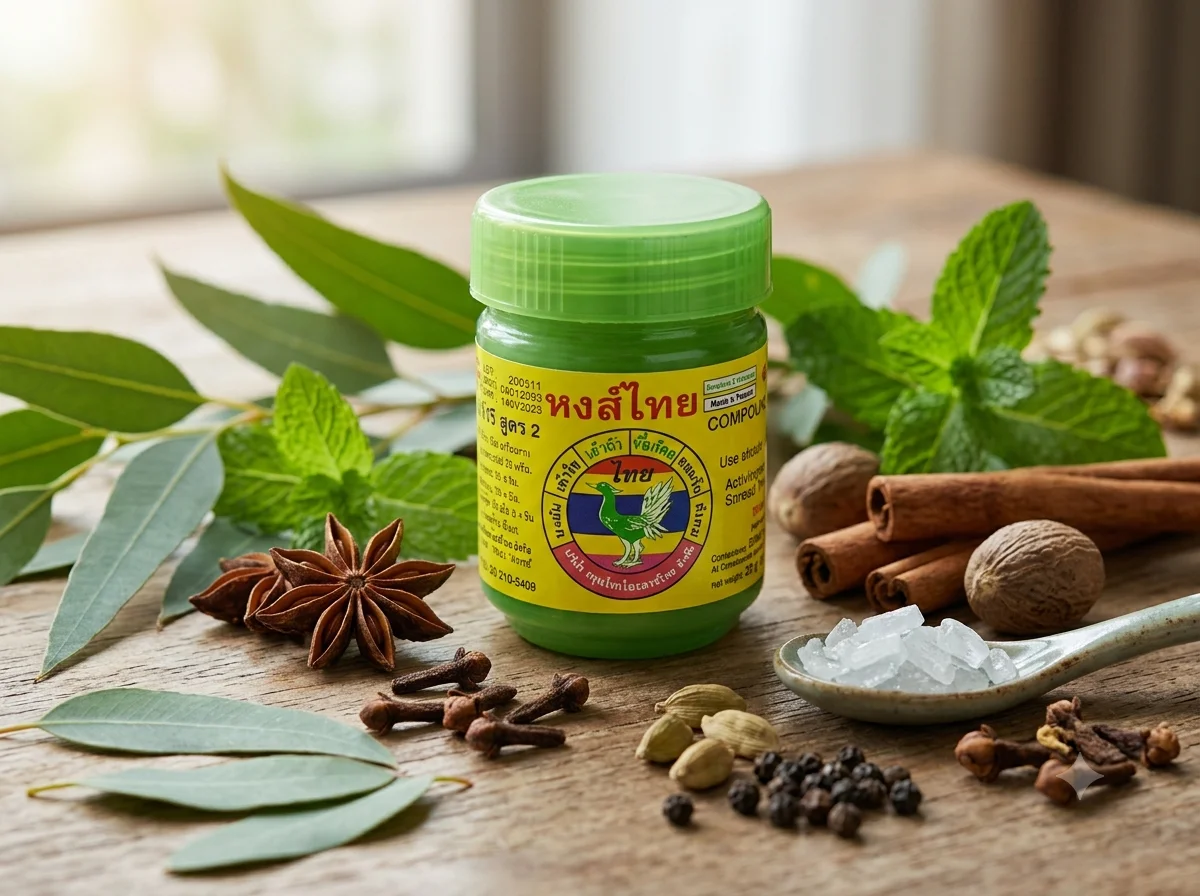
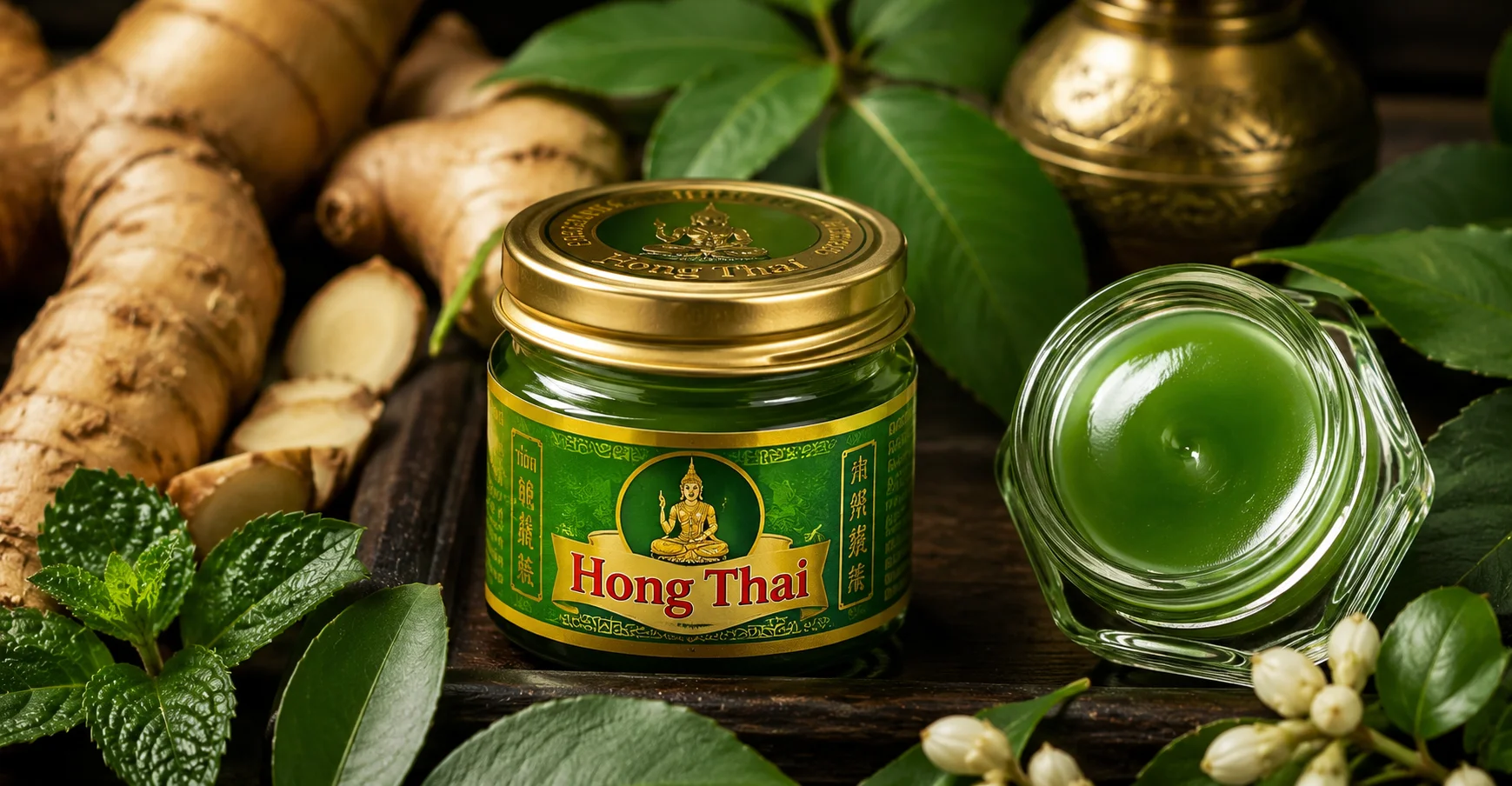
The Hong Thai Formula 2 green jar is the product most people associate with the brand.
Unlike a conventional inhaler containing only a menthol-soaked wick, Hong Thai uses a combination of aromatic compounds, essential oils and dried herbs.
Available product and registration information identifies four major quantified components:
A product listing for Formula 2 gives the following percentages:
Thai FDA records confirm that Hong Thai Compound Herbal Inhaler Formula 2 is registered under marketing authorization G 309/62, approved on August 19, 2019, with validity listed through August 18, 2029.
Menthol is probably the most recognizable ingredient in the formula.
It creates the intense cooling sensation people feel when they inhale Hong Thai.
Menthol interacts with cold-sensitive receptors in the sensory system, creating a feeling of coolness even when the actual temperature has not changed.
That sensation is one reason menthol is so common in inhalers, topical pain products, cough products and oral-care products.
Camphor gives Hong Thai its strong medicinal aroma.
It also contributes to the cooling and stimulating sensory experience associated with the inhaler.
Camphor is a traditional ingredient in many Asian topical and inhaled preparations.
However, concentrated camphor can be toxic if swallowed, and products containing it should be used according to their labeling.
Borneol is an aromatic compound commonly used in traditional Chinese and Southeast Asian medicine.
It contributes a distinctive cooling, camphor-like scent to the formula.
It also helps create the layered aroma that makes Hong Thai smell different from simpler peppermint inhalers.
Eucalyptus oil contributes the sharp, clean sensation that many people associate with open breathing.
Its aroma is particularly noticeable when inhaled.
Hong Thai’s combination of eucalyptus, menthol, camphor and borneol creates the strong first impression that has become central to the brand.
The dried herbs are what make the green Hong Thai jar particularly distinctive.
The company and retailers describe the product as containing around 15 types of dried Thai herbs, held inside a small mesh pouch within the container.
Online sources commonly identify ingredients such as aromatic flowers and spices, including:
However, this is an area where consumers should be careful.
The company treats the exact formula as part of its product identity, and online reseller lists are not necessarily official ingredient disclosures. For that reason, it is more accurate to describe Hong Thai as a proprietary blend of approximately 15 dried herbs rather than claim that every online ingredient list represents the current official formula.
Hong Thai’s own marketing describes its inhalers as products for:
The company says the inhaler can help users feel refreshed and alert.
The important distinction is that the cooling and aromatic sensation is not the same thing as treating the underlying medical cause of dizziness, congestion or headaches.
For a consumer-health article, Hong Thai is best described as a traditional herbal inhaler used for sensory refreshment and certain minor symptoms rather than as a substitute for medical treatment.
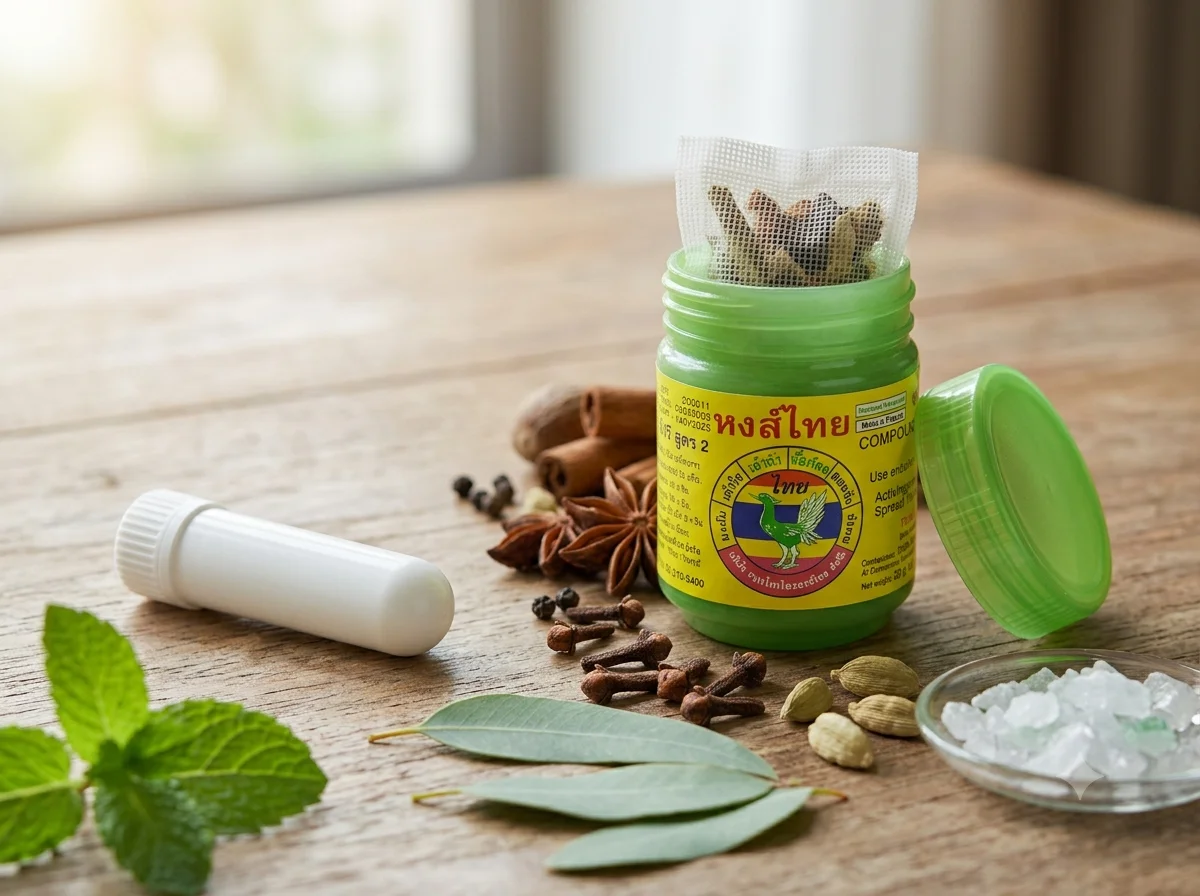
This is one of the most important reasons behind its success.
A traditional tube inhaler typically has a narrow shape and contains an absorbent material carrying aromatic oils.
Hong Thai’s green Formula 2 is different.
It uses a wide-mouth jar with a mesh pouch of dried herbs.
Open the lid and the scent comes from several layers at once.
First comes the sharp menthol and eucalyptus.
Then camphor and borneol.
Then the more complex herbal fragrance from the dried botanical mixture.
That sensory complexity has become part of the product’s identity.
Consumers don’t simply recognize the packaging.
They recognize the smell.
And that is extremely valuable for a consumer brand.
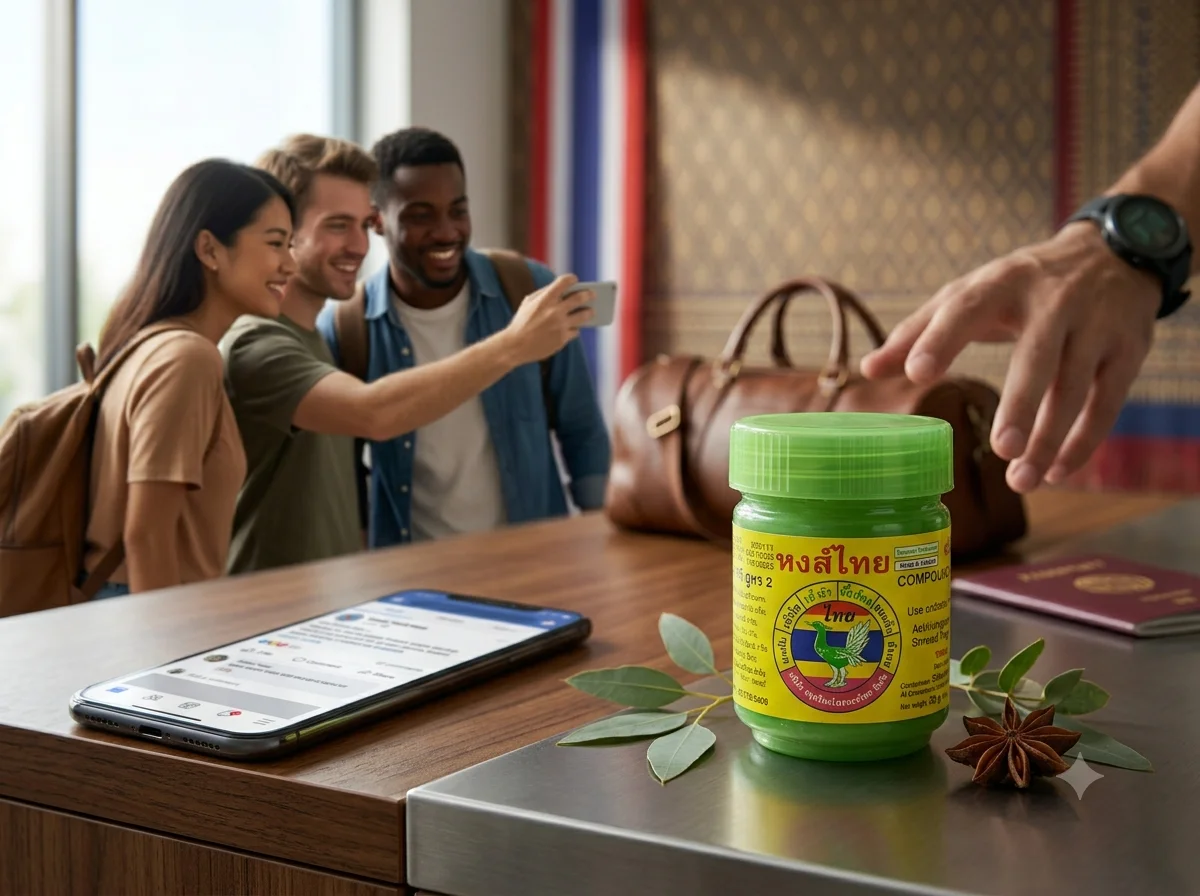
Hong Thai’s marketing story is unusual because the company has repeatedly emphasized word of mouth rather than traditional advertising.
According to a 2025 APEA post celebrating Thai Herbal Hong Thai’s Inspirational Brand Award, the company claimed it had achieved more than 300 million baht in revenue in 2024 without paying for traditional advertising, attributing its growth to customer recommendations and product experience.
Whether one describes that as “zero advertising” in an absolute sense requires caution, because modern brands can receive enormous exposure through social media, influencers, distributors and earned media without paying directly for each mention.
Still, the central point is clear:
Hong Thai’s biggest marketing engine has been people talking about the product.
The most famous example came in 2023.
BLACKPINK member Lisa, whose real name is Lalisa Manobal, was seen using a Thai herbal inhaler during her birthday celebrations.
The moment spread rapidly across social media.
Fans began searching for the product.
Hong Thai became one of the brands associated with the sudden international interest in Thai inhalers.
This was a classic example of earned celebrity exposure.
The company did not need to spend millions putting the product into a Hollywood movie.
A single highly visible celebrity moment created enormous curiosity.
The product was already inexpensive and easy to understand.
A consumer could see the green jar, search for it online and buy one without making a major financial commitment.
That is a perfect environment for viral commerce.
A luxury product might get millions of views but convert only a small percentage of viewers.
A low-cost pocket inhaler can turn curiosity into an immediate purchase.
Khaosod English reported that Hong Thai had also become associated with celebrities including Chris Hemsworth and Central Cee, further reinforcing its international image.
Again, this matters because the product was no longer perceived simply as an older Thai household remedy.
It became something internationally recognizable.
Hong Thai also gained visibility among Thai athletes during the Paris 2024 Olympics.
Khaosod reported that Thai Olympic athletes used the inhaler, adding another layer to the product’s image as something associated with alertness, relaxation and travel.
Sports exposure is particularly useful for a product like Hong Thai.
An inhaler is easy to carry, inexpensive and can be used before or after physical activity.
Hong Thai has also received recognition within Thailand.
Its official website lists awards including:
The company has also highlighted participation in Thailand’s National Herb Expo.
In 2025, Thai Herbal Hong Thai received the Inspirational Brand Award from the Asia Pacific Enterprise Awards (APEA).
These awards help reinforce the company’s story as a homegrown Thai brand rather than simply a mass-produced souvenir product.
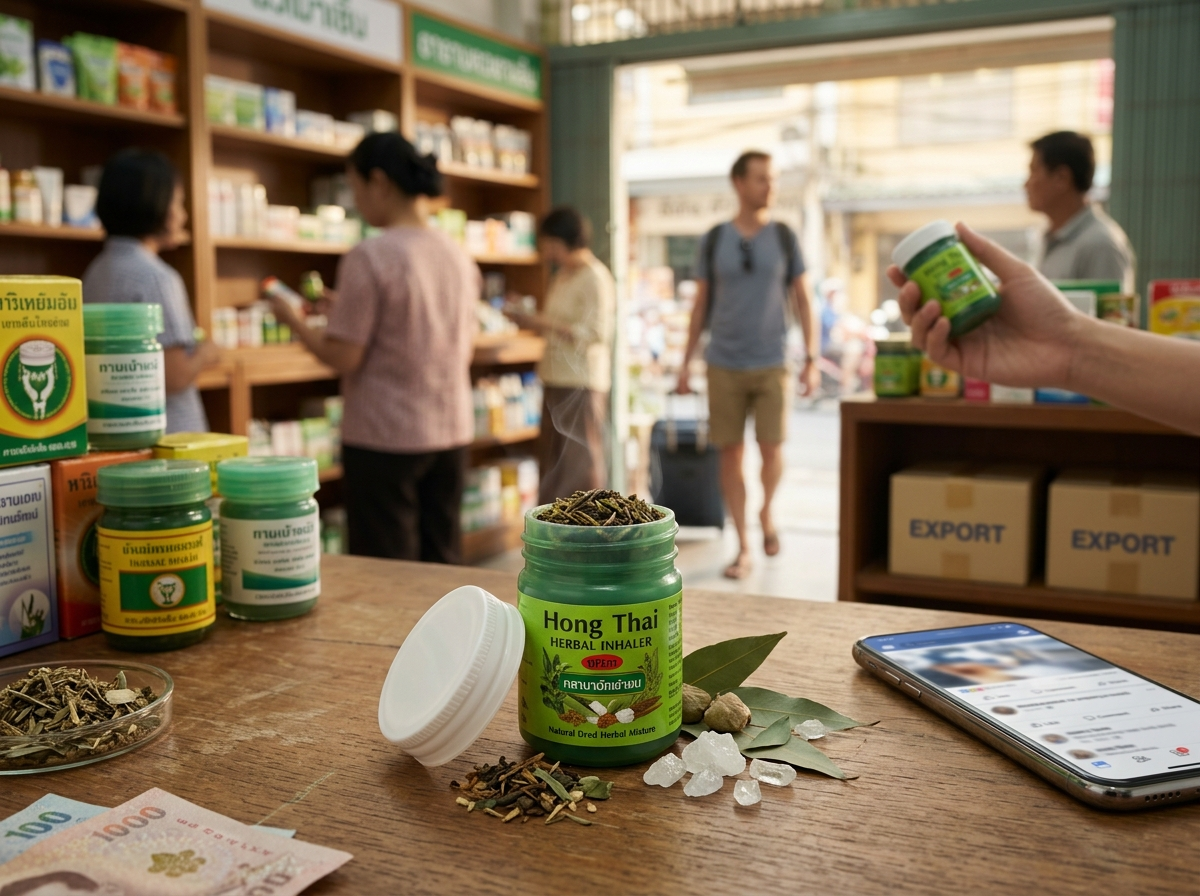
It would be inaccurate to say Hong Thai dominates the entire global inhaler market.
It does not.
Large pharmaceutical and consumer-health companies are much bigger worldwide.
But Hong Thai has developed a powerful position within the Thai herbal inhaler category, particularly for dry-herb jar-style inhalers.
There are several reasons.
The green jar is instantly recognizable.
That is an enormous advantage.
Most competing inhalers rely heavily on familiar menthol or peppermint aromas.
Hong Thai combines those sensations with dried herbs, camphor, borneol and eucalyptus.
The result is harder to copy precisely.
Thai herbal inhalers are inexpensive enough to become impulse purchases.
VnExpress reported that herbal inhalers commonly sell for around 20 to 50 baht, depending on the product.
Hong Thai is not just a product.
It has become associated with Thai daily life.
That makes it particularly attractive to tourists and international consumers interested in Thai culture.
The product’s success has largely been driven by users recommending it to other users.
That is especially powerful for a product based on scent.
You smell it once.
You remember it.
You tell someone else about it.
The Lisa effect took an established Thai product and gave it global visibility.
That is difficult for competitors to reproduce.
Hong Thai has actively pursued international trademarks and distribution.
The company’s 2025 Canadian trademark filings show that it is continuing to build legal protection for the brand outside Thailand.
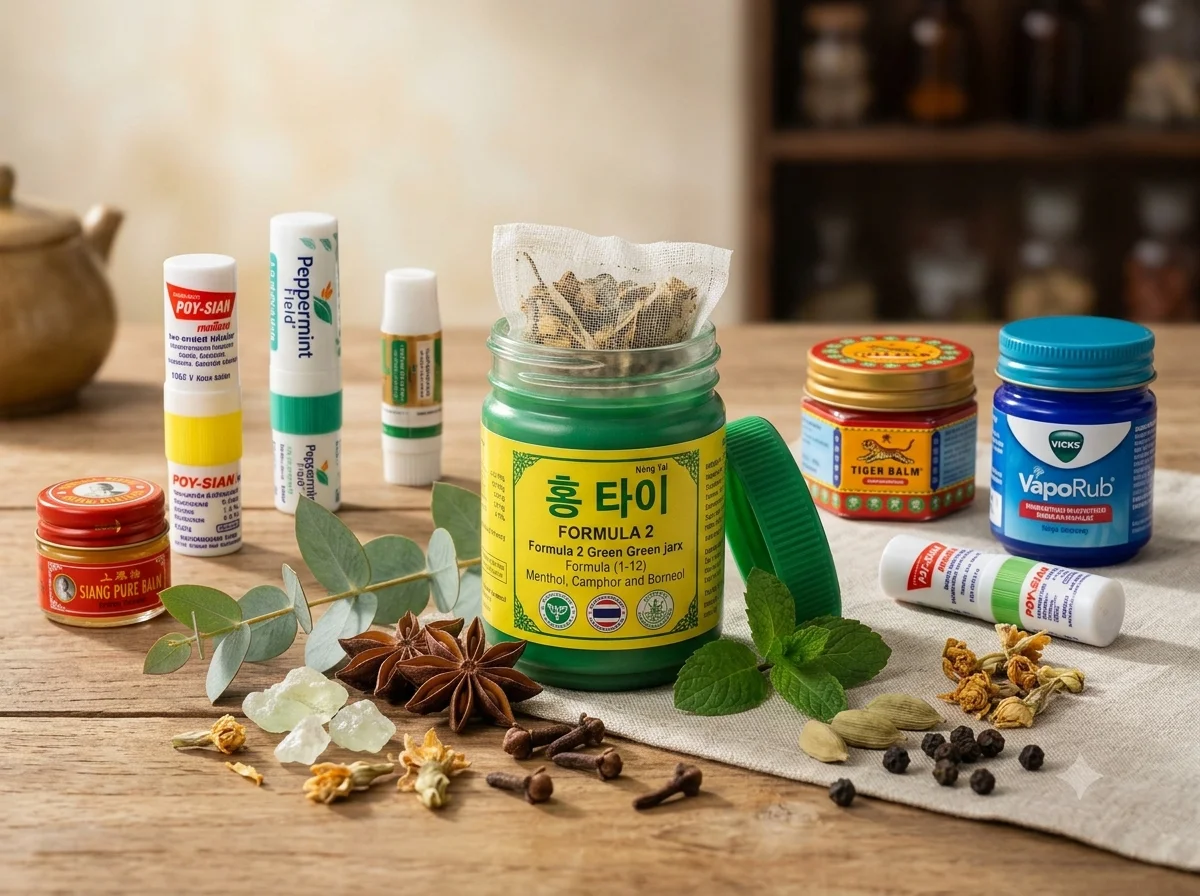
Hong Thai competes in a specialized category, so its competitors fall into several groups.
Poy-Sian is arguably Hong Thai’s strongest direct competitor in Thailand.
It is one of the country’s most recognizable traditional inhaler brands.
The main difference is product format.
Poy-Sian is famous for its compact two-ended tube, while Hong Thai’s signature product uses a jar with dried herbs.
Peppermint Field is another major Thai inhaler brand.
It is owned by Bertram (1958), the same company behind Siang Pure.
Peppermint Field focuses heavily on peppermint and refreshing aromas and has expanded into international markets.
Siang Pure is another major Thai consumer-health brand.
Its inhalers and medicated oils overlap with Hong Thai in the areas of refreshment, dizziness and everyday discomfort.
Siang Pure has a much longer corporate history, with its roots going back to 1958.
Tiger Balm is one of the most recognizable Asian topical-relief brands internationally.
It competes with Hong Thai in the broader traditional Asian wellness and topical-relief category, although Tiger Balm is primarily known for balms rather than dry-herbal inhalers.
Vicks represents the mainstream Western consumer-health competitor.
Its inhaled and mentholated products compete for consumers looking for congestion and respiratory comfort.
The positioning is very different, however.
Vicks is pharmaceutical-style consumer healthcare, while Hong Thai emphasizes Thai herbal tradition and sensory refreshment.
There are numerous smaller Thai inhaler brands competing on price, herbal formulas and local recognition.
This fragmented competition makes Hong Thai’s distinctive green jar particularly valuable.
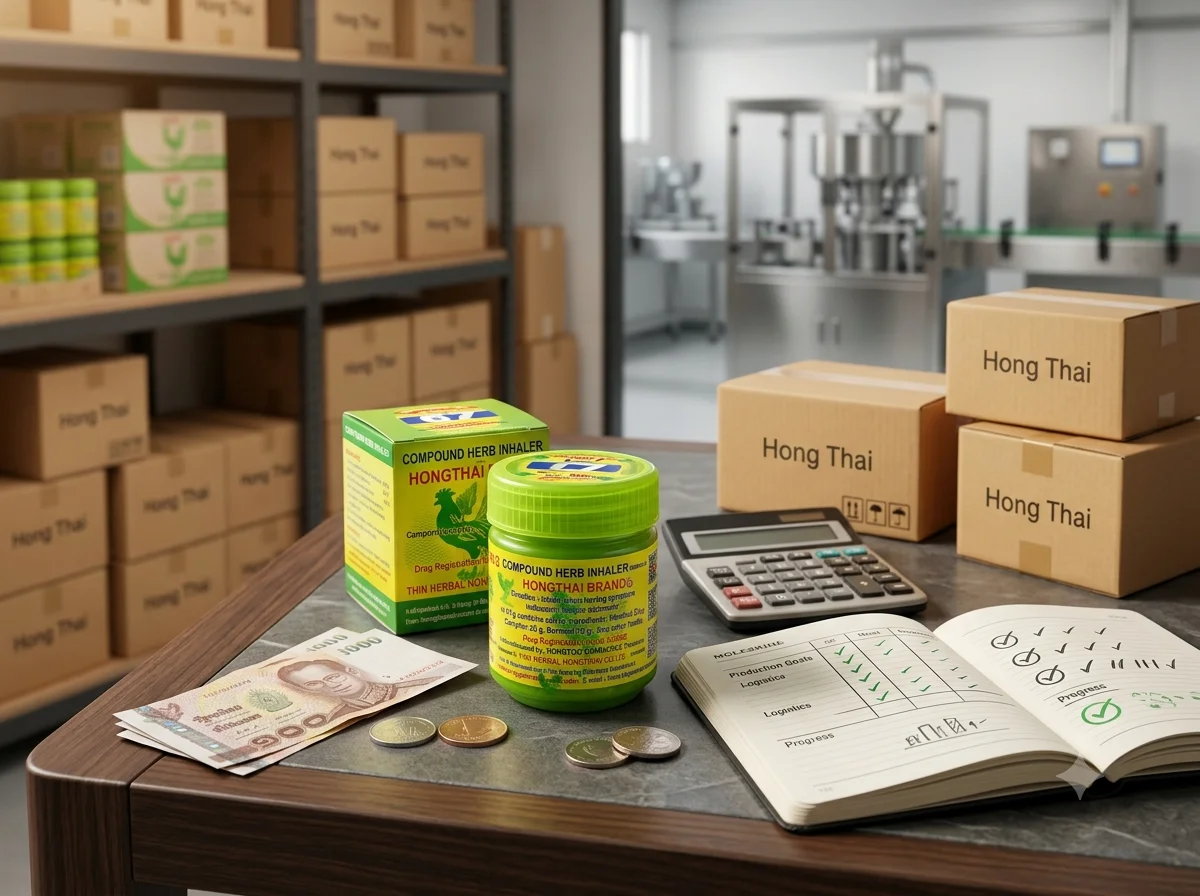
This is one of the areas where online information needs careful handling.
Thai Herbal Hong Thai is privately held, so there is no public stock-market filing providing a complete 2025 or 2026 audited revenue figure comparable to what you would find for a publicly traded multinational.
However, there are several useful data points.
A company analysis published through SCG Packaging’s platform, using data attributed to Thai corporate records, reported revenue of approximately:
17.82 million baht in 2020
with a loss of approximately 6.14 million baht.
The same source reported:
24.85 million baht revenue in 2021
with a loss of approximately 5.16 million baht.
Revenue reportedly jumped to:
62.72 million baht in 2022
with approximately 783,000 baht in profit.
That is a major increase compared with 2020.
The company’s growth accelerated dramatically.
In 2024, The Nation reported that Hong Thai was targeting 500 million baht in sales for 2024, compared with approximately 300 million baht in the previous year.
That suggests reported 2023 sales of around 300 million baht.
However, this should be described as a reported sales figure or company target context, not as audited public financial data.
A 2025 APEA announcement stated that Thai Herbal Hong Thai had achieved more than 300 million baht in revenue in 2024.
This is interesting because the company had previously announced a target of 500 million baht.
So the cleanest way to report the information is:
Hong Thai publicly discussed a 500 million baht sales target for 2024, while an APEA 2025 announcement said the company achieved more than 300 million baht in 2024.
There is no basis for claiming that the company actually reached 500 million baht unless stronger financial evidence becomes available.
There is currently no sufficiently reliable public source establishing audited 2025 or 2026 annual revenue.
That means an SEO article should not invent a 2026 revenue number.
The company was clearly still investing in expansion and manufacturing capacity, but the 2025 product-quality crisis complicates any simple growth narrative.
Any up-to-date 2026 article about Hong Thai that ignores the 2025 recall is incomplete.
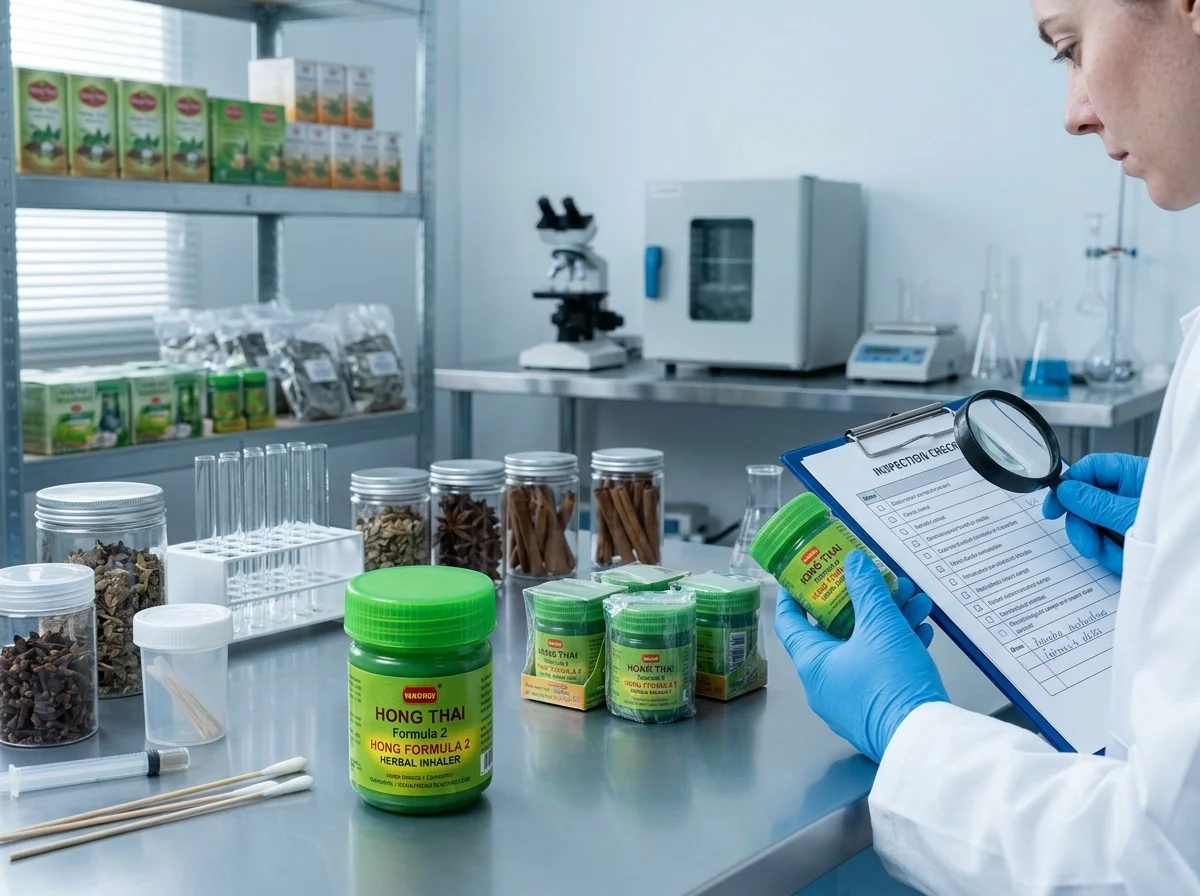
In October 2025, Thailand’s FDA reported that Hong Thai Formula 2, registration G 309/62, lot 000332 failed microbiological standards.
The lot was manufactured on December 9, 2024, with an expiry date of December 8, 2027.
Testing found excessive microbial contamination, including mold, yeast and Clostridium species. Confirmatory testing identified Clostridium perfringens.
The issue was not described as affecting every Hong Thai product or every Formula 2 batch.
It concerned the identified lot.
The situation became larger when Thai authorities investigated manufacturing locations.
CNA reported that more than 2.3 million herbal products were seized from four unauthorized manufacturing and storage sites in Bangkok, including approximately 400,000 Formula 2 inhalers. The total value of the seized products was reported at more than 100 million baht.
The investigation found that the company had a manufacturing license for its Bangkok facility but had also been producing products at another facility without the required FDA approval, according to authorities cited by CNA.
This is an important distinction:
The unauthorized facilities should not be described as Hong Thai’s official factories.
The company’s listed headquarters and manufacturing arrangements should be separated from facilities identified by authorities as unauthorized.
The company said it strengthened production and quality-control processes, including additional controls and UV sterilization, according to reporting at the time.
For consumers, the practical lesson is straightforward:
If purchasing Hong Thai in 2026, check the product’s lot number, registration information, importer and packaging, particularly when buying through third-party international sellers.
The Thai FDA’s official registration database confirms Formula 2’s registration number G 309/62.
Hong Thai is a traditional herbal inhaler, but “natural” does not automatically mean risk-free.
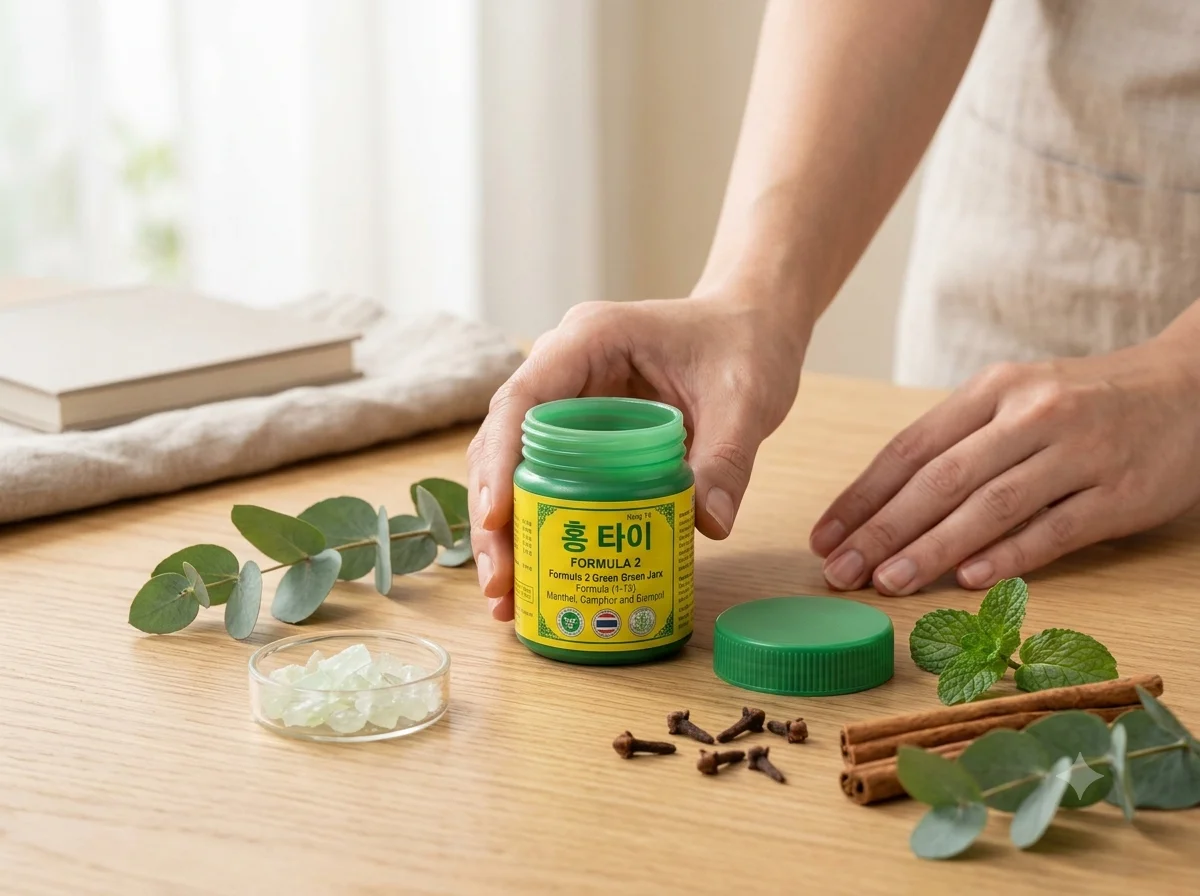
Its formula contains strong aromatic compounds including menthol, camphor, borneol and eucalyptus oil.
People with allergies or sensitivity to essential oils may experience irritation or discomfort.
The product should be used according to its label and should not be swallowed.
It is also important not to confuse temporary sensory relief with treatment of an underlying medical condition.
For example, smelling menthol may make a person feel that their nose is more open because of the cooling sensation, but that does not necessarily mean nasal inflammation has been treated.
And anyone experiencing persistent dizziness, fainting, breathing difficulty, severe headaches or other concerning symptoms should seek medical care rather than relying on an inhaler.
Perhaps the most interesting part of the Hong Thai story is that the company did not set out to become a global cultural symbol.
It started with a cheap course.
Then came experimentation.
Then local customers.
Then word of mouth.
Then social media.
And eventually global celebrities.
That progression transformed Hong Thai from a small herbal product into something much bigger.
The green jar now functions almost like a small piece of Thailand that tourists can put in their luggage.
This is why the brand fits naturally into the discussion around Thai soft power.
A consumer in New York, London, Dubai or Budapest may not know much about Thai herbal medicine.
But they may know the green Hong Thai jar because they saw it on TikTok, Instagram or in a celebrity photo.
That is powerful branding.
Hong Thai is one of Thailand’s most recognizable traditional herbal inhaler brands, manufactured by Thai Herbal Hongthai Co., Ltd.
Its founder, Theerapong Rabuetham, built the business from very modest beginnings. After taking a low-cost course on making herbal inhalers, he experimented repeatedly with formulas and sold them at markets and gas stations. Customer demand for his distinctive aroma eventually convinced him that he had found a product with real commercial potential.
The company was formally registered in 2012, according to corporate information cited by SCG Packaging.
Its main listed Thai address is 434 Phutthamonthon Sai 2 Road, Bang Phai, Bang Khae, Bangkok, while the company also lists an international distribution center in Phuket and a North American business address in Delaware.
The famous Formula 2 green inhaler contains key aromatic components including menthol, camphor, borneol and eucalyptus oil, along with approximately 15 types of dried herbs. Available product information lists 41.5% menthol, 16.6% camphor, 8.5% eucalyptus oil and 6.4% borneol.
Hong Thai’s biggest marketing advantage has been word of mouth.
The product’s distinctive scent created repeat customers long before social media existed.
Then celebrity exposure changed the scale of the business.
The 2023 Lisa effect, followed by visibility involving celebrities such as Chris Hemsworth and Central Cee and use among Thai Olympic athletes, helped turn Hong Thai into an international curiosity.
The brand competes most directly with Poy-Sian, Peppermint Field, Siang Pure and other Thai herbal inhalers, while broader competitors include products from Tiger Balm and Vicks.
Financially, the company experienced dramatic growth.
Reported corporate data shows revenue rising from approximately 17.8 million baht in 2020 to 62.7 million baht in 2022. Later reporting placed Hong Thai at around 300 million baht in 2023, while the company targeted 500 million baht in 2024. An APEA announcement subsequently said the company achieved more than 300 million baht in 2024.
There is no reliable public audited figure for 2025 or 2026 revenue, so those numbers should not be invented.
Most importantly, the 2026 picture of Hong Thai must include the 2025 Formula 2 recall.
Thailand’s FDA found that lot 000332 contained microbial contamination above permitted limits, including Clostridium perfringens. Authorities later seized more than two million herbal products from unauthorized facilities during the investigation.
That episode is an important reminder that even highly popular traditional products need modern manufacturing controls.
Despite the setback, Hong Thai remains a fascinating Thai consumer-brand success story.
It combines traditional herbal culture, an instantly recognizable product, a memorable scent, low-cost accessibility, word-of-mouth marketing, celebrity exposure and international distribution.
The brand’s biggest achievement may not simply be selling millions of inhalers.
It is turning a small green jar that was once familiar mainly to Thai consumers into a product recognized by people around the world.
And that is what makes Hong Thai more than just an herbal inhaler.
It has become a Thai cultural product with global commercial potential.