Tiger Balm White is one of those products that many people recognize before they even know exactly what is inside the jar. The small white container, strong herbal aroma and familiar cooling sensation have made it a household name across Asia and increasingly in North America, Europe and other parts of the world. But Tiger Balm White is more than an old-fashioned ointment. It is part of a consumer-health brand that has been around for more than a century and is now sold across more than 100 countries.
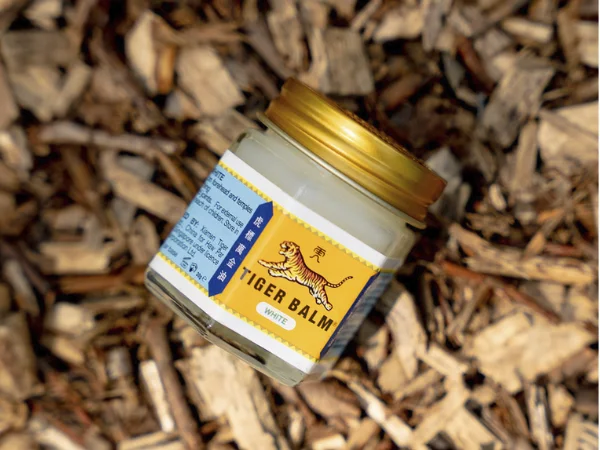
Tiger Balm White does not have a separate origin story from the broader Tiger Balm brand.
Its roots go back to 19th-century Rangoon, now Yangon, Myanmar, where Aw Chu Kin, the father of the famous Aw brothers, established a medical practice and apothecary known as Eng Aun Tong, or the “Hall of Everlasting Peace.”
Aw Chu Kin’s sons, Aw Boon Haw and Aw Boon Par, later took over the family business and worked on improving their father’s ointment.
The brothers developed and sold a preparation known as Ban Kim Ewe, translated as “Ten Thousand Golden Oils.” Boon Par focused heavily on the formulation while Boon Haw became the more commercially aggressive partner. He visited Chinese shops and persuaded retailers to stock the product, helping establish the early distribution network.
The Tiger Balm name dates to 1909.
Aw Boon Haw, whose name is associated with the meaning “Gentle Tiger,” used the tiger identity to build the brand. The tiger was not merely decorative. It became the central symbol of the company and eventually one of the most recognizable identities in topical pain relief.
By 1920, Tiger Balm’s founder had become one of the wealthiest Chinese businessmen in Rangoon. He subsequently looked toward Malaya and Singapore as important commercial markets.
In 1926, Aw Boon Haw moved the business to Singapore.
A much larger factory was established along Neil Road, and Tiger Balm’s own historical records state that its production capacity was approximately ten times that of the earlier Rangoon operation. Singapore’s location as a major regional trading and shipping center made it an ideal base for international expansion.
This was also the period when Aw Boon Haw became known for unconventional marketing.
He reportedly drove through smaller towns in Malaya in a custom vehicle featuring a tiger’s head and a horn that roared. When crowds gathered, he handed out samples of Tiger Balm and related products.
For a modern marketer, this is essentially a combination of experiential marketing, product sampling, mobile advertising and word-of-mouth marketing, decades before those terms became common.
The business established factories and distribution relationships across Malaya, Hong Kong, Batavia (now Jakarta), China and Thailand during its early expansion.
After the deaths of the Aw brothers, the family business continued evolving. In 1969, most of the family’s businesses were brought into Haw Par Brothers International Limited, which was listed in Singapore and Malaya. The company was later renamed Haw Par Corporation Limited in 1997.
Today, Haw Par owns the Tiger Balm brand and describes Tiger Balm as the largest contributor to its Healthcare business.
Tiger Balm’s manufacturing network is international rather than being concentrated in one factory.
The brand currently states that Tiger Balm products are made in China, Malaysia, Singapore, Thailand, Taiwan, India and Japan.
Haw Par’s current corporate contact information identifies healthcare manufacturing operations associated with Singapore, Johor, Malaysia and Xiamen, China.
A newer facility in Johor, Malaysia, is particularly important. Haw Par says the plant began commercial production for selected markets in September 2024. In April 2026, the company said the facility was operating at utilization broadly in line with expectations during its ramp-up period and that there were no plans to consolidate the company’s three Tiger Balm factories, because maintaining multiple facilities provides manufacturing flexibility and operational resilience.
Haw Par also states that Tiger Balm and Kwan Loong products are manufactured in GMP-certified facilities and maintain ISO 9001 quality-management and GMP certifications.
This is where it is important to distinguish Tiger Balm White specifically from the entire Tiger Balm product family.
Tiger Balm sells ointments, patches, rubs, sprays, gels and liniments, and their formulas are not identical.
For the U.S. Tiger Balm White Regular Strength ointment, the current DailyMed label lists the following:
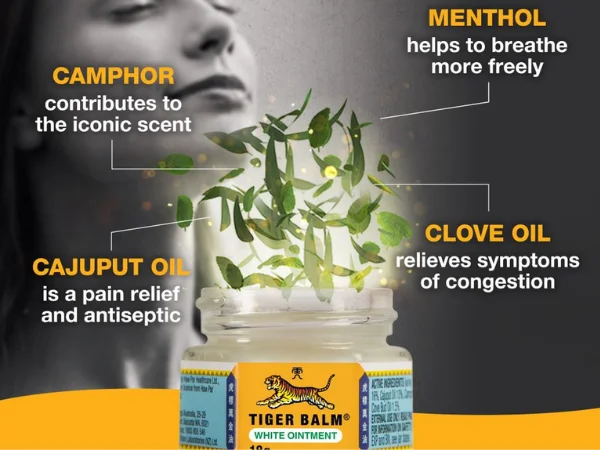
Camphor is one of Tiger Balm White’s two active ingredients.
In the U.S. formulation, it is present at 11% and is classified as a topical analgesic. It produces the familiar sensation associated with the balm and contributes to the product’s counterirritant effect.
Camphor can create a warming or cooling sensation depending on the formulation and how it interacts with sensory receptors in the skin.
The important practical point is that this sensation does not mean the product is literally heating the deeper tissues. It changes how the skin perceives temperature and discomfort.
Menthol is the second active ingredient in U.S. Tiger Balm White Regular Strength.
The current U.S. label lists 8% menthol. Like camphor, it is classified as a topical analgesic.
Menthol is responsible for much of Tiger Balm White’s characteristic cooling sensation.
It interacts with temperature-sensitive receptors in the skin, producing a feeling of coolness that can help alter the perception of minor pain.
Cajuput oil is part of the essential-oil blend used in Tiger Balm White.
Tiger Balm describes cajuput as having traditional antiseptic and analgesic uses and says it contributes to the formula’s characteristic aroma.
It is important not to overstate the evidence here. In the U.S. product, cajuput oil is an inactive ingredient, while camphor and menthol are the labeled active analgesics.
Clove oil is another component of the traditional formula.
Tiger Balm describes clove as having historical topical analgesic and counterirritant uses. It also contributes to the distinctive smell of the ointment.
Again, it is not one of the U.S. label’s active analgesic ingredients.
Dementholised mint oil is derived from mint oil and contributes to the overall aromatic and cooling profile.
Tiger Balm describes it as a traditional herbal ingredient used for symptomatic relief of localized muscular aches and pains.
Paraffin petrolatum forms part of the ointment base.
It gives the product its familiar semi-solid texture and helps distribute the active and aromatic ingredients across the skin. The current U.S. DailyMed label lists paraffin petrolatum among the inactive ingredients.
The aroma is not caused by one ingredient.
It comes from the combination of camphor, menthol, cajuput oil, clove oil and dementholised mint oil.
Tiger Balm itself says this herbal blend produces the brand’s distinctive aroma.
That strong smell is actually part of the product’s sensory identity. A consumer may recognize Tiger Balm without seeing the jar simply because the scent is so distinctive.
Yes, although they share much of the same basic formula.
Tiger Balm states that White and Red both contain camphor, menthol, cajuput oil, dementholised mint oil and clove oil. Red additionally contains cassia or cinnamon oil, which gives it its characteristic reddish-yellow color and contributes to its warming profile.
The exact formulation and permitted claims vary by country, so consumers should always follow the label of the product sold in their market.
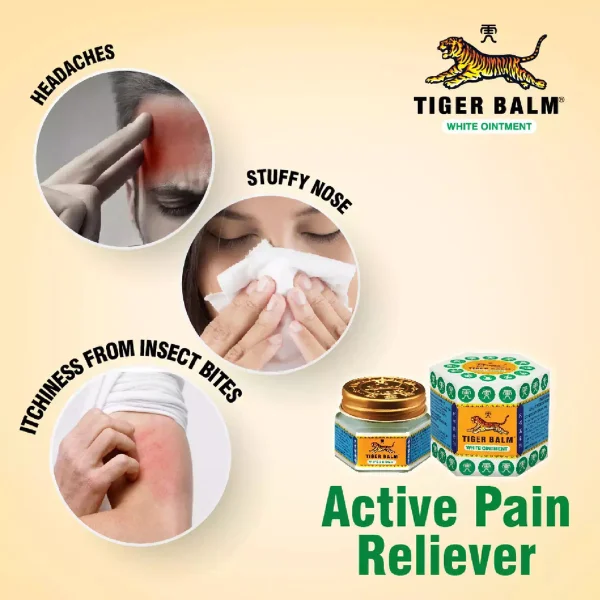
In the United States, Tiger Balm White Regular Strength is labeled for the temporary relief of minor aches and pains of muscles and joints associated with simple backache, bruises, strains, sprains and arthritis.
Tiger Balm’s international products can have different labeled uses.
For example, the company’s UK version is marketed for muscular aches and tension headaches in adults, while Tiger Balm’s product information in other markets also discusses uses involving stuffy noses.
This is a useful distinction for anyone researching Tiger Balm online. The same product name does not necessarily mean the exact same regulatory label in every country.
Tiger Balm White is for external use only.
The current U.S. label says not to apply it to wounds, damaged or irritated skin, and not to use it with a heating pad or under a bandage or wrap. It also says to avoid the eyes and mucous membranes. Adults and children over 12 are directed to rub it onto the affected area three to four times daily; children 12 or younger should be discussed with a doctor.
The label also advises stopping use and seeking medical advice if severe skin irritation occurs, the condition worsens, or pain continues for more than seven days.
Tiger Balm’s marketing success did not begin with Instagram, television commercials or celebrity endorsements.
It began with Aw Boon Haw himself.
The founder’s tiger-themed vehicle is one of the most memorable examples of early experiential marketing.
He traveled through towns in Malaya, attracted crowds with the unusual vehicle and distributed samples. The approach gave potential customers a chance to experience the product instead of merely hearing about it.
The Aw brothers also used their regional newspaper network to promote Tiger Balm.
Haw Par has noted that newspapers were an important part of the brand’s expansion from the 1920s through the 1950s. This helped Tiger Balm cross borders and become established in markets outside Singapore.
Sports became one of Tiger Balm’s most effective modern positioning tools.
The logic is simple: athletes experience muscle soreness, physical strain and recovery as part of their everyday lives. That makes sports a natural environment for a topical analgesic brand.
Haw Par’s recent campaigns have included football, marathons and other sports partnerships. In France, the company has used football and major marathon sponsorships, while Germany and France have seen cross-media and sports-focused campaigns.
Tiger Balm announced a four-year regional partnership with FC Bayern Munich in 2024 covering Singapore, Thailand, Malaysia, Vietnam, Hong Kong and Mainland China. In 2025, Haw Par said the partnership was expanded through fan meetings and integrated online-to-offline campaigns.
The association is strategically strong because Bayern Munich brings global football recognition while Tiger Balm brings its active-lifestyle positioning.
One of Tiger Balm’s most prominent recent campaigns came in 2025, when it partnered with Sony Pictures for the launch of Karate Kid: Legends.
The campaign operated across the United States, Canada and Japan and included invite-only events, karate tournaments and digital activations. Haw Par said the collaboration helped increase consumer engagement and sales.
This is a good example of modern brand positioning: instead of simply advertising “pain relief,” Tiger Balm places itself alongside a cultural property built around martial arts, physical training and discipline.
Tiger Balm also launched its first travel-retail pop-up at Changi Airport Terminal 1 in 2025 as part of Singapore’s 60th-birthday celebrations. Haw Par highlighted the activation in its annual report as part of its efforts to increase regional visibility and consumer engagement.
For a Singapore-rooted brand, an international airport is a particularly useful marketing location because it exposes the brand to both local consumers and international travelers.
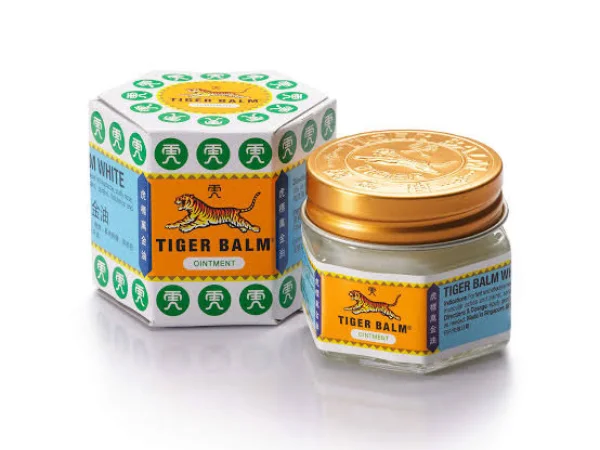
Tiger Balm’s success is not simply about its formula.
The company has several advantages that are extremely difficult for a new competitor to reproduce.
Tiger Balm has something modern brands cannot manufacture overnight: heritage.
The brand dates back to 1909, and its history has been passed through multiple generations. Haw Par says Tiger Balm products are now sold in more than 100 countries.
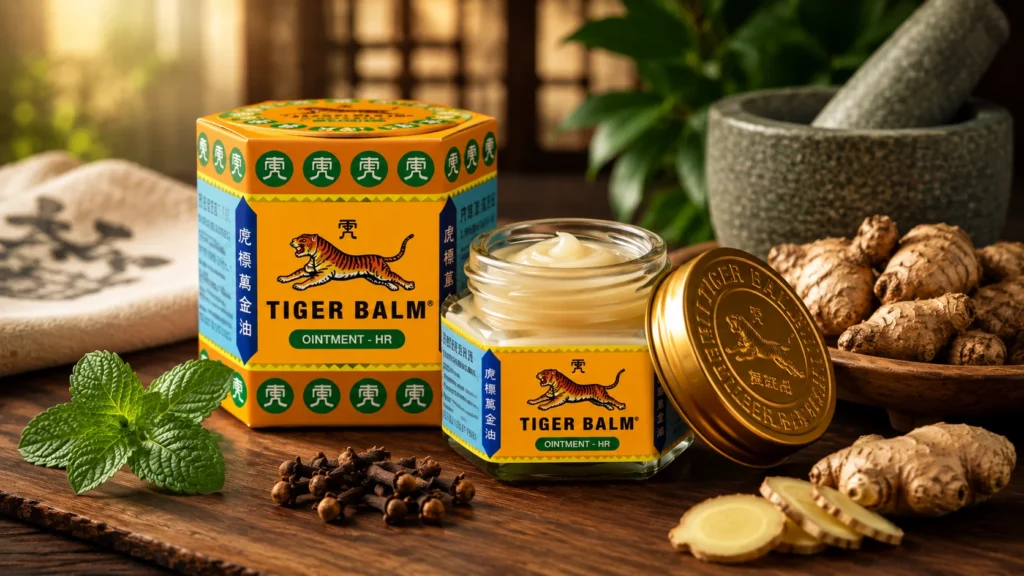
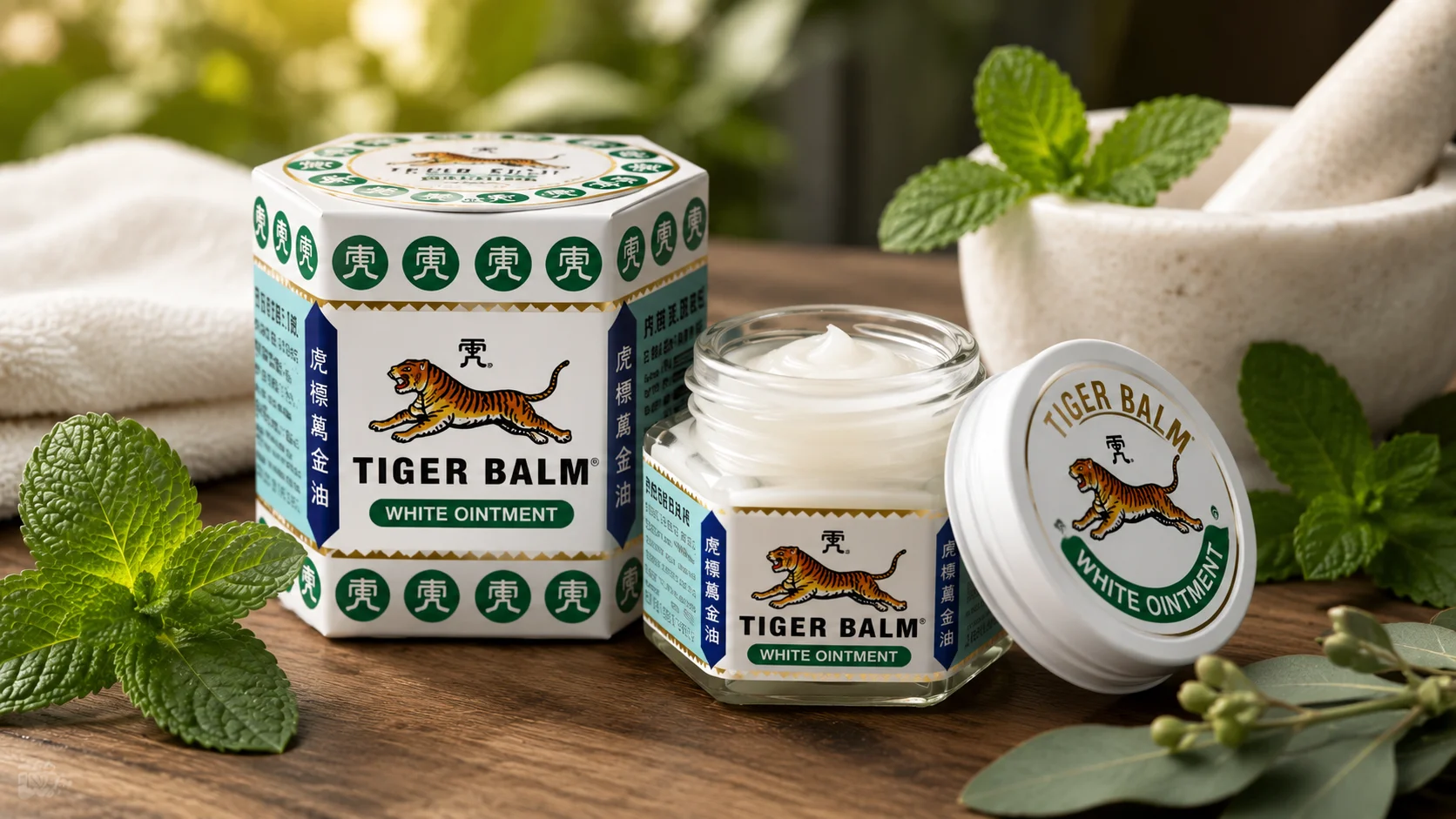
The jar, tiger logo and distinctive packaging create strong visual recognition.
But the branding goes further.
The smell and cooling sensation create a recognizable sensory experience. Consumers can often identify Tiger Balm from its aroma alone.
Tiger Balm has spent decades developing distributor relationships and retail networks.
Haw Par says its global expansion continues through partnerships with distributors.
This is particularly valuable in consumer healthcare because availability is part of brand strength. A product that is consistently available at pharmacies, supermarkets, online retailers and travel outlets has more opportunities to become habitual.
Tiger Balm is no longer dependent on one ointment.
Its U.S. portfolio includes Ultra Strength, Extra Strength and Regular Strength ointments, patches, neck and shoulder rubs, arthritis rubs, muscle rubs, liniment oil, muscle gel and muscle spray.
This allows the brand to meet different consumer preferences.
Someone who dislikes an ointment can use a patch. Someone who wants a less traditional format can choose a rub, gel or spray.
Tiger Balm has increasingly combined traditional retail with e-commerce and digital marketing.
Haw Par’s 2025 report specifically credits stronger e-commerce growth and broader retail coverage with helping Tiger Balm gain modest market share in North Asia.
That is important because the brand’s future depends partly on reaching younger consumers who may be less familiar with traditional ointments than older generations.
Perhaps the most important strategy is modernization.
Tiger Balm launched Tiger Balm Sensorial Therapy in 2024, moving the brand into aromatherapy and broader wellness. Haw Par said in its 2025 report that the product line continued to gain traction in selected Asian markets.
The company is therefore attempting to preserve the heritage of Tiger Balm while expanding what consumers think the brand represents.
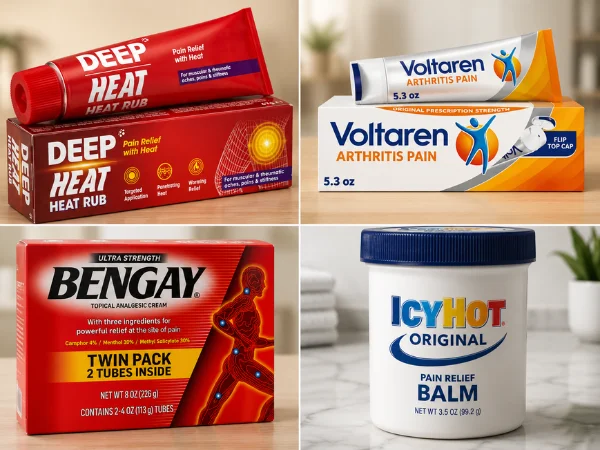
Tiger Balm White competes in a crowded topical pain-relief market, but its competitors vary considerably by country.
Since this article focuses on the global market outside India, some of the most relevant competitors include the following.
Icy Hot is a major U.S. topical pain-relief brand offering creams, gels, sprays and patches.
Its strong American retail presence makes it one of the most obvious alternatives for consumers comparing topical pain-relief products with Tiger Balm.
Bengay has a long history in the U.S. muscle and joint pain-relief category.
It overlaps with Tiger Balm in several consumer use cases, particularly minor aches and pains associated with muscles and joints.
Salonpas is especially important in the topical patch category.
Its patches provide an alternative to ointments for consumers who prefer a product they can apply and leave in place while continuing their daily activities.
Deep Heat is a significant topical pain-relief brand in the United Kingdom and other markets.
Its emphasis on warming relief makes it a particularly relevant competitor to Tiger Balm products that consumers associate with warming sensations.
Voltaren is a major global topical pain-relief competitor, but it takes a different pharmaceutical approach.
Many Voltaren topical products use diclofenac, a nonsteroidal anti-inflammatory drug, rather than the camphor-and-menthol approach used by Tiger Balm White.
That difference is important. Consumers are not always choosing between two identical types of topical products. They may be choosing between a counterirritant-style product and a topical NSAID.
Counterpain is another established Southeast Asian topical pain-relief brand and therefore competes directly with Tiger Balm in several Asian markets.
The competition is particularly significant because consumers in these regions are already familiar with topical ointments, balms and liniments.

There is no reliable public figure for Tiger Balm White’s individual annual sales or revenue.
This is an important distinction because Haw Par reports financial performance by business segment rather than breaking out revenue for individual Tiger Balm products such as White, Red, Ultra Strength or patches.
The latest full-year figures available in 2026 come from Haw Par’s 2025 Annual Report.
For FY2025:
However, S$210.4 million is not Tiger Balm White revenue and should not be described as Tiger Balm revenue alone.
The Healthcare segment includes Tiger Balm and Kwan Loong. Haw Par identifies Tiger Balm as the largest contributor to the Healthcare business, but it does not publicly provide a product-level revenue split.
The brand showed a mixed but resilient performance.
Haw Par reported solid growth in North America, with the company’s 2025 initiatives driving double-digit consumer sales growth in the United States. The company said Tiger Balm was among the fastest-growing brands in the external analgesics category there.
In Canada, Tiger Balm gained market share, supported by new product launches and continued demand for core products.
European markets also showed resilience, with moderate growth in key countries.
Asia was more uneven. Haw Par pointed to softer consumer sentiment, weaker tourism-dependent retail and broader trade uncertainty as factors affecting performance.
Haw Par’s 2026 strategy is focused on several areas:
The company says the Johor factory will gradually increase utilization as regulatory approvals are obtained in additional markets. Haw Par also confirmed in April 2026 that it does not plan to consolidate its three Tiger Balm factories, emphasizing resilience and alternate production capacity instead.
That suggests the company is thinking about Tiger Balm as a long-term global consumer-health business rather than simply protecting the traditional ointment.
Tiger Balm White is one of the best-known products within a consumer-health brand that has survived for more than a century.
Its story began in 19th-century Rangoon, where Aw Chu Kin established an apothecary and passed the family business to his sons, Aw Boon Haw and Aw Boon Par. The Tiger Balm name was established in 1909, and the business expanded to Singapore in 1926 before spreading throughout Asia and eventually into more than 100 countries.
The modern brand is owned by Haw Par Corporation Limited, a Singapore-listed multinational company.
Tiger Balm White’s U.S. Regular Strength formulation contains 11% camphor and 8% menthol as its active ingredients, with cajuput oil, clove oil, dementholised mint oil and paraffin petrolatum among the inactive ingredients.
The product’s popularity comes from a combination of factors rather than one secret ingredient.
It has a recognizable name, distinctive packaging, an unmistakable aroma, a century of consumer familiarity, extensive distribution and an increasingly sophisticated marketing strategy.
The company has also learned how to make an old brand relevant to younger consumers.
Sports partnerships with organizations such as FC Bayern Munich, entertainment campaigns around Karate Kid: Legends, e-commerce expansion and new wellness products such as Tiger Balm Sensorial Therapy show how the company is moving beyond the traditional jar.
Financially, the most recent public data show S$210.4 million in FY2025 Healthcare revenue for Haw Par, but that figure includes Kwan Loong and therefore cannot honestly be labeled as Tiger Balm White’s or even Tiger Balm’s standalone revenue.
That transparency matters when evaluating the brand.
Tiger Balm White may look like a simple ointment, but behind that familiar jar is a global consumer-health business with more than a century of brand-building, international manufacturing, sophisticated distribution and modern marketing.
And perhaps that is the most important reason Tiger Balm White has remained relevant for so long: the company has managed to preserve what makes the original product recognizable while continually finding new ways to introduce the tiger to another generation of consumers.