Amrutanjan Balm is one of India’s oldest and most recognizable pain-relief brands. Its story goes back to 1893, when it was developed in Mumbai by freedom fighter, philanthropist and entrepreneur Kasinadhuni Nageswara Rao Pantulu, commonly known as Desoddharaka Nageswara Rao Pantulu.
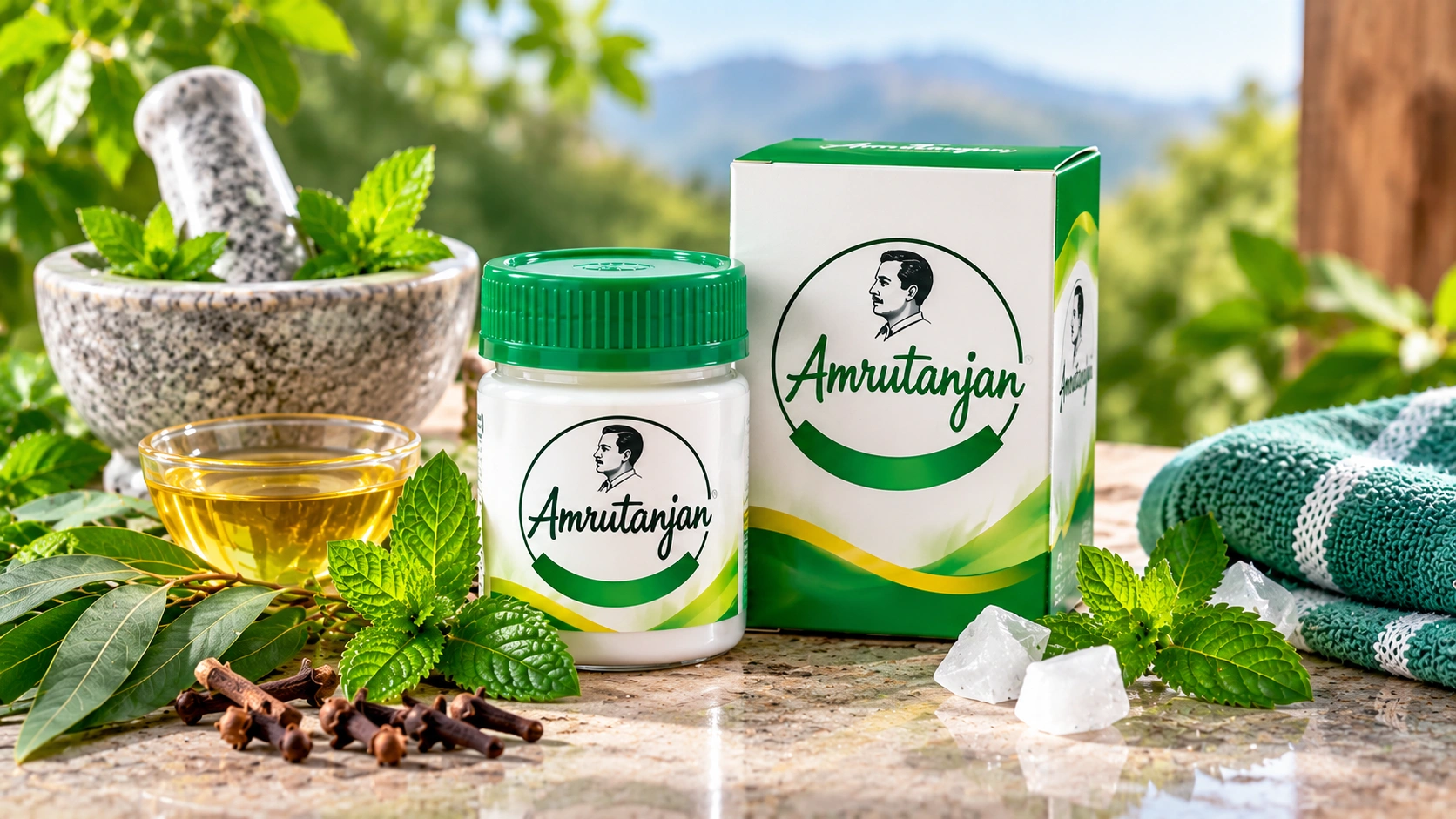
Amrutanjan’s history begins in 1893 in Mumbai.
The company was founded by Kasinadhuni Nageswara Rao Pantulu, a prominent Indian freedom fighter, philanthropist, publisher and entrepreneur. The company itself identifies him as the founder and describes him as an important figure in its early development. :contentReference[oaicite:1]{index=1}
At the time, commercial healthcare products in India were very different from today’s OTC market. Traditional medicine, household remedies and emerging pharmaceutical manufacturing were developing alongside one another.
Amrutanjan’s early success came from turning an Ayurvedic-inspired formulation into a standardized packaged product that could be manufactured, advertised and distributed to consumers.
That was an important business innovation.
Instead of relying only on local practitioners or traditional medicine shops, the company developed a recognizable consumer brand.
Kasinadhuni Nageswara Rao Pantulu was much more than the founder of a pain-balm company.
He was involved in India’s freedom movement, philanthropy, journalism and business. His broader public legacy helped give the Amrutanjan name a cultural identity beyond the product itself.
The company has continued to highlight his legacy in corporate communications, and he has also been commemorated on an Indian postage stamp.
This founder story is an important part of Amrutanjan’s brand equity because the company can connect its commercial history with India’s pre-independence period.
Amrutanjan Balm succeeded by solving a very simple consumer problem: providing a familiar topical product that people could keep at home for everyday headaches and aches.
The classic yellow balm became strongly associated with headache relief.
Over time, consumers began using the product across generations.
The company itself describes the original balm as one of India’s pre-century-old pain balms and says it was developed in 1893. :contentReference[oaicite:2]{index=2}
This longevity became one of Amrutanjan’s biggest competitive advantages.
A new pain-relief company has to spend heavily to establish trust.
Amrutanjan inherited that trust from generations of users.
Another major milestone came in 1936, when the company went public.
This makes Amrutanjan unusual among Indian consumer-health brands because its corporate history stretches back well before the modern Indian stock-market era.
The company remains publicly listed in 2026.
Amrutanjan did not remain dependent on one product.
Over the decades, it expanded into multiple categories.
Its current portfolio includes:
The current official website confirms that pain management remains one of the company’s core categories, while the portfolio also includes congestion management, women’s hygiene, beverages and other products. :contentReference[oaicite:3]{index=3}
Amrutanjan Balm is manufactured and sold by Amrutanjan Health Care Limited, an Indian publicly listed healthcare company headquartered in Chennai, Tamil Nadu.
The company has its corporate and regional presence in Chennai and operates manufacturing facilities supporting its healthcare and consumer products.
Amrutanjan’s FY2022-23 annual report identified three state-of-the-art manufacturing units as part of its operating infrastructure. :contentReference[oaicite:4]{index=4}
The company’s current business strategy also emphasizes manufacturing capabilities, research and development, consumer research and distribution as major pillars of the business.
Amrutanjan has developed a substantial distribution network in India.
During its 2024 annual general meeting, the company said its products were available in approximately 1.13 million outlets, with direct distribution reaching approximately 3.6 lakh outlets. It also reported distribution presence in 19 countries. :contentReference[oaicite:5]{index=5}
The company has also expanded into modern trade, e-commerce and quick-commerce platforms.
This is important because the way consumers buy pain-relief products has changed significantly.
Historically, a consumer would visit a neighborhood pharmacy or grocery store.
Today, the same consumer may order a balm through Amazon, Flipkart, a pharmacy app or a 10-minute delivery platform.
Amrutanjan has adapted to those changes instead of relying exclusively on traditional retail.
The current Amrutanjan Pain Balm Extra Power listed by the company contains ten active ingredients and an ointment base.
The official ingredient list includes:
The product also contains an ointment base and Quinoline Yellow as a color ingredient. The current official product page provides the botanical names and plant parts used for the listed ingredients. :contentReference[oaicite:6]{index=6}
Camphor is one of the best-known ingredients in traditional Indian pain balms.
It creates a noticeable cooling, warming or tingling sensation when applied to the skin.
Camphor interacts with several sensory receptors and can alter how the nervous system perceives local discomfort.
It is one reason Amrutanjan has such a distinctive aroma and immediate sensory effect.
Pudina refers to mint.
Mint-derived preparations can contain menthol and other compounds that activate cold-sensitive sensory receptors.
This produces the familiar cooling sensation associated with topical headache balms.
Menthol does not necessarily cool the skin by dramatically lowering its actual temperature. Instead, it changes the sensory signal received by the nervous system.
Gandhapura oil is derived from Gaultheria and is commonly associated with wintergreen oil.
It contains methyl salicylate, a compound used in many topical products for temporary relief of minor aches and muscular discomfort.
This ingredient contributes to the warming and penetrating sensation associated with traditional pain balms.
Eucalyptus oil gives Amrutanjan much of its characteristic herbal aroma.
Eucalyptus is commonly used in aromatic preparations associated with congestion and respiratory comfort.
However, consumers should not confuse an aromatic topical product with a treatment for respiratory infections.
Clove oil contains eugenol, a compound that has been studied for analgesic and antimicrobial properties.
Clove has a long history in traditional medicine, particularly in oral-care preparations.
In a topical balm, it contributes both aroma and sensory activity.
Cinnamon oil contributes a warm aromatic sensation.
Its major compounds can interact with sensory receptors in the skin and complement the cooling effect of mint.
Yavani refers to Trachyspermum ammi, commonly known as ajwain.
The concentrated plant preparation is traditionally used in Ayurvedic formulations.
Its strong aromatic character contributes to the overall sensory profile of the balm.
Amrutanjan Balm is best understood as a topical sensory pain-relief product.
Its ingredients interact with sensory receptors in the skin, creating cooling, warming and aromatic signals.
These signals can influence how the brain interprets discomfort.
Mint-derived menthol activates cold-sensitive receptors such as TRPM8.
The nervous system interprets this stimulation as cooling.
That cooling signal can temporarily compete with pain signals and change the subjective intensity of discomfort.
Camphor, wintergreen-derived compounds, cinnamon and other aromatic ingredients contribute additional sensory stimulation.
The combined effect is the distinctive hot-and-cool sensation that many consumers associate with Amrutanjan.
The company’s directions recommend gently massaging the balm onto the forehead for headache use.
Massage itself can contribute to relaxation and may be particularly relevant when tension around the forehead, scalp or neck is contributing to discomfort.
This means the consumer experience is not simply about the chemical ingredients.
It is a combination of topical ingredients, aroma, cooling or warming sensations and physical massage.
The classic Amrutanjan Pain Balm Extra Power is marketed primarily for headaches and cold-related body discomfort.
The official directions recommend applying it to the forehead and gently massaging it for headache use. The company also gives directions involving the throat and chest for cold-related relief. :contentReference[oaicite:7]{index=7}
Other Amrutanjan formulations are specifically designed for body pain.
The current portfolio includes products positioned for:
This product segmentation allows Amrutanjan to compete with both traditional balms and modern creams, sprays and roll-ons.
Headache relief remains the most important association with the original Amrutanjan brand.
The classic ritual is simple: apply a small amount to the forehead and gently massage.
The cooling aroma and physical massage can feel soothing, especially when tension is contributing to the headache.
However, a topical balm should not be considered a cure for migraine or other neurological headache disorders.
People who experience frequent, severe or changing headaches should seek appropriate medical evaluation.
The company has developed separate body-pain products rather than relying exclusively on the original balm.
For example, its Advanced Back Pain Roll-On contains mint, wintergreen oil, camphor, clove oil and capsaicin and is designed for application to affected areas. :contentReference[oaicite:8]{index=8}
This product diversification helps Amrutanjan compete with modern roll-ons and sprays.
One of Amrutanjan’s greatest marketing successes was making the product itself the brand.
Consumers do not always say “pain balm.”
They may simply say “Amrutanjan.”
That level of brand association is extremely valuable.
It means the company achieved strong mental availability, where the brand immediately comes to mind when consumers think about headaches or balms.
During its 2024 AGM, the company specifically discussed the importance of continuous advertising in sustaining a more-than-century-old brand.
This is a critical lesson from Amrutanjan’s history.
Heritage alone does not guarantee relevance.
A brand must continue communicating with new generations.
Amrutanjan has therefore continued to invest in mass media, digital channels, sampling and merchandising. Its FY2024-25 annual report specifically identified ongoing investment in brand-building across mass media and digital channels. :contentReference[oaicite:9]{index=9}
The classic yellow Amrutanjan Balm is visually distinctive.
That makes the product easy to recognize on shelves.
In FMCG marketing, packaging recognition is extremely important because consumers often make purchase decisions quickly.
Amrutanjan’s traditional appearance has therefore become an advantage rather than simply an old-fashioned design.
One of the company’s smartest product innovations was moving beyond the traditional balm jar.
Amrutanjan introduced roll-on formats that were easier to carry and apply.
The company’s 2017-18 annual report described its head and body roll-ons as an innovation success because of their portability and formulation. :contentReference[oaicite:10]{index=10}
This allowed Amrutanjan to compete with younger brands without abandoning its heritage.
Amrutanjan says it was the first company to launch a pain balm in a sachet format during the 1990s.
This was a clever mass-market strategy.
A sachet reduced the upfront cost and made the product accessible to consumers who might not want to purchase a larger container.
It also made the product highly portable.
The company continues to highlight this innovation in its corporate presentations. :contentReference[oaicite:11]{index=11}
Amrutanjan has adapted its distribution strategy to modern shopping habits.
The company now sells through e-commerce and modern retail while maintaining its traditional pharmacy and grocery distribution.
This omnichannel strategy is particularly important because younger consumers may discover the product online rather than through a neighborhood pharmacy.
Instead of constantly changing the original balm, Amrutanjan has expanded the range.
The company now offers extra-power products, roll-ons, sprays and patches.
This allows the brand to appear relevant to consumers looking for different application formats.
Amrutanjan has repeatedly emphasized trust as part of its identity.
The company’s long history provides a powerful credibility story.
It is difficult for a new competitor to reproduce a consumer relationship that has existed for more than 130 years.
Amrutanjan’s biggest competitive advantage is time.
Few Indian pain-relief brands can claim an origin in 1893.
Generational use creates familiarity and reduces the perceived risk of trying the product.
The company’s reported reach of approximately 1.13 million outlets gives it substantial visibility.
Its direct distribution network reaches around 360,000 outlets, according to the company’s 2024 AGM presentation. :contentReference[oaicite:12]{index=12}
This makes the brand easy to find.
Amrutanjan no longer depends exclusively on one balm.
It has products for headache, body pain, congestion, women’s hygiene, beverages and other healthcare needs.
This reduces the company’s dependence on one product category.
This may be the company’s most important strategic achievement.
Amrutanjan has not attempted to replace the classic balm.
Instead, it created new formats around it.
Roll-ons, sprays and patches allow the company to reach consumers who want modern convenience while preserving the original product’s identity.
Amrutanjan has built a broader OTC healthcare identity rather than positioning itself only as an Ayurvedic company.
The company describes its approach as combining natural extracts with scientific research.
This allows it to appeal to consumers who value traditional ingredients but still expect modern manufacturing and product development.
The company has identified direct-to-consumer commerce, e-commerce, modern trade and digital marketing as important areas for future growth.
Its FY2024-25 annual report specifically mentions building the D2C channel and using AI/ML in areas including customer service, marketing, product design and operations. :contentReference[oaicite:13]{index=13}
Amrutanjan competes with several major Indian and international brands in the topical pain-relief market.
Zandu is perhaps the most direct heritage competitor.
Like Amrutanjan, it combines traditional Indian medicine with mass-market branding and has been part of Indian households for generations.
The two brands compete heavily on familiarity and consumer trust.
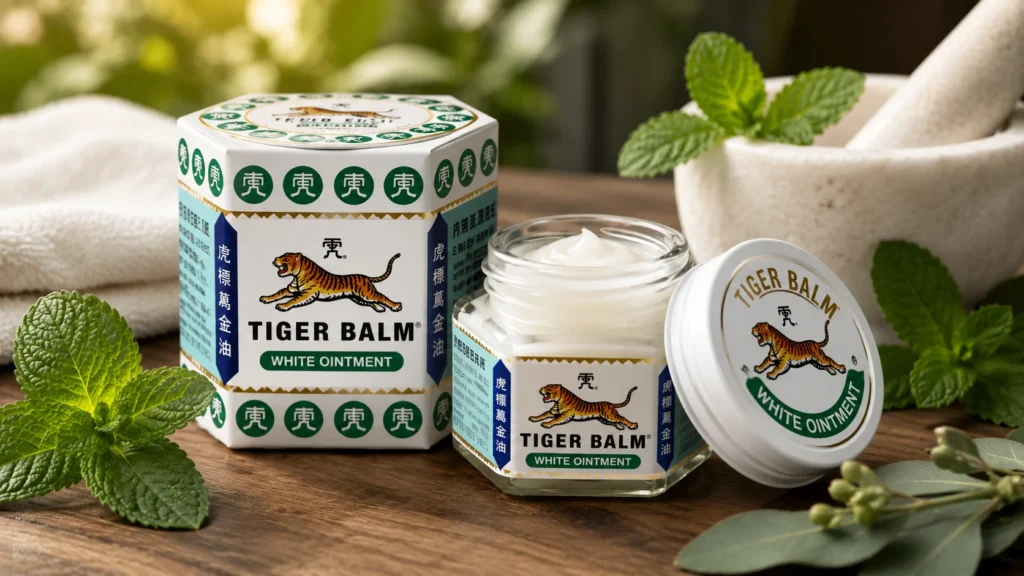
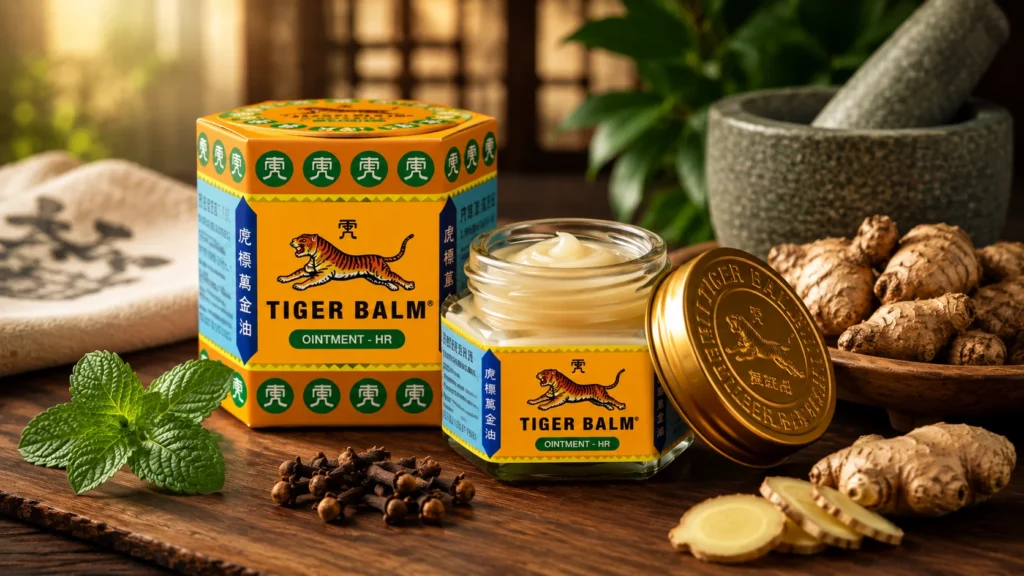
Tiger Balm is a major international competitor with deep Asian heritage.
Its cooling and warming topical formulations overlap with Amrutanjan’s traditional balm positioning.
Tiger Balm’s strength is global recognition, while Amrutanjan’s strength is its uniquely Indian heritage.
Iodex competes more strongly in the pharmaceutical-style topical pain-relief category.
Its modern gel and ointment formats appeal to consumers looking for conventional pain-relief products.
Moov is an important modern Indian competitor.
Its creams, sprays and other topical products have helped establish a contemporary alternative to traditional balms.
This competition has encouraged Amrutanjan to develop sprays, roll-ons and patches.
Volini competes particularly strongly in muscle and sports-related pain.
Its sprays and gels provide a modern alternative to balm-based products.
Unlike many privately held wellness brands, Amrutanjan provides publicly available financial information because Amrutanjan Health Care Limited is a listed company.
This makes it possible to discuss its current financial performance with considerably more confidence.
Current FY2026 financial data reports revenue from operations of approximately ₹502.55 crore, representing growth of approximately 11.23% over the previous year.
Reported FY2026 net profit was approximately ₹57.92 crore, while computed EBITDA was approximately ₹93.26 crore. :contentReference[oaicite:14]{index=14}
These figures relate to Amrutanjan Health Care Limited as a company, not to Amrutanjan Balm alone.
For the quarter ended March 2026, Amrutanjan reported standalone net sales of approximately ₹149.77 crore, up about 10.6% year over year.
Net profit for the quarter was approximately ₹16.19 crore. :contentReference[oaicite:15]{index=15}
This was an important milestone because it showed continued topline growth into FY2026.
The company does not publicly disclose a separate audited revenue number for the original Amrutanjan Balm.
However, pain management remains a major part of the OTC business.
In its FY2024-25 annual report, the company stated that 62% of OTC revenue came from the Head and Body categories, highlighting the continuing importance of pain-management products. :contentReference[oaicite:16]{index=16}
This is a useful indicator of the importance of the pain business, but it should not be interpreted as saying that 62% of the entire company revenue comes from Amrutanjan Balm.
During its 2024 AGM, the company reported ₹472 crore in gross sales for FY2024 and approximately ₹420 crore in net sales for the previous year.
The company also said new-product sales accounted for approximately 44% of total sales, showing that it was increasingly relying on products beyond its traditional flagship balm. :contentReference[oaicite:17]{index=17}
Amrutanjan reported distribution presence in 19 countries during its 2024 AGM.
This demonstrates that the brand has moved beyond its historical Indian market, although India remains its core market.
The international opportunity is particularly relevant among consumers familiar with Indian healthcare and Ayurvedic products.
The biggest difference is heritage combined with adaptation.
A modern pain-relief startup can develop a roll-on in a few months.
What it cannot reproduce quickly is more than 130 years of consumer familiarity.
Amrutanjan has also shown that heritage does not require a company to remain technologically or commercially old-fashioned.
The company has moved into:
This combination gives the company a rare position in the Indian market.
It can appeal to consumers who want the familiar balm their parents used while also offering younger consumers portable and modern formats.
Amrutanjan Balm is one of India’s oldest and most successful consumer healthcare products, with a history stretching back to 1893.
The brand was founded in Mumbai by Kasinadhuni Nageswara Rao Pantulu, a freedom fighter, philanthropist, publisher and entrepreneur whose legacy remains closely connected with the company.
The original balm became famous as an everyday product for headaches and other forms of discomfort, eventually becoming a household name across India.
The company went public in 1936, giving Amrutanjan an unusually long history as a publicly listed Indian healthcare business.
Today, Amrutanjan Health Care Limited is still independent and publicly traded, rather than being a subsidiary of a multinational or large FMCG conglomerate.
The company has expanded far beyond the original balm.
Its current portfolio includes classic and stronger pain balms, headache and body roll-ons, back-pain products, sprays, patches, cold and congestion products, women’s hygiene products, beverages and other healthcare items.
The current Pain Balm Extra Power formulation contains ten active ingredients, including camphor, Yavani Satwa, Pudina Satwa, Gaultheria oil, pine oil, eucalyptus oil, lemongrass oil, cinnamon oil, mint oil and clove oil. :contentReference[oaicite:18]{index=18}
These ingredients create the characteristic cooling, warming and aromatic experience associated with the product.
Menthol-containing mint ingredients activate cold-sensitive sensory receptors, while camphor and other aromatic compounds create additional sensory stimulation.
The resulting effect may temporarily change how discomfort is perceived, but this should not be confused with treating the underlying cause of a headache or migraine.
Amrutanjan’s business success is not based solely on its formula.
Its greatest advantage is its brand equity.
The company has maintained the Amrutanjan name across more than 130 years, allowing multiple generations of consumers to become familiar with the product.
Its marketing strategy has also evolved.
The company introduced pain-balm sachets in the 1990s, developed portable roll-ons, launched sprays and patches, and increasingly uses e-commerce, quick commerce and modern trade.
Its 2024 AGM presentation reported availability across approximately 1.13 million outlets, direct distribution to around 3.6 lakh outlets and presence in 19 countries. :contentReference[oaicite:19]{index=19}
This distribution scale is one of the company’s strongest competitive advantages.
Amrutanjan competes with major brands including Zandu, Tiger Balm, Iodex, Moov, Volini, Dr. Ortho, Vicks and Mentho Plus.
Zandu is perhaps its closest heritage competitor in India, while Moov and Volini represent newer, more modern approaches to topical pain relief.
Financially, Amrutanjan remains a substantial Indian consumer-health business.
Current FY2026 financial data puts company revenue from operations at approximately ₹502.55 crore, with net profit of approximately ₹57.92 crore. The March 2026 quarter generated approximately ₹149.77 crore in net sales, up 10.6% year over year. :contentReference[oaicite:20]{index=20}
However, there is an important distinction: these numbers represent Amrutanjan Health Care Limited as a company and are not the revenue of Amrutanjan Balm alone.
The company does not publicly disclose a standalone 2026 revenue figure for the original balm.
The broader pain-management business remains central to the company. Its FY2024-25 annual report stated that Head and Body categories contributed approximately 62% of OTC revenue. :contentReference[oaicite:21]{index=21}
That makes the pain-relief franchise one of the company’s most important commercial engines.
Perhaps the most impressive part of the Amrutanjan story is its ability to evolve without abandoning its identity.
The original balm remains recognizable, while the company has developed roll-ons, sprays and patches for consumers who want convenience.
It has also moved into women’s hygiene, beverages and other healthcare categories.
In other words, Amrutanjan has not tried to become a completely different company.
It has used its original strength in pain management as a foundation for a broader consumer-health business.
That is why Amrutanjan remains relevant in 2026.
It is not simply an old balm brand surviving on nostalgia.
It is a 130-plus-year-old Indian healthcare company that has continuously adapted its products, distribution and marketing to changing consumer behavior.
Its heritage provides trust.
Its distribution provides availability.
Its product innovation provides relevance.
And its continued investment in digital and modern retail gives the brand a path to reach younger consumers.
For consumers, Amrutanjan Balm remains a familiar topical option for temporary relief from everyday headache and discomfort.
For the consumer-health industry, however, its importance is much greater.
Amrutanjan is a case study in how an Indian health brand can survive for more than a century by combining traditional knowledge, recognizable branding, product innovation, distribution and continuous advertising.
That combination explains why the Amrutanjan name continues to hold a strong position in India’s pain-relief market in 2026.

Watch expert-inspired short videos on health, wellness, nutrition, fitness, preventive care, and healthy living in under a minute.