The title refers to legendary and ancient sacred plants associated with South American spiritual traditions, not five scientifically confirmed extinct species. The plants discussed below are documented in historical, archaeological, or ethnobotanical research, and several continue to grow and be used today.
Long before modern neuroscience introduced terms such as cognitive enhancement, brain performance, and nootropics, Indigenous societies across South America developed complex relationships with plants believed to connect people with ancestors, spirits, nature, and the divine.
In the Andes and Amazon basin, certain plants occupied a position that went far beyond ordinary food or medicine. They appeared in healing ceremonies, religious practices, funerary traditions, and systems of knowledge passed down through generations. Some were associated with endurance and alertness, while others were used in ceremonies intended to produce visions or help spiritual specialists interpret illness and misfortune.
Modern research has begun to uncover physical evidence of these practices. Archaeologists have discovered plant remains, ritual objects, and chemical traces associated with psychoactive substances in ancient South American contexts. A 2019 study of a roughly 1,000-year-old ritual bundle from the Andes, for example, identified evidence of several psychoactive plants, revealing the sophisticated botanical knowledge of ancient ritual specialists. Read the study in the Proceedings of the National Academy of Sciences.
However, there is an important difference between a sacred plant, a psychoactive plant, and a nootropic. A plant that changes perception is not automatically a substance that improves memory, intelligence, or long-term cognitive performance. Many traditional accounts describe spiritual or ceremonial meanings that cannot be reduced to modern pharmacology.
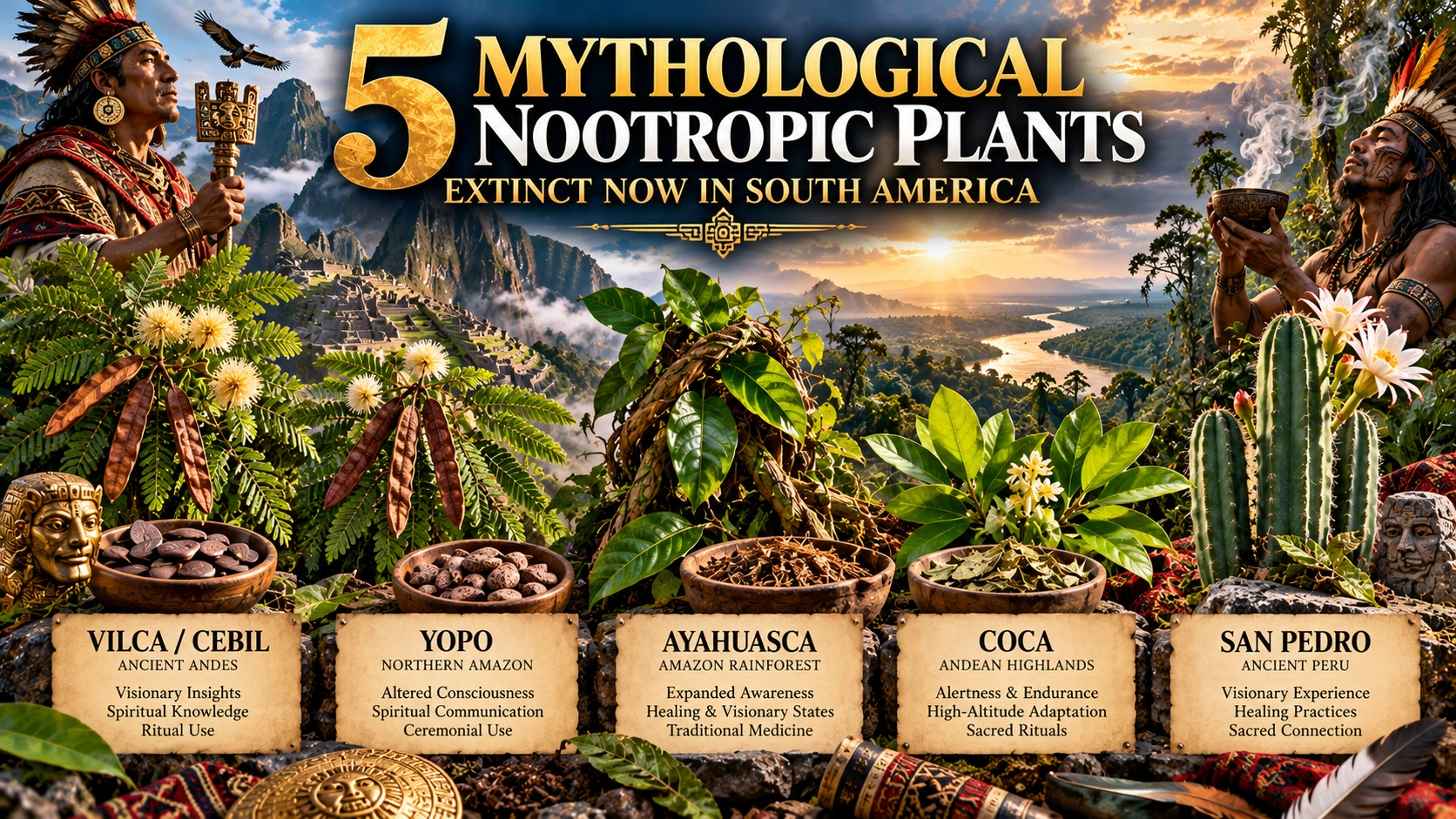
This article explores five South American plants connected to ancient ritual life and traditional understandings of consciousness: vilca, yopo, ayahuasca, coca, and the San Pedro cactus. Their histories are fascinating, but none should be presented as a scientifically confirmed extinct nootropic plant.
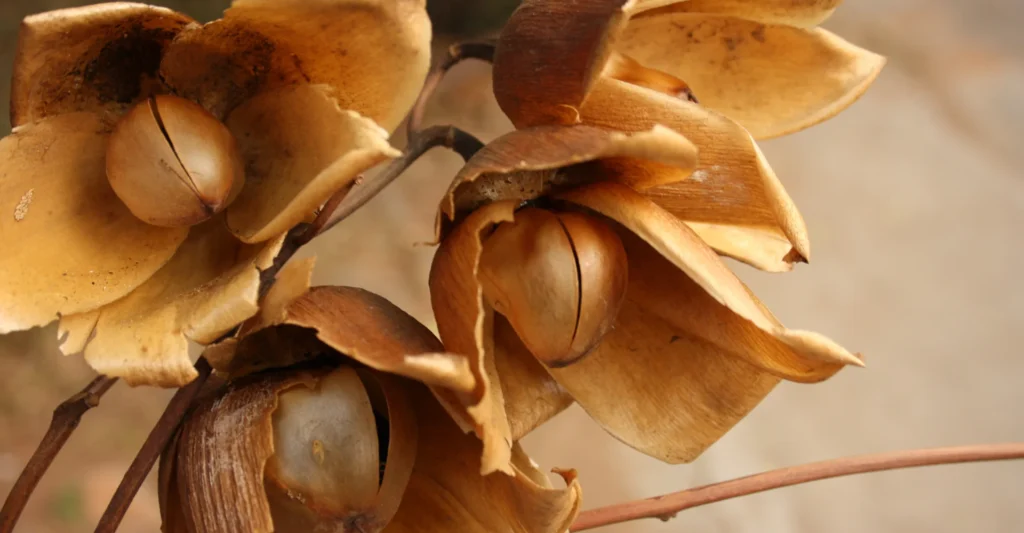
Vilca, also known as willka or cebil, refers to Anadenanthera colubrina var. cebil, a tree native to parts of South America. It has delicate, feathery, divided leaves, rounded clusters of small flowers, and long, flattened seed pods containing hard, flattened seeds.
The tree belongs to the legume family and grows in seasonally dry environments. Its appearance is quite different from the stereotypical image of a mysterious medicinal herb: it is a woody tree whose seeds became important in ancient ritual practices.
Vilca or cebil has a documented history in the southern Andes, including parts of present-day Peru, Bolivia, northern Chile, and northwestern Argentina. Archaeological discoveries of seeds and associated equipment indicate that the plant was used thousands of years ago.
Research published in 2024 in the journal Plants reviews its historical and contemporary uses. The study describes archaeological evidence extending back approximately 4,000 years and documents continued uses in modern traditional medicine and ritual contexts.
Read the 2024 research paper on vilca and cebil.
In pre-Hispanic Andean societies, vilca had religious, medicinal, and cosmological importance. Historical sources describe its association with ritual practices and visionary experiences. Its seeds contain psychoactive compounds, including bufotenine and other tryptamine-related substances, although composition can vary.
For practitioners in the traditions where it was used, the plant’s significance was not limited to its chemistry. It formed part of a wider worldview in which illness, spiritual imbalance, relationships with the natural world, and community life could be interconnected.
It would be misleading to interpret every traditional reference to vitality or spiritual knowledge as evidence of enhanced intelligence. The historical record primarily supports its ritual and psychoactive significance, not a proven nootropic effect.
No. The plant species is not confirmed extinct, and a 2024 ethnobotanical study documents its continued use. Some researchers have suggested that vilca’s prominence declined after the expansion of the Inca Empire and during Spanish colonial rule. That historical decline in use is not the same as biological extinction.
Historical significance: Vilca demonstrates how a living tree could become central to ancient South American ideas about healing, altered consciousness, and sacred knowledge.
Yopo is a common name associated with Anadenanthera peregrina, a tree related to the vilca or cebil tree. It has finely divided, feathery leaves, small flowers grouped into rounded clusters, and seed pods containing flat seeds.
Although closely related to vilca, yopo is associated with a different geographical range and distinct regional traditions. Its historical use has been documented in parts of the northern Amazon and Orinoco basin, including areas of present-day Venezuela and Colombia.
Historical and ethnographic research describes the ceremonial use of yopo seeds by Indigenous communities in parts of South America. The seeds contain psychoactive compounds, and preparations made from them have been associated with visionary and religious practices.
A review of archaeological, historical, and ethnographic evidence published in the medical literature discusses the ancient use of Anadenanthera seeds across South America. Archaeological findings include seeds and equipment associated with the preparation or consumption of psychoactive snuff. The research also documents the continuing use of related plants among some Indigenous groups.
Read the review of ritual use of Anadenanthera seeds.
In ceremonial settings, visionary experiences could be interpreted through a community’s spiritual traditions. The purpose was not necessarily recreational or focused on improving productivity. It could involve healing, social relationships, spiritual communication, or understanding events that ordinary perception was thought unable to explain.
There is no reliable basis for calling yopo a proven cognitive enhancer. Psychoactive effects can alter perception and consciousness, but that does not establish benefits for memory, concentration, learning, or long-term brain health.
Its historical importance is better understood through ethnobotany and the study of Indigenous religious practices than through modern supplement marketing.
No. Anadenanthera peregrina is a recognized plant species and is not established as extinct. Its ceremonial history may be unfamiliar to many outside the region, but a decline in public visibility does not mean the plant has disappeared.
Historical significance: Yopo illustrates how a plant’s effects and meaning can be inseparable from the cultural setting in which it is used.
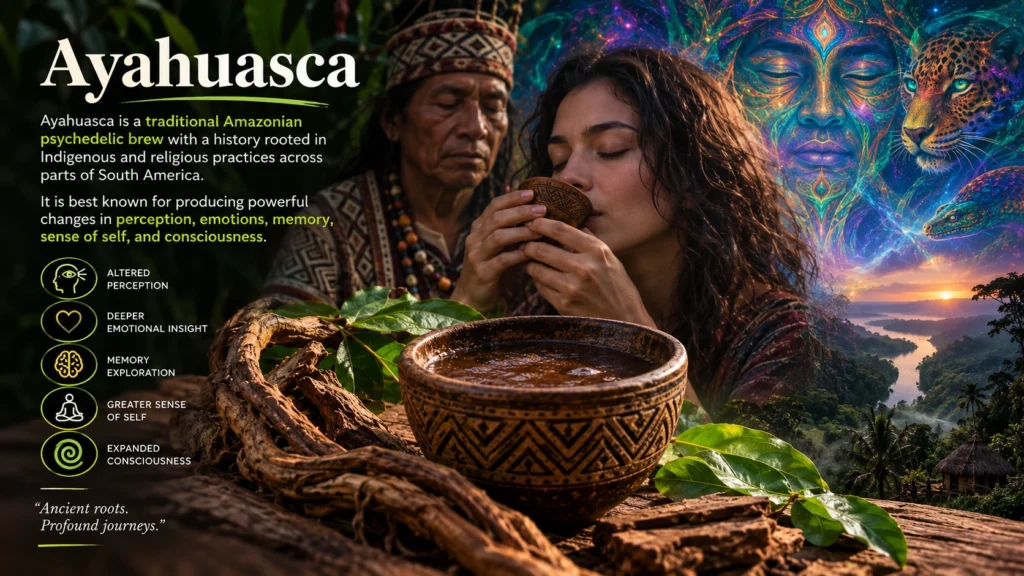
Ayahuasca is best known as a ceremonial preparation rather than a single plant. One of its principal ingredients is Banisteriopsis caapi, a woody climbing vine native to tropical South America. The vine grows through forest vegetation and has broad green leaves.
Many traditional preparations also include the leaves of Psychotria viridis, a tropical shrub. The exact plants used can vary by region and tradition, and historical references do not always identify botanical ingredients with certainty.
Ayahuasca is associated with Indigenous and local communities across Amazonia, including areas of present-day Peru, Ecuador, Colombia, Brazil, and neighbouring countries. It has been used in ceremonial and healing contexts, with different communities maintaining their own knowledge, terminology, and practices.
An influential review in the Journal of Ethnopharmacology examined hallucinogenic plant use and related Indigenous belief systems in the Ecuadorian Amazon. It highlighted the relationship between plant preparations, folk medicine, and Indigenous worldviews.
Read the review on Amazonian plant use and belief systems.
Ayahuasca can produce profound changes in perception, emotion, and subjective experience. Its effects are related to the chemistry of its ingredients and the way they interact in a preparation. The vine contains beta-carboline compounds, while certain commonly used leaf ingredients contain DMT.
For the communities that use it ceremonially, the experience may be understood as a way of engaging with spiritual beings, examining personal or community problems, or seeking healing. Those interpretations deserve to be understood in their own cultural context rather than dismissed or treated as universal scientific explanations.
At the same time, intense altered states are not evidence of improved intelligence. Research into possible therapeutic applications is ongoing, and findings about specific clinical settings should not be generalized to unsupervised use or long-term cognitive enhancement.
No. The principal plants associated with ayahuasca are not confirmed extinct. The tradition is also not simply a forgotten relic of an ancient civilization; it remains part of living practices in Amazonia and beyond.
Historical significance: Ayahuasca provides an example of how botanical knowledge, spiritual beliefs, and traditional healing systems can become closely intertwined.
Coca plants belong to the genus Erythroxylum. They are shrubs with small, smooth-edged leaves and modest flowers. Two cultivated species, Erythroxylum coca and Erythroxylum novogranatense, are especially relevant to the history of coca cultivation in South America.
The leaves contain several alkaloids, including cocaine in naturally occurring quantities. Coca leaf is not identical to purified cocaine, and its traditional uses should not be confused with the effects or risks of concentrated products.
Coca has a long history in the Andes, including areas of present-day Peru and Bolivia. Archaeological and historical research documents its use for centuries, with evidence of consumption extending back thousands of years.
Coca leaves have been associated with social exchange, ritual life, traditional medicine, and the challenges of living and working at altitude. In some Andean contexts, coca also holds spiritual importance and is incorporated into practices involving offerings and relationships with sacred places.
Research published in Systematic Biology examined the origins and domestication history of coca using genetic evidence, showing that the plant’s history is more complex than a single simple origin story.
Read the research on the origins of coca.
Coca leaves have stimulant properties. Their traditional use has been associated with managing fatigue and supporting work in demanding environments. These effects, however, should not be taken as proof that coca improves every aspect of cognition or prevents cognitive decline.
A stimulant effect is not the same as a nootropic benefit. Improved wakefulness in a particular setting does not automatically mean improved memory, reasoning, or long-term brain health.
Coca’s cultural history also cannot be understood solely through the later global history of cocaine. The plant has been cultivated and used in South America for purposes that predate the modern cocaine trade by many centuries.
No. Coca remains cultivated in parts of South America. Its history includes changes in cultivation, colonial restrictions, international drug policies, and major differences between traditional leaf use and illicit cocaine production.
Historical significance: Coca demonstrates why traditional plant histories need to be studied in their social and historical context rather than reduced to a single chemical compound.
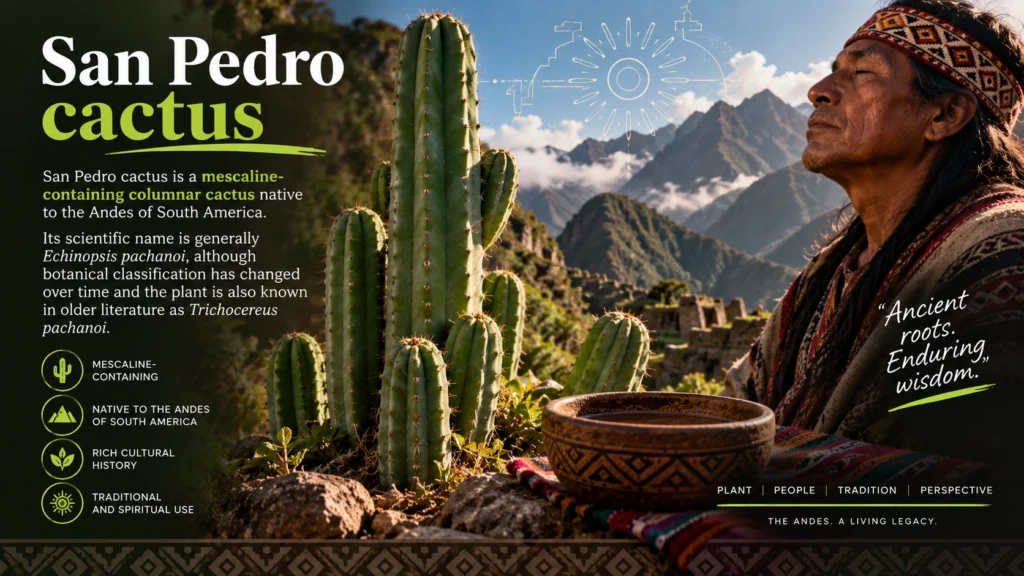
San Pedro is a columnar cactus commonly identified as Echinopsis pachanoi (also known in some botanical literature as Trichocereus pachanoi). It grows upright in long, ribbed green columns, often producing large, pale flowers.
Unlike the trees and vines discussed above, San Pedro has a distinctive cactus form. It grows in parts of the Andes and has a long history in traditional healing practices, especially in northern Peru.
Archaeological and ethnographic research documents San Pedro’s ritual importance in northern Peru. A 2006 review discusses evidence associated with pre-Columbian cultures including Cupisnique, Chavín, Moche, and Lambayeque, as well as contemporary Andean healing traditions.
Read the archaeological and ethnographic review of San Pedro.
Research on Chavín de Huántar has also examined evidence for psychoactive plants in ancient ceremonial life. Some interpretations are supported by iconography and archaeological context, while the precise role of particular plants in specific ceremonies remains uncertain.
Read research on psychoactive plants and Chavín ritual.
San Pedro contains mescaline, a psychoactive alkaloid capable of producing substantial changes in perception and consciousness. In some Andean healing traditions, ceremonial experiences involving the cactus have been associated with spiritual insight, diagnosing illness, and restoring balance.
The cactus is therefore significant not only because of its chemistry, but also because of the traditions, rituals, and cultural knowledge surrounding it.
Calling San Pedro a nootropic would be inaccurate if that term is taken to mean a proven supplement for improving memory or intelligence. Its psychoactive effects and its ceremonial meaning are different questions from whether it produces measurable cognitive benefits.
No. San Pedro is a living cactus and continues to be cultivated and used. Its history is an example of cultural continuity rather than botanical extinction.
Historical significance: San Pedro reveals the long relationship between Andean ritual specialists, plant knowledge, healing, and interpretations of altered consciousness.
The histories of vilca, yopo, ayahuasca, coca, and San Pedro show that South American societies developed diverse and sophisticated relationships with the plant world.
Some plants were associated with stimulation or endurance. Others were used in ceremonies that could involve visions, healing, or spiritual communication. Archaeological evidence, chemical analysis, historical documents, and ethnobotanical fieldwork help researchers investigate these traditions, although the evidence varies from plant to plant.
It is important not to collapse all these different histories into a single category. A stimulant is not necessarily a nootropic; a visionary experience is not proof of enhanced intelligence; and a plant’s decline in ceremonial use is not the same as its extinction.
The 2024 study of vilca is a useful example. It challenges the assumption that the plant’s use disappeared entirely after colonial rule and documents its continued presence in contemporary ethnobotanical practice. Similarly, studies of San Pedro describe continuity between archaeological evidence and living Andean healing traditions.
These examples also underline the importance of respecting Indigenous knowledge. Such traditions are not merely curiosities from the distant past. Many remain part of living cultures, and their meanings cannot be fully understood through chemistry alone.
Based on the evidence discussed here, none of these five plants should be described as a confirmed extinct species. Vilca, yopo, ayahuasca-associated plants, coca, and San Pedro have all been documented as living plants. Their histories include changes in use, colonial suppression, changing social conditions, and differing levels of scientific documentation—but these are not equivalent to biological extinction.
There are genuine conservation concerns affecting many South American plant species, particularly those threatened by habitat loss, deforestation, climate change, or unsustainable harvesting. Those cases require species-specific evidence from botanical surveys and conservation assessments.
For this reason, the phrase “extinct now” is best treated as a provocative editorial hook rather than a factual claim about the five plants in this article.
South America’s sacred plants reveal a history in which botany, medicine, spirituality, and human consciousness often overlapped. Vilca and yopo were associated with visionary practices; ayahuasca became part of diverse Amazonian ceremonial traditions; coca played an important role in Andean life; and San Pedro has a documented history in ritual healing.
Modern research can investigate their chemistry and historical use, but it cannot automatically validate every spiritual claim or establish these plants as cognitive enhancers. Nor does the historical decline of a tradition prove that its plants became extinct.
The most accurate story is therefore not that five proven nootropic plants vanished from South America. It is that five remarkable plants remain connected to ancient traditions of sacred knowledge, altered consciousness, and healing—and their histories continue to be explored by researchers today.