Africa’s ancient plant traditions reveal a remarkable intersection of mythology, medicine, spirituality, and human consciousness. From the lost medicinal plant of ancient Cyrenaica to South African mood-altering herbs and Central African ceremonial plants, these botanical histories show how people have used plants to interpret the mind, connect with the spiritual world, and support traditional healing.
But the phrase “extinct nootropic plants” requires careful examination. Only some plants discussed in popular historical accounts are genuinely lost, and there is no scientific evidence that all five plants in this article were nootropics. Several are still used in traditional practices, while others are valued for fragrance, medicinal properties, or their role in religious ceremonies.
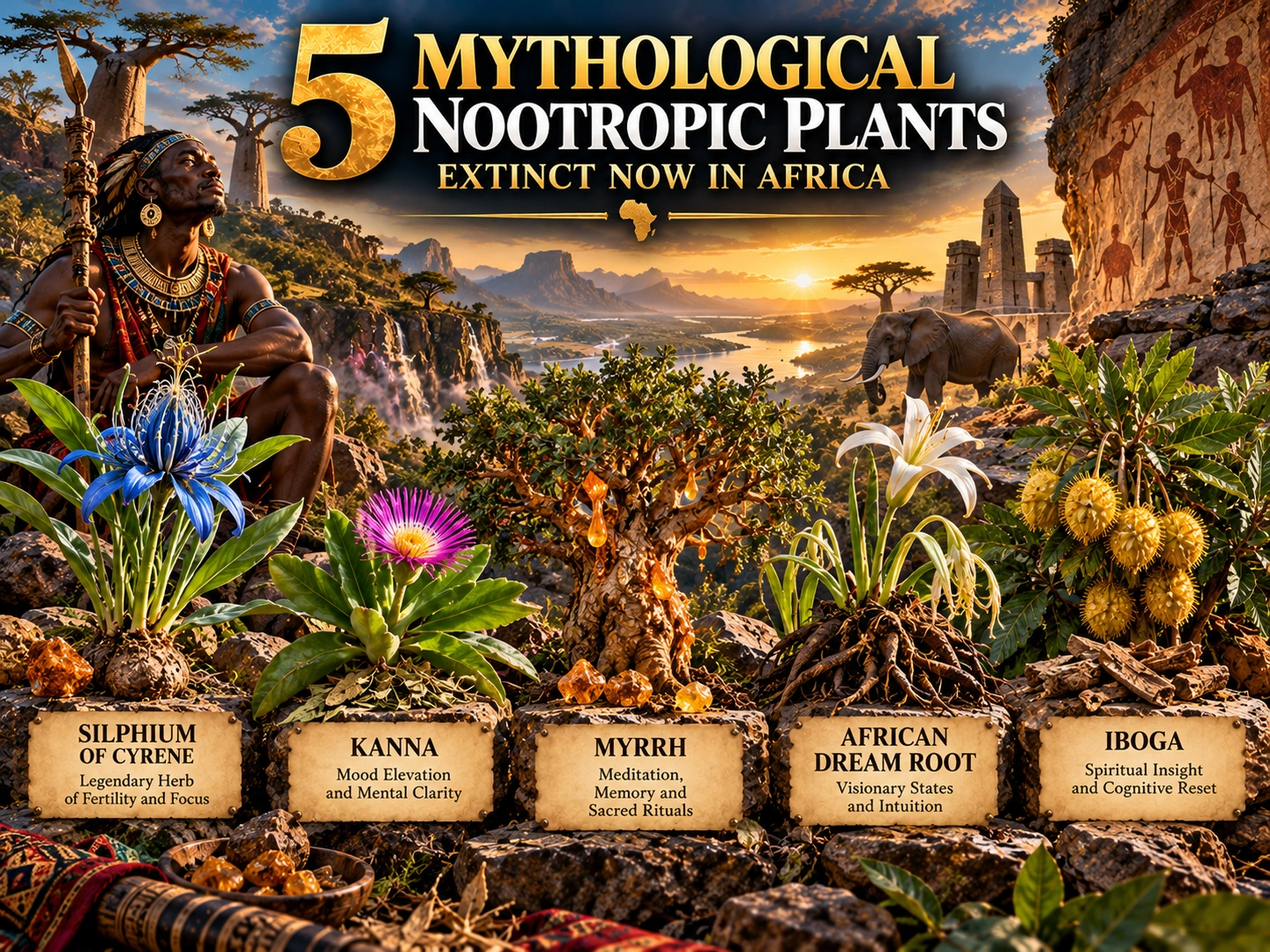
This article examines five notable African plants and plant traditions: Silphium of Cyrenaica, Kanna, Myrrh, African Dream Root, and Iboga. Their stories reveal what ancient societies believed about plants, what modern research has established, and where the evidence remains uncertain.
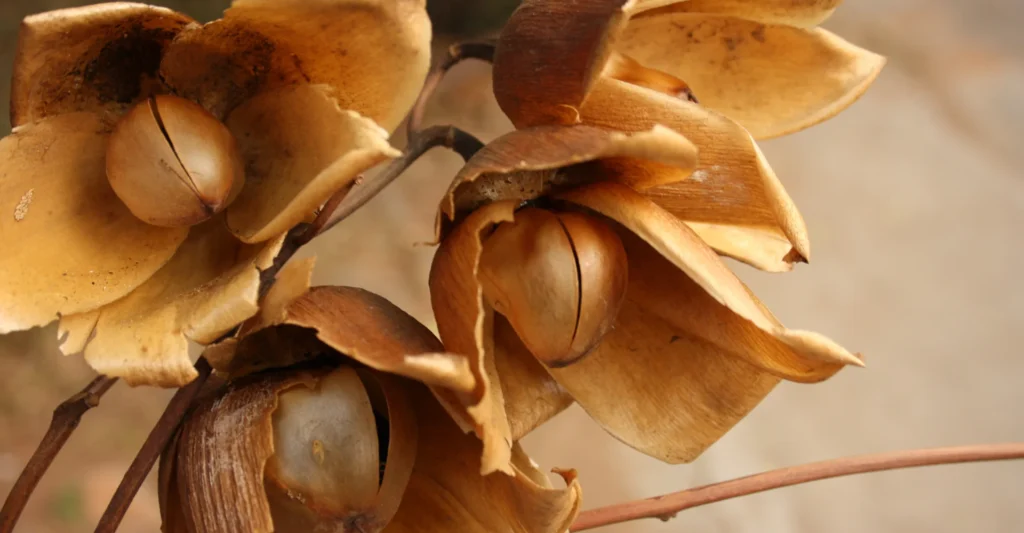
Silphium was a highly prized plant associated with ancient Cyrenaica, a historical region on the Mediterranean coast of present-day Libya. Although its precise botanical identity remains unresolved, ancient descriptions and images on coins suggest that it belonged to, or closely resembled, the carrot and celery family, Apiaceae.
Ancient writers described a plant with a substantial root, a sturdy stalk, yellow flowers, and distinctive heart-shaped fruits. Its image appeared on coins produced in Cyrene, demonstrating how important it was to the region’s economy and cultural identity.
Researchers have proposed several possible botanical relatives, including species of Ferula, Margotia, Thapsia, and Cachrys. However, no modern species has been conclusively identified as the original Silphium.
Silphium grew in the region surrounding ancient Cyrene, an important Greek-founded city in what is now northeastern Libya. The plant became a valuable commercial resource, supplying a sought-after product that was traded throughout the Mediterranean world.
Its economic significance was so substantial that Cyrenaican coins frequently displayed its image. The plant was valued as a spice and medicinal resource, and its commercial importance helped make Cyrene wealthy.
A historical review published in the Bulletin de l’Académie Nationale de Médecine describes Silphium as a valuable medicinal and culinary plant whose disappearance was probably linked to overharvesting and overgrazing. The plant’s exact identity remains uncertain.
Read the research: Silphium from Cyrenaica: An Extinct Medicinal Plant.
Ancient Greek and Roman medical writers attributed several medicinal properties to Silphium. Historical accounts mention its use for digestive complaints, fever, and conditions involving the reproductive system. These descriptions reflect ancient medical beliefs and practices rather than modern clinical evidence.
Silphium has also acquired a reputation in popular accounts as an ancient fertility remedy or aphrodisiac. However, its precise chemical composition is unknown because the original plant has not been conclusively identified. Claims about its contraceptive or sexual effects should therefore be treated cautiously.
Its importance to ancient society was broader than medicine. Silphium became a symbol of Cyrenaica’s prosperity, and its appearance on coins connected the plant with civic identity, trade, and the region’s natural wealth.
Although its medicinal reputation makes it relevant to the history of pharmacology, there is insufficient evidence to classify Silphium as a nootropic. Ancient use for physical ailments does not establish an ability to improve memory, focus, or intelligence.
Silphium is widely considered to have disappeared from its original habitat during antiquity, probably by the early centuries of the Common Era. The Roman author Pliny the Elder reported that the plant was no longer available in its natural range, although historical accounts concerning its final disappearance are not entirely consistent.
Researchers have investigated whether a modern plant, particularly Ferula drudeana found in Anatolia, might be related to the lost Silphium. Some morphological and chemical similarities have attracted attention, but this does not establish that the ancient Libyan species has been rediscovered.
A 2021 paper in Plants examines the historical evidence, possible botanical relationships, and conservation questions surrounding Silphium. A more recent 2026 phytochemical review also emphasizes that its botanical identity remains unresolved.
Further reading: The Legend of Silphion: Botanical and Historical Investigations.
Historical significance: Silphium is the clearest example in this article of a famous ancient African medicinal plant that appears to have vanished from its original habitat. Its story is also a warning about the consequences of excessive harvesting and the loss of botanical knowledge.
Kanna, also known as kougoed, is commonly identified as Sceletium tortuosum. It is a small, fleshy succulent native to arid regions of South Africa, particularly parts of the Western, Eastern, and Northern Cape provinces.
The plant has thick green leaves, a low-growing or scrambling habit, and delicate flowers. Its ability to grow in dry environments reflects its adaptation to the challenging conditions of southern Africa.
Unlike Silphium, whose original botanical identity remains uncertain, Kanna is a recognized living species with a documented history of traditional use.
Kanna has long been associated with Khoi and San communities in southern Africa. Historical accounts describe the use of its plant material in traditional practices involving mood, fatigue, appetite, and general well-being.
One preparation historically known as kougoed involves processing and fermenting the plant material. Historical descriptions record chewing and other traditional methods of use, although practices and interpretations have varied over time.
Researchers have noted that some Indigenous knowledge surrounding Kanna was disrupted by colonial expansion, loss of land, cultural suppression, and the erosion of oral traditions. This history makes it important to distinguish what has been documented from what remains uncertain.
Read the research: A Chewable Cure: Biological and Pharmaceutical Properties of Kanna.
Kanna contains mesembrine-type alkaloids, a group of compounds that has attracted scientific interest because of its potential effects on mood and the nervous system. Traditional accounts describe its use in contexts involving relaxation, mood elevation, and the management of fatigue.
Modern researchers have investigated Kanna extracts for possible effects on stress, anxiety, and aspects of cognitive function. A 2021 review in the Journal of Ethnopharmacology examined its traditional uses, chemical composition, pharmacology, and available clinical evidence.
The review found promising biological and preclinical findings, but also highlighted limitations in the evidence. Results from laboratory experiments or animal studies cannot automatically establish that a plant improves cognition in humans.
Read the review: Sceletium tortuosum: Phytochemistry, Pharmacokinetics, and Biological and Clinical Activities.
Not conclusively. Kanna is relevant to research on mood and potential cognitive effects, but evidence is not sufficient to describe it as a proven general-purpose nootropic. Mood improvement, stress reduction, and measurable improvements in memory or attention are separate outcomes that require different forms of evidence.
Its historical importance lies in its place in South African traditional medicine and its continuing scientific investigation. Calling it a legendary brain enhancer without explaining the limits of current evidence would overstate what is known.
No. Kanna is a living South African plant, and cultivated material is used in contemporary products. Nevertheless, research has raised concerns about the historical reduction of wild resources through overharvesting, land-management pressures, and other environmental factors.
Declining wild populations and the loss of traditional knowledge are serious conservation and cultural concerns, but they are not equivalent to global extinction.
Historical significance: Kanna illustrates how an Indigenous plant tradition can become the subject of modern pharmacological research while retaining a cultural history that deserves careful documentation and respect.
Myrrh is an aromatic gum-resin obtained from trees and shrubs of the genus Commiphora. One important species is Commiphora myrrha, which grows in parts of northeastern Africa and the southern Arabian Peninsula.
These plants are adapted to dry environments. Many have thorny branches, small leaves, and bark that produces resin when damaged. The resin hardens into irregular, fragrant pieces that have been traded and used for thousands of years.
Because myrrh is a resin rather than a single leafy herb, its history is best understood through the trees that produce it and the cultural roles of the aromatic material.
Myrrh has a long history in northeastern Africa, including areas associated with ancient Egyptian trade, as well as in the Horn of Africa and across Red Sea trading networks. Its fragrance and relative portability made it a valuable commodity in the ancient world.
Historical records connect myrrh with perfumery, incense, ceremonial offerings, and preparations used in traditional medicine. It also became associated with funerary customs and religious symbolism in several ancient cultures.
Its cultural importance was not limited to a single civilization. Trade networks moved aromatic resins across regions, linking African sources with markets and religious practices elsewhere in the Mediterranean and Middle East.
Read the scientific review: Commiphora myrrh: A Phytochemical and Pharmacological Update.
Myrrh’s strongest historical associations are with fragrance, purification, ritual, and traditional healing rather than with measurable cognitive enhancement. In religious settings, aromatic smoke and perfumes could help establish a ceremonial atmosphere and symbolize offerings, reverence, or transition between ordinary and sacred spaces.
Modern research has examined the chemical constituents of Commiphora myrrha, including terpenoids and other compounds, as well as possible anti-inflammatory, antimicrobial, and related biological activities. Such findings do not establish that inhaling myrrh smoke improves intelligence, memory, or attention.
It is important to distinguish the psychological experience of a ritual environment from a direct pharmacological effect on cognition. A fragrance may carry strong emotional and cultural associations without functioning as a nootropic.
No. Myrrh-producing species remain present in parts of Africa and Arabia. However, the availability of particular resin sources can be affected by drought, habitat change, grazing, harvesting practices, and trade pressures.
Myrrh therefore belongs in an article about ancient African botanical traditions, not as a confirmed extinct species. Its inclusion helps show that a plant can become historically legendary while remaining part of the living natural world.
Historical significance: Myrrh demonstrates the importance of African plant products in ancient medicine, commerce, and ritual life. Its story also shows why sacred or ceremonial significance should not automatically be interpreted as evidence of cognitive enhancement.
African Dream Root is commonly associated with Silene capensis, a plant native to southern Africa and traditionally linked with Xhosa spiritual practices. It is a herbaceous plant with green foliage and pale flowers. Accounts describing it as a dream plant often emphasize its roots and its place in ceremonial preparation.
Popular descriptions sometimes give the plant an almost supernatural reputation, but its actual botanical characteristics are those of a flowering herb. Its cultural significance comes from how particular communities understand dreams and spiritual experience, not from evidence that the plant has supernatural powers.
Silene capensis has been discussed in ethnobotanical literature relating to southern African traditions, particularly practices associated with dreams and spiritual knowledge. The details of preparation and use can differ between communities, and published descriptions do not represent every local tradition.
In some accounts, the plant is associated with dreams that are considered meaningful or instructive. Dreams may be interpreted as sources of insight, communication, or guidance within a particular spiritual worldview.
A review of psychoactive plant use in southern Africa describes the cultural context of African Dream Root and notes the need for greater understanding of its traditional uses and potential risks.
Read the review: The Use and Potential Abuse of Psychoactive Plants in Southern Africa.
Dreams have played important roles in spiritual and cultural traditions across the world. In some southern African contexts, African Dream Root has been associated with attempts to influence dream experiences or seek insight through them.
These practices make the plant relevant to the cultural history of consciousness. However, dream vividness, dream recall, and cognitive enhancement are not interchangeable concepts. Even if a substance changes the subjective experience of dreaming, that does not establish improvements in memory, learning, or daytime reasoning.
There is limited high-quality clinical evidence establishing the safety and effectiveness of Silene capensis for dream manipulation or cognitive enhancement. Its traditional significance should not be confused with proven neurological effects.
There is no strong evidence that Silene capensis is globally extinct. The plant remains known to botanical and ethnobotanical literature. Some of the traditions associated with it may be less familiar outside their communities, and traditional knowledge can be vulnerable to social change, cultural disruption, and commercial appropriation.
That distinction matters: a practice may become less visible in public records without the plant itself disappearing. Similarly, a tradition can survive even when documentation of its earlier forms is incomplete.
Historical significance: African Dream Root highlights how some plant traditions focus on dreams, intuition, and spiritual interpretation rather than on physical strength or conventional medicine. The scientific evidence remains limited, so its effects should not be overstated.
Iboga is the common name for Tabernanthe iboga, a shrub native to parts of Central Africa, including Gabon, Cameroon, the Republic of the Congo, the Democratic Republic of the Congo, and the Central African Republic.
The plant belongs to the Apocynaceae family. It has green leaves, small flowers, and fruits, while its roots contain several alkaloids, including ibogaine. The roots have a long history of ceremonial importance in some Central African traditions.
Iboga’s botanical and cultural significance should be considered separately from the modern use of isolated ibogaine, which has a distinct pharmacological profile and can pose serious health risks.
Iboga is particularly associated with Gabon and the spiritual traditions of Bwiti. In some Bwiti communities, the plant has a role in initiation ceremonies and other practices connected to spiritual identity, ancestral relationships, and community life.
These traditions are diverse and should not be treated as a single uniform belief system. The meanings of ceremonies and the roles of plants can differ among communities and practitioners.
The International Union for Conservation of Nature’s Red List account for Tabernanthe iboga records its native range in Central Africa and describes its use in initiation rites in Gabon.
Read the species assessment: IUCN Red List: Tabernanthe iboga.
Iboga’s roots contain ibogaine and other alkaloids that can affect the central nervous system. Its traditional ceremonial use has been associated with intense subjective experiences and spiritual interpretations. These properties have also attracted modern scientific interest.
However, the plant’s cultural significance cannot be reduced to its active compounds. Within traditional settings, ceremonies may involve instruction, community participation, and established systems of meaning that are not reproduced simply by isolating a chemical substance.
Modern investigations into ibogaine have explored potential applications in substance-use research, but the evidence and safety questions remain substantial. Ibogaine can cause serious adverse effects, including dangerous cardiac rhythm disturbances, and has been associated with fatal outcomes. It is not appropriate to describe iboga or ibogaine as a casual brain-enhancement supplement.
No. The IUCN assessment published in 2019, based on a 2018 evaluation, listed Tabernanthe iboga as Least Concern and described its population trend as stable at the time of assessment. That historical assessment does not mean every population is free from local pressure or that future monitoring is unnecessary.
Conservation and sustainable sourcing remain important questions when traditional plants attract international commercial interest. The growing global attention surrounding psychoactive plants can create tensions between commercial demand, ecological sustainability, and the rights of Indigenous communities.
Historical significance: Iboga offers a powerful example of a living plant whose meaning is deeply embedded in Central African ceremonial life. It is not an extinct species, and its potent effects require a careful distinction between cultural history, medical research, and safety.
Silphium, Kanna, Myrrh, African Dream Root, and Iboga represent different relationships between plants and human experience. They should not be treated as interchangeable examples of ancient nootropics.
These histories also illustrate why the modern term “nootropic” needs to be used carefully. A nootropic is generally understood as a substance intended to affect aspects of cognition, but traditional medicine often uses different categories. A plant may be valued for spiritual meaning, pain relief, mood, ritual, or fragrance without having been studied as a cognitive enhancer.
Modern research can investigate chemical constituents and biological activity, but laboratory findings do not automatically prove benefits in humans. Likewise, historical records can document traditional uses without confirming every claimed effect.
The evidence does not support describing all five plants as extinct. Silphium is the strongest example of a historically important plant believed to have disappeared from its original North African habitat, although its exact botanical identity remains uncertain. Kanna, Myrrh-producing species, African Dream Root, and Iboga are living plants documented in modern botanical or ethnobotanical sources.
It is also important to distinguish global extinction from local disappearance, declining wild populations, loss of traditional knowledge, or the decline of a ceremonial practice. Each represents a different problem and requires different evidence.
A plant may become scarce in a particular region without being extinct worldwide. A community’s knowledge may be disrupted by colonization or social change even while the plant survives. And a historical account may describe a lost ritual without providing evidence that the botanical species itself has vanished.
For accurate conservation reporting, researchers need botanical identification, field surveys, herbarium evidence, and appropriate conservation assessments. For historical claims, they need ancient texts, archaeological findings, and careful evaluation of later interpretations.
Africa’s plant history is not simply a story of mysterious substances and forgotten powers. It is a record of human ingenuity, trade, healing, ritual, and the transmission of knowledge across generations.
Silphium stands out as a cautionary tale about a valuable plant that appears to have disappeared from its original habitat. Kanna continues to attract research into mood and pharmacology, while Myrrh remains an important aromatic resin. African Dream Root is associated with traditional understandings of dreams, and Iboga remains connected to Central African ceremonial life.
None of these histories proves that the plants were supernatural substances or universally effective nootropics. Their significance is more interesting when the evidence is kept clear: ancient beliefs can be studied as cultural history, traditional uses can guide research questions, and modern science can evaluate specific effects without erasing the communities that preserved the knowledge.
The most defensible conclusion is that Africa’s botanical heritage includes both a famous lost medicinal plant and several living plants with remarkable cultural histories. Understanding them requires curiosity, scientific caution, and respect for the traditions in which they continue to matter.