Europe’s ancient myths describe mysterious plants and substances capable of protecting the mind from enchantment, erasing painful memories, restoring sanity and bringing mortals closer to the gods. Some were associated with real Mediterranean herbs, while others existed only in the imaginative world of Greek mythology.
<text>Mythological tradition: Ancient Greece
Primary source: Homer’s Odyssey, Book 10
Legendary location: The island of Aeaea, associated with the sorceress Circe
Attributed powers: Protection against enchantment, preservation of mental control and resistance to magical transformation</text>
Moly is among the most fascinating botanical mysteries in European mythology because Homer provides an unusually memorable description of it.
In Book 10 of the Odyssey, Hermes gives Odysseus a mysterious herb before the Greek hero approaches Circe’s palace. The plant is described as having a black root and a flower resembling milk, with a quality that makes it difficult for ordinary mortals to obtain.
This description has encouraged centuries of speculation about its botanical identity.
One proposed candidate is the common snowdrop, Galanthus nivalis, a small European bulbous plant that produces delicate white, bell-shaped flowers and narrow green leaves. The snowdrop grows in parts of Europe and is associated with woodland habitats and early spring.
The theory gained attention because snowdrops contain compounds with acetylcholinesterase-inhibiting properties. However, a 2024 peer-reviewed review concluded that identifying Homer’s moly with Galanthus nivalis remains questionable. The ancient description, the plant’s pharmacology and its historical context do not conclusively establish that identification. <a href=”https://pmc.ncbi.nlm.nih.gov/articles/PMC10799392/“>Source: Journal of Ethnobiology and Ethnomedicine</a>.
It is therefore more accurate to describe the snowdrop as a proposed candidate than as the confirmed surviving form of a lost magical plant.
In the Odyssey, moly is obtained through Hermes, who reveals its protective properties to Odysseus before the hero enters Circe’s domain on the mythical island of Aeaea.
Aeaea is a literary and mythological location, not an archaeologically confirmed island where botanists have discovered moly.
If the plant had a real botanical counterpart, the Mediterranean world would be a reasonable region to investigate because the epic’s setting and ancient Greek herbal traditions draw heavily on Mediterranean landscapes.
Nevertheless, no verified collection site has established the identity of Homer’s plant.
Moly’s defining benefit was its ability to protect the mind against supernatural manipulation.
Circe uses a magical preparation to transform Odysseus’s companions into pigs while leaving them with their human reasoning faculties. Hermes gives Odysseus moly so that the sorceress cannot successfully enchant him.
From a modern perspective, this sounds like a substance that preserves cognition under the influence of another drug.
That interpretation is interesting, but it remains speculative. There is no clinical evidence that moly exists as a distinct medicinal species capable of reversing magical effects or protecting a person from every form of poisoning.
The snowdrop hypothesis emerged partly because researchers have investigated the pharmacological properties of its alkaloids. Such research may illuminate the history of ancient medicine, but it does not demonstrate that the plant has the powers described in Homer’s poem.
The encounter with Circe is one of the most memorable episodes in the Odyssey.
After Circe transforms his companions, Odysseus sets out to rescue them. Hermes intercepts him and explains how to resist the sorceress’s enchantment.
Armed with the protective herb and Hermes’ instructions, Odysseus enters Circe’s palace. When she attempts to bewitch him, her usual magic fails. Odysseus then forces her to release his companions, who regain their human forms.
The episode gives moly an unusual role in Greek mythology: it is not primarily a medicine for physical injury or a substance granting immortality. Its power lies in preserving a person’s ability to resist deception and manipulation.
That makes moly one of the closest mythological parallels to the modern idea of a cognitive-protective substance.
There is no scientific evidence that moly was a distinct plant species that subsequently became extinct.
The name may have referred to a real plant, a medicinal preparation or a mythological substance whose identity cannot now be established. The snowdrop remains a hypothesis, not a definitive answer.
Its enduring significance comes from a question that ancient literature leaves unresolved: could a story about magical protection preserve a distorted memory of a real botanical substance?
<text>Mythological tradition: Ancient Greece
Primary source: Homer’s Odyssey, Book 4
Legendary location: The palace of Menelaus and Helen in Sparta
Attributed powers: Relief from grief, forgetfulness of distress and emotional tranquillity</text>
Nepenthe is different from moly because Homer does not describe it as a distinct flowering plant with identifiable roots, leaves or petals.
Instead, it appears as a mysterious drug mixed into wine.
In Book 4 of the Odyssey, Helen introduces nepenthe into a drink shared by the people gathered at Menelaus’s palace. Its supposed effect is to relieve sorrow and make a person forget painful experiences.
The word is associated with the removal of grief, which helps explain why nepenthe has remained an enduring literary symbol of emotional escape.
Because the text does not provide a reliable botanical description, claims that nepenthe was definitely a particular flower, mushroom or herb are unsubstantiated.
The episode takes place in the palace of Menelaus and Helen at Sparta, within the world of Greek heroic mythology.
Homer describes Helen as having acquired knowledge of a potent substance associated with Egypt. This detail has encouraged scholars to investigate whether the story reflects ancient Mediterranean and Egyptian traditions concerning medicinal preparations.
However, the text does not identify a verified collection site or establish that nepenthe was a single plant species.
It is possible that the literary image drew on real knowledge of medicinal or psychoactive substances. It is equally possible that nepenthe was primarily a poetic invention representing the desire to escape emotional suffering.
Nepenthe’s central effect is psychological rather than physical.
Unlike moly, which protects Odysseus against enchantment, nepenthe removes the emotional weight of distressing memories. Its fictional purpose is not necessarily to erase a person’s identity or intelligence but to provide temporary relief from grief.
This makes it especially interesting when compared with modern discussions about mood, memory and cognitive performance.
Today, researchers investigate how sleep, stress, trauma and psychiatric conditions influence memory and emotional processing. Ancient Greek literature explored some of the same human experiences through stories about supernatural substances.
However, nepenthe should not be equated with an antidepressant, sedative or clinically validated treatment. There is no established botanical identity or medical evidence showing that the legendary preparation existed as described.
Helen introduces nepenthe while the household is discussing the Trojan War and the painful memories associated with it.
The substance changes the atmosphere of the gathering by relieving sorrow and helping the participants continue their conversation.
The scene is striking because it places a mysterious drug inside an ordinary social setting. Rather than being consumed by a warrior before battle or a priest during a sacred ritual, nepenthe is mixed into wine during a gathering where painful memories threaten to overwhelm the participants.
The episode reveals an ancient literary fascination with the possibility of controlling emotion through substances.
It also invites a difficult question: if grief could be removed instantly, would that necessarily help a person understand or recover from what had happened?
Homer does not offer a medical answer. Instead, nepenthe functions as a literary device through which the poem explores the relationship between memory, suffering and social life.
Nepenthe cannot be classified confidently as an extinct plant because its botanical identity is unknown.
It may have been inspired by ancient medicinal knowledge, but there is insufficient evidence to establish that it existed as a distinct botanical species.
Its legacy survives mainly as a cultural idea: the imagined substance that could remove grief when ordinary human consolation was not enough.
<text>Mythological tradition: Ancient Greece
Primary source: Homer’s Odyssey, Book 9
Legendary location: The land of the Lotus-Eaters, somewhere along Odysseus’s mythical Mediterranean journey
Attributed powers: Oblivion, loss of motivation to return home and absorption in immediate pleasure</text>
The lotus in the Odyssey has generated considerable botanical debate because Homer does not provide a description sufficient to identify it conclusively.
One candidate frequently discussed in historical botanical literature is Ziziphus lotus, a spiny shrub native to parts of the Mediterranean and North Africa. It produces small fruits that can be consumed, and its growth form differs substantially from the aquatic lotus plants familiar from other cultural traditions.
The ancient Greek word translated as “lotus” did not necessarily refer to one universally recognized botanical species. It could have been applied to different plants in different contexts.
The proposed identification with Ziziphus lotus is therefore plausible as a historical hypothesis, not a confirmed solution to the Homeric mystery.
In the epic, Odysseus and his companions encounter the Lotus-Eaters during their journey home after the Trojan War.
The precise geographical location of their land is not established. Attempts to place it in a specific part of North Africa or the Mediterranean remain interpretations of the poem rather than confirmed archaeological discoveries.
The real Mediterranean distribution of Ziziphus lotus provides one possible geographical connection, but the existence of the plant in a region does not prove that it was the lotus described by Homer.
The lotus is unusual because its legendary effect is not portrayed as a straightforward improvement in intelligence.
Those who consume it lose interest in returning home. They become absorbed in the immediate experience of eating the plant and forget the obligations that previously defined their lives.
The story therefore presents a substance that changes motivation, memory and a person’s relationship with the future.
In modern language, readers might compare this with altered attention or the influence of psychoactive substances on behaviour. But the epic does not establish a pharmacological mechanism, and no evidence demonstrates that the proposed botanical candidate produces the exact effects described in the poem.
The lotus is better understood as a mythological warning about pleasure that becomes so absorbing that a person loses sight of long-term commitments.
After leaving Troy, Odysseus and his crew arrive in the land of the Lotus-Eaters. Some of his men consume the mysterious plant and no longer wish to return to their homeland.
Odysseus recognizes the danger. He takes the affected men back to the ships and ensures that they leave before the rest of the crew can be similarly distracted.
The episode is relatively brief, but its significance extends throughout the Odyssey.
Odysseus’s journey is fundamentally a story about returning home despite temptation, danger and uncertainty. The lotus represents a threat that does not rely on violence. Instead, it threatens the very desire to complete the journey.
In that sense, the plant is almost the opposite of a conventional cognitive enhancer. Rather than helping its users plan, remember or pursue a goal, it appears to make the goal itself irrelevant.
The mythological lotus has not been identified with certainty, so its extinction status cannot be established.
Some plants proposed as candidates, including Ziziphus lotus, still exist. What remains lost is the definitive link between a living species and the substance in Homer’s story.
The Lotus-Eaters continue to resonate in modern literature because their story addresses a timeless concern: the possibility of becoming so comfortable in the present that the future no longer matters.
<text>Mythological tradition: Ancient Greece
Primary sources: Homeric poetry and Hesiod’s mythological tradition
Legendary location: Mount Olympus and the divine world
Attributed powers: Immortality, divine nourishment, preservation and extraordinary vitality</text>
Ambrosia is one of the most famous substances in European mythology, but it requires an important qualification: it is not consistently described as a plant.
In ancient Greek literature, ambrosia is associated with the nourishment of the gods and their immortal condition. Together with nectar, it represents the extraordinary sustenance that separates divine existence from ordinary human life.
Different literary and artistic traditions have portrayed ambrosia in different ways, including as food, a fragrant substance or a divine preparation. There is no established botanical description identifying it as a particular herb or flower.
This distinction makes ambrosia a useful example of how mythology can turn an imagined substance into a symbol of extraordinary biological power without providing evidence that it originated from a real plant.
Ambrosia belongs to the divine world, especially the tradition of Mount Olympus as the home of the Greek gods.
Its mythological setting is therefore different from the Mediterranean landscapes associated with proposed candidates for moly or the lotus.
No verified geographical location has produced an ancient plant identified as ambrosia. Its relationship with Olympus is symbolic and religious rather than a botanical distribution record.
Ambrosia’s most important supposed benefit was the preservation of divine life.
The gods’ immortality distinguished them from human beings, who experienced ageing, injury and death. Ambrosia was part of the literary system through which Greek poets represented this fundamental difference.
It is tempting to compare ambrosia with modern longevity research, anti-ageing compounds or supplements intended to support cellular health. But those comparisons are metaphors, not scientific equivalences.
Modern researchers study biological processes involved in ageing and investigate whether particular interventions can influence them. No evidence establishes that a real substance corresponding to mythological ambrosia can grant immortality.
Ambrosia appears across Greek mythology in stories involving gods, heroes and the boundary between mortal and immortal existence.
In the Iliad, divine substances and interventions help preserve or protect exceptional figures. In other traditions, ambrosia reinforces the distinction between the food of the gods and the ordinary nourishment of humanity.
Its importance is not tied to one universally agreed event. Instead, ambrosia contributes to the larger mythology of divine power and the possibility—usually denied to ordinary humans—of escaping mortality.
The substance also illustrates a recurring pattern in ancient literature: immortality is not merely a matter of possessing greater strength or intelligence. It represents a different condition of existence, one in which the limitations governing human life no longer apply.
Ambrosia is not a confirmed extinct plant species. Its identity as a specific plant was never established.
It belongs primarily to mythology and religious symbolism, although later writers and artists have given it various physical forms.
Its relevance to the history of nootropics is indirect. Ambrosia represents the ultimate fantasy of biological enhancement: a substance that could move a living being beyond the ordinary limits of human existence.
<text>Mythological tradition: Ancient Greece
Associated myth: Melampus and the daughters of Proetus
Historical region: Argos and other parts of ancient Greece
Attributed powers: Treatment of certain forms of madness in ancient medical and mythological traditions</text>
Unlike moly, nepenthe and ambrosia, hellebore refers to real plants.
Several species belong to the genus Helleborus. Depending on the species, they may have evergreen or seasonally persistent leaves, sturdy stems and flowers that range from greenish-white to purple or dark red.
The Christmas rose, Helleborus niger, is one familiar species. It has dark green leaves and pale flowers, although it should not automatically be identified as the exact plant used in every ancient Greek account.
Hellebores have a long history in European herbal medicine, including historical use in preparations intended to treat conditions that ancient physicians interpreted as forms of madness.
But these plants can be toxic. Their historical use should not be interpreted as evidence that self-treatment with hellebore is safe or medically appropriate.
Hellebore species are native to parts of Europe, including the Mediterranean and Balkan regions, with distributions varying by species.
The myth of Melampus is associated with Argos in the northeastern Peloponnese of Greece. The ancient story describes a healer treating the daughters of Proetus, who were believed to have become afflicted with madness.
The myth does not establish a single botanical collection site for the plant. It does, however, reflect the place of medicinal herbs in ancient Greek attempts to understand and treat unusual mental states.
Hellebore was associated with treating certain forms of madness in ancient Greek medical traditions.
This is particularly interesting in the context of cognitive history because the ancient Greeks did not always separate psychological symptoms, neurological disorders and spiritual affliction in the way modern medicine attempts to do.
The story of Melampus demonstrates how a healer could be portrayed as using a botanical remedy to restore normal behaviour.
A scholarly paper indexed in PubMed examines the myth of Melampus and the madness of the Proetides, discussing the historical relationship between Greek mythology, pharmacology and early approaches to mental illness. <a href=”https://pubmed.ncbi.nlm.nih.gov/27625080/“>Read the research on Melampus, hellebore and ancient medicine</a>.
However, the existence of biologically active compounds does not establish that ancient hellebore treatments were reliably effective. Hellebore species contain toxic constituents, and their use can cause serious harm.
In Greek mythology, the daughters of Proetus are afflicted by a form of madness. Melampus, a seer and healer, becomes associated with their treatment and recovery.
Later interpretations connect his treatment with hellebore, illustrating the close relationship between religious healing and practical medicine in ancient Greek culture.
The story is significant because it depicts mental disturbance as something that might be addressed through intervention rather than simply accepted as an irreversible condition.
It also reveals the risks of ancient pharmacology. A plant capable of producing strong physiological effects could be interpreted as a powerful remedy, even when the difference between a therapeutic and harmful dose was poorly understood.
No. Hellebore species still exist in Europe.
The ancient story is therefore not an example of a lost botanical species. Instead, it demonstrates how a real plant could acquire a place in mythological narratives about mental illness, healing and the extraordinary abilities of legendary physicians.
Hellebore’s history also offers an important reminder that a plant’s presence in ancient medicine does not make it a safe modern treatment.
The evidence does not support describing all five as extinct plants.
Moly has an uncertain botanical identity. Nepenthe may have been a literary invention or a substance inspired by ancient medicinal preparations. The lotus in the Odyssey has several proposed botanical candidates. Ambrosia is primarily a divine food rather than an established plant species. Hellebore, meanwhile, belongs to a living genus of European plants.
Their stories remain valuable for a different reason: they reveal how ancient societies imagined the relationship between plants and the human mind.
Some legendary substances protected against enchantment. Others were said to erase grief, change motivation, grant immortality or treat madness. These effects resemble modern concerns about memory, mood, attention and cognitive health, but resemblance is not proof of a shared pharmacological mechanism.
Historical plant traditions can help researchers identify questions worth investigating, but they cannot substitute for botanical identification or clinical evidence.
Ethnobotanists examine historical texts, traditional practices, plant distribution and surviving medicinal knowledge to understand how people used natural substances. Pharmacologists can then investigate particular species and their chemical constituents.
The process requires caution. A proposed modern equivalent of a mythological plant should not be treated as confirmed merely because it grows in the right region or contains an interesting compound.
Research on Homer’s moly provides a good example. The snowdrop hypothesis has been discussed for decades, but the 2024 review argues that the identification remains uncertain and that the fantastic elements of the myth must be separated from possible historical realities. <a href=”https://pmc.ncbi.nlm.nih.gov/articles/PMC10799392/“>Read the full scientific review</a>.
The same principle applies to claims that ancient plants enhanced intelligence or treated neurological conditions. Such claims need evidence specific to the plant, preparation, dose and outcome being studied.
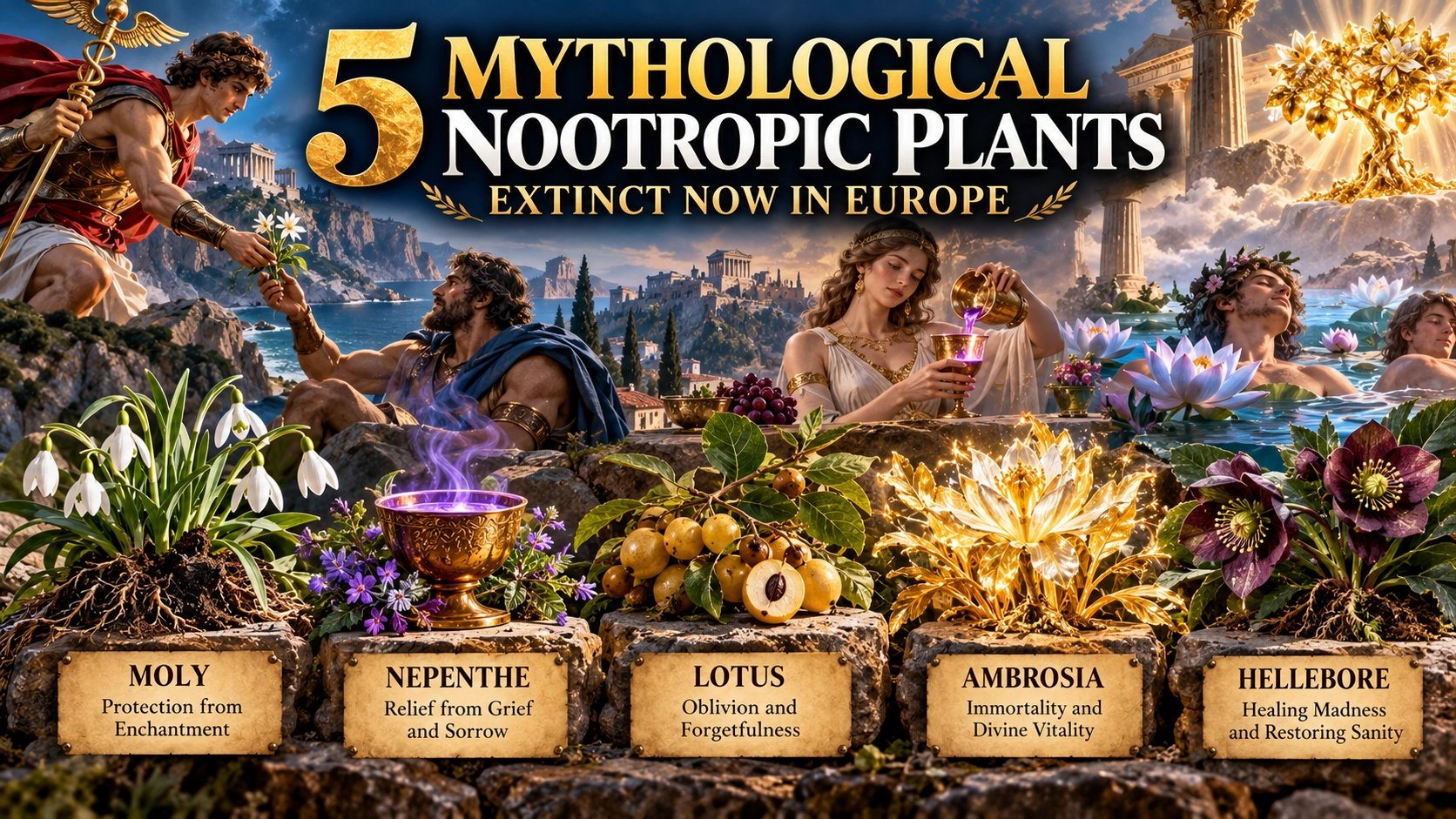
Moly, nepenthe, the lotus of the Lotus-Eaters, ambrosia and hellebore occupy different positions between mythology and botanical history.
Moly represents protection against enchantment and the preservation of mental control. Nepenthe embodies the desire to escape grief. The lotus illustrates the danger of losing one’s purpose. Ambrosia symbolizes immortality, while hellebore connects ancient beliefs about madness with the real, sometimes dangerous, pharmacology of European plants.
None should be presented as a confirmed extinct nootropic species. Some are legendary substances whose identities remain unknown; others are associated with plants that still exist.
Their continuing fascination lies in the questions they raise about memory, motivation, emotional suffering, healing and the human desire to overcome natural limitations.
The ancient Greeks did not possess modern neuroscience, but their stories reveal a sustained interest in how substances might alter the mind and the course of a person’s life. Understanding those stories requires both imagination and scientific restraint.
The most compelling mystery may not be whether a lost plant could grant superhuman intelligence. It may be how ancient people used botanical legends to explore the same questions about the mind that researchers continue to investigate today.
Editorial note: This article explores European mythology and historical botanical traditions. It does not claim that all five substances were once real plants or that any of them is a proven cognitive enhancer. Hellebore and other historically used medicinal plants may be toxic and should not be consumed as self-treatment.